Leek
VegetableAllium ampeloprasum
Have seeds for this? Add to inventory →Leeks are hardy alliums with a mild, sweet onion flavour that can be harvested through winter in many climates. They are excellent companion plants whose strong scent deters carrot fly and other pests.
Native Range
- Origin
- Leek is a cultivated form associated with wild Allium ampeloprasum, native around the Mediterranean and western Asia.
- Native Habitat
- Rocky open ground, field margins, dry slopes, coastal scrub, and disturbed Mediterranean soils.
- Current Distribution
- Cultivated globally; does not occur as a native plant in this form.
Growing Conditions
Sunlight
Full Sun
Water Needs
Moderate
Soil
Rich, well-draining loam; pH 6.0 - 7.0
Spacing
6 inches
Days to Maturity
100 - 130 days from transplant
Growing Zones
Thrives in USDA Zones 3 - 10
Companion Planting
Keep Away From
When to Plant
Start Indoors
10 - 12 weeks before last frost
Transplant
4 - 6 weeks before last frost; plant deep to blanch stems
Harvest
100 - 130 days; can leave in ground through winter in mild climates
Phenology (Natural Timing Cues)
Start Indoors
Leeks need a very early indoor start - 10 to 12 weeks before last frost - because they grow slowly and need to reach pencil thickness before transplanting. Start them in a flat or cells, growing them upright like grass until seedlings are 6 - 8 inches tall and stout enough to be planted deep for blanching. The long lead time is not optional: leeks transplanted as weak, thin seedlings rarely develop the thick white shaft that defines a well-grown crop.
- Deciduous trees are still bare with no visible bud movement.
- Forsythia has not yet started blooming.
- Early dandelions are not yet in bloom.
- The last expected frost date is 10 - 12 weeks away.
Transplant
Transplant leeks into cool, well-prepared soil early in the season so they have the full growing period to develop their characteristic long white shaft. The blanching technique - dropping seedlings into deep holes without immediately backfilling - is what creates the white, mild lower stem. Leeks are cold-tolerant and can go out while light frosts are still possible, which is an advantage: early planting builds more size before summer heat slows the cool-season growth they prefer.
- Forsythia is in full bloom or just finishing.
- Early dandelions are blooming.
- Soil is workable, moist, and cool but not frozen or sticky.
- Light frosts are still possible but hard freezes have ended.
Start Dates (Your Location)
Based on your saved growing zone and this plant's timing notes.
Typical Last Frost
Set your growing zone to see personalized calendar dates.
Organic Growing Tips
Plant in trenches and earth up progressively to blanch the white stem portion as plants grow.
Interplant with carrots - each repels the other's primary fly pest through aromatic masking.
Apply neem oil spray at dusk at first signs of rust to slow its progression through the crop — applying after pollinators have finished foraging protects the beneficial insects you want in your garden.
Top-dress with compost in midsummer and harvest as needed through winter — leeks improve in flavour after frost, and compost feeding supports strong growth through their long season.
Common Pests
- Leek Rust
- Onion Fly
- Thrips
- Allium Leaf Miner
All pest management in Garden uses safe, organic, non-toxic methods only. No synthetic pesticides, ever.
Taxonomy
- Kingdom
- Plantae
- Family
- Onion family (Amaryllidaceae)
- Genus
- Allium
- Species
- Allium ampeloprasum
Natural History
Allium ampeloprasum is native to the Mediterranean basin and western Asia, and the cultivated leek is one of several forms derived from wild ampeloprasum alliums - alongside elephant garlic, kurrat (Egyptian leek), and pearl onion. The leek is one of the oldest documented vegetables; it is mentioned in the Bible's Book of Numbers (11:5), where the Israelites in the wilderness lament the absence of the leeks, onions, and garlic of Egypt. It was an important food in ancient Egypt and appears consistently in records across the ancient Near East. The Romans consumed leeks extensively; the emperor Nero reportedly ate them daily to improve his voice, earning the nickname Porrophagus - leek eater. The leek became the national emblem of Wales through an association with a battle on St. David's Day in 633 CE, where Welsh warriors wore leeks in their hats to identify one another - a tradition already ancient when recorded by Tudor chroniclers. Unlike other alliums, the leek does not form a distinct bulb and is selected entirely for the thick blanched shank formed by tightly wrapped leaf bases.
Traditional Use
Leek has one of the longest documented food records of any vegetable, appearing in Egyptian records, the Bible, Roman chronicles, and medieval European household accounts. Its cultural identity is woven into Welsh national symbolism in a way unique among garden vegetables.
Parts Noted Historically
Ancient Egypt and Biblical Record - Shank
Leeks appear in Numbers 11:5, one of the earliest biblical agricultural references, where the Israelites recall the leeks, onions, and garlic of Egypt with longing during their desert wandering. Egyptian records confirm leek cultivation as a significant food crop from at least the 2nd millennium BCE, and leeks appear in lists of provisions for construction workers and in temple offering records.
Roman Cultivation and Nero's Voice - Shank
The Romans were enthusiastic leek cultivators; the emperor Nero reportedly consumed leeks daily in the belief they improved his singing voice, earning the nickname Porrophagus (leek eater) among contemporaries. Pliny the Elder discusses leek cultivation in Naturalis Historia. The town of Arras in northern France was associated with high-quality leek production in the Roman period.
Welsh National Emblem - Whole plant
The leek became the national emblem of Wales through a tradition connected to a battle on St. David's Day in 633 CE, where Welsh fighters wore leeks in their caps to distinguish themselves from enemies. The tradition was already ancient when Tudor writers recorded it. Shakespeare's Henry V (1599) includes a scene in which the Welsh captain Fluellen references the custom with evident cultural pride. The leek and the daffodil remain the two official national symbols of Wales.
Medieval European Winter Cookery - Shank and leaves
Leeks were a staple winter vegetable across medieval northern Europe, appearing in household accounts, monastery records, and the earliest surviving English cookbooks. The 1390 cookbook Forme of Cury, compiled by the master cooks of King Richard II, includes several leek preparations. Their value lay in winter hardiness - leeks stand in frozen ground and can be dug as needed throughout winter, making them practically indispensable before refrigeration and modern storage.
This information is provided for historical and educational purposes only and is not medical advice. Always consult a qualified healthcare professional before making decisions related to your health.
Morphology (Plant Structure & Identification)
Root System
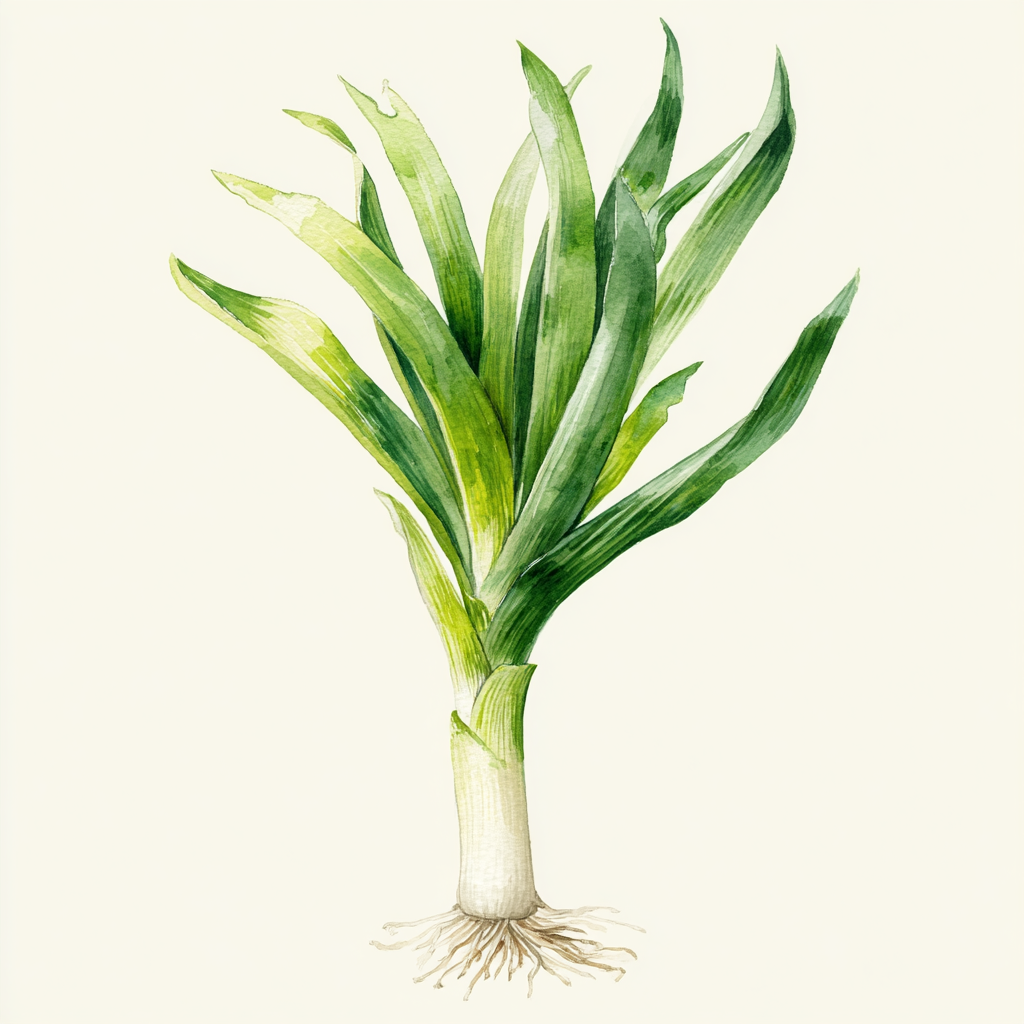
Shallow fibrous roots from the basal plate. Plants need consistent moisture and benefit from loose soil for easy lifting.
Stem
The edible white portion is a blanched pseudostem formed by overlapping leaf bases. Earthing up or deep planting lengthens the pale section.
Leaves
Flat blue-green leaves arranged in a fan, unlike the hollow round leaves of onion. Leaf bases wrap tightly around each other.
Flowers
Second-year plants form a tall solid scape topped with a round umbel of pale allium flowers.
Fruit
Produces small black seeds after flowering. The harvested crop is the thick leaf base and lower leaves, not a bulb.
Known Varieties
Common cultivars worth knowing
- Best for: summer and early fall harvests
King Richard
Early leek with long white shanks and tender texture.
- Best for: general garden use
American Flag
Hardy standard variety with thick stems and broad adaptability.
- Best for: winter harvests
Bandit
Very cold-hardy blue-green leek for overwintering.
- Best for: fall harvests
Tadorna
Uniform variety with strong standing ability and good shank quality.
- Best for: traditional winter leeks
Musselburgh
Old hardy variety with thick stems and reliable cold tolerance.
Related Articles
Loading photo submission…