Echinacea
FlowerEchinacea purpurea
Have seeds for this? Add to inventory →Echinacea (purple coneflower) is a robust native perennial wildflower whose large daisy flowers attract bees, butterflies, and beneficial wasps in abundance. It is long-lived, drought-tolerant, and provides rich seed heads for birds in winter.
Native Range
- Origin
- Purple coneflower is native to central and eastern North America, with its natural range extending from the Great Plains eastward to the Atlantic coast and from southern Canada to the Gulf of Mexico.
- Native Habitat
- Native to prairies, savannas, glades, open woodlands, and dry meadow edges, typically growing in well-drained lean soils with full sun exposure and seasonal moisture variation.
- Current Distribution
- Native throughout much of central and eastern North America, and now widely cultivated beyond its native range in ornamental gardens, pollinator plantings, and restored prairie landscapes across temperate regions.
Growing Conditions
Sunlight
Full Sun
Water Needs
Low
Soil
Well-draining loam; pH 6.0 - 7.0; tolerates poor soil
Spacing
18 - 24 inches
Days to Maturity
Perennial; blooms from year 2; most prolific in years 3 - 5
Growing Zones
Thrives in USDA Zones 3 - 9
Companion Planting
When to Plant
Transplant
Spring or autumn
Direct Sow
Autumn (cold stratification needed for spring germination)
Harvest
Leave seed heads for birds; divide clumps every 3 - 4 years
Phenology (Natural Timing Cues)
Direct Sow
Echinacea seed benefits from cold-moist stratification before germinating reliably. The easiest approach is autumn sowing, letting winter provide natural stratification so seed sprouts with early spring warmth. Spring sowings work well when seed has been refrigerator-stratified for 4 - 8 weeks in damp growing mix beforehand. Surface sow or barely cover seed - light improves germination. First-year plants establish root systems rather than flowering; bloom typically begins in year two.
- Nights are dropping consistently and soil is cooling (autumn sowing).
- Forsythia is blooming and soil is warming from winter dormancy (spring sowing of pre-stratified seed).
- Soil is workable without drying to a hard crust between waterings.
Transplant
Echinacea transplants most reliably when roots have the full growing season to establish before hard winter or summer heat stress. Spring transplanting shortly after last frost is the main window. Autumn transplanting can also work, but allow at least 6 - 8 weeks before first hard freeze so the crown has time to anchor before going dormant.
- Forsythia or lilacs are in bloom (spring transplant).
- Soil is warming and holds moisture without staying saturated.
- Nights are consistently cool but not dropping below freezing (autumn transplant).
- Transplants have several true leaves and a root ball that holds together when tipped from the pot.
Start Dates (Your Location)
Based on your saved growing zone and this plant's timing notes.
Best Planting Window
Spring window
Spring
Plant early enough for roots to settle before summer heat.
Autumn window
Early autumn
Plant early enough for roots to grow before winter; avoid late planting into cold, wet soil.
Planting Method
Use nursery-grown planting stock rather than treating this as a standard seed-starting crop.
Critical Timing Note
Plant early enough for roots to establish before weather stress arrives.
Organic Growing Tips
Leave seed heads standing through winter as an important food source for goldfinches and other small birds.
Divide congested clumps in spring every 3 - 4 years to reinvigorate flowering and spread the planting.
Avoid rich, wet soil - echinacea is native to prairies and thrives in conditions that stress more delicate plants.
Mulch lightly with bark or leaf mould to retain moisture without enriching soil — echinacea's root system builds deep organic channels that improve soil structure over time, and letting fallen leaves decompose around plants supports the fungi these native plants evolved with.
Common Pests
All pest management in Garden uses safe, organic, non-toxic methods only. No synthetic pesticides, ever.
Taxonomy
- Kingdom
- Plantae
- Family
- Daisy family (Asteraceae)
- Genus
- Echinacea
- Species
- Echinacea purpurea
Natural History
Echinacea purpurea is native to the central and eastern United States, growing in open woods, prairies, and disturbed areas from Missouri and Ohio south through the Appalachians. The genus name comes from the Greek echinos - hedgehog - referring to the spiny central cone. Nine Echinacea species are recognized across North America, most native to the Great Plains; their deep perennial taproots are adapted to the cycle of prairie drought and fire, persisting through multiple seasons of surface disturbance. Echinacea angustifolia, the narrow-leaved prairie coneflower, was the species most widely known to Plains nations and was the plant that entered 19th-century American herbal commerce. Wild-harvested Echinacea root was a significant component of late 19th-century American botanical medicine and overharvesting of wild populations near the turn of the 20th century was an early documented case of medicinal plant conservation concern. Echinacea purpurea's superior garden performance over E. angustifolia made it the dominant cultivated species and the focus of most modern phytochemical research.
Traditional Use
Echinacea has one of the most thoroughly documented traditional-use histories of any North American plant, with recorded knowledge from at least a dozen Plains and eastern nations, a century of commercial use in American botanical medicine, and a substantial modern European phytomedicine research tradition.
Parts Noted Historically
Plains Indigenous Nations - Root
Echinacea angustifolia root was documented among the Lakota, Cheyenne, Comanche, Dakota, and Pawnee peoples, among others. The American botanist Melvin Gilmore's 1919 study Uses of Plants by the Indians of the Missouri River Region documented specific traditions across the Great Plains. The root was chewed, made into preparations for external application, and recorded as an antidote to snakebite - among the most widespread reported uses, appearing in records from multiple nations and collectors.
American Eclectic Medicine - Root and flowering tops
American eclectic physicians - a 19th-century movement combining European herbalism with North American plant knowledge - adopted Echinacea in the 1870s largely through the commercial efforts of Dr. H.C.F. Meyer, a Nebraska lay practitioner who marketed a preparation called Meyer's Blood Purifier. Echinacea became one of the bestselling botanicals in eclectic medicine by the 1890s and appeared in the US National Formulary from 1916.
German Phytomedicine - Aerial parts and roots
In the 1930s, Dr. Gerhard Madaus imported Echinacea purpurea seeds to Germany after encountering the American eclectic tradition. Unable to obtain sufficient E. angustifolia root (the eclectic standard), he studied E. purpurea instead and found it viable for large-scale cultivation. German phytomedicine built a substantial research tradition around Echinacea that continues today; it is among the most-studied plants in modern clinical pharmacology literature, particularly in Germany and Switzerland.
Native Plant and Prairie Restoration Movement - Flowers and seed heads
In the late 20th century, Echinacea purpurea became a cornerstone of the North American native plant garden movement, valued for ornamental quality and documented ecological function. Its seed heads are fed on by goldfinches through winter; its flowers support native bees, butterflies, and parasitic wasps. This ecological role gave it standing in wildlife gardening that operates independently of its medicinal history.
Echinacea is in the Asteraceae family; people with ragweed or chrysanthemum allergies may experience cross-reactions. Some clinical guidelines note caution for people with autoimmune conditions.
This information is provided for historical and educational purposes only and is not medical advice. Always consult a qualified healthcare professional before making decisions related to your health.
Morphology (Plant Structure & Identification)
Root System
Deep perennial crown with fibrous roots and, in some species, thicker storage roots that help plants survive drought.
Stem
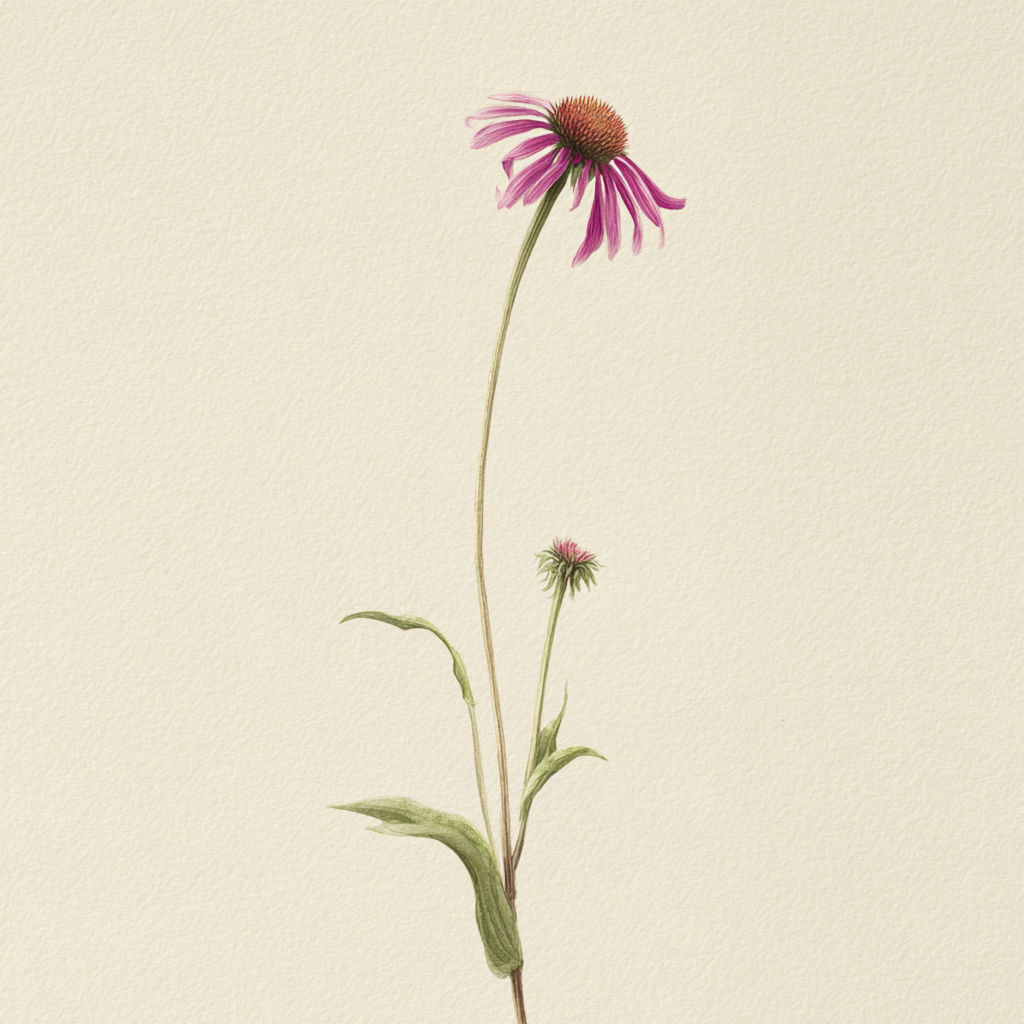
Upright rough stems that branch lightly and hold flowers above the foliage.
Leaves
Coarse oval to lance-shaped leaves with rough surfaces, toothed margins, and a basal clump early in the season.
Flowers
Daisy-like heads with drooping purple to pink ray florets around a raised spiny orange-brown cone.
Fruit
Dry achenes held in the cone after petals drop; seed heads remain valuable for birds.
Known Varieties
Common cultivars worth knowing
- Best for: native-style perennial beds
Echinacea purpurea
Classic purple coneflower species with strong garden performance.
- Best for: reliable ornamental bloom
Magnus
Large pink-purple flowers with flatter rays than many wild forms.
- Best for: small spaces
PowWow Wild Berry
Compact seed-grown cultivar with vivid magenta flowers.
- Best for: white perennial borders
White Swan
White-flowered purple coneflower selection with orange cones.
- Best for: distinctive displays
Green Twister
Unusual green and pink bicolor petals around dark cones.
- Best for: mixed color plantings
Cheyenne Spirit
Seed-grown mix with red, orange, yellow, cream, and purple tones.
Loading photo submission…