Comfrey
HerbSymphytum officinale
Have seeds for this? Add to inventory →Comfrey is a permaculture powerhouse and dynamic accumulator, drawing up potassium, calcium, nitrogen, and phosphorus from deep in the soil with its long taproot. Chopped and dropped as mulch or steeped as liquid feed, it is one of the most valuable plants in an organic garden.
Native Range
- Origin
- Common comfrey is native to Europe and western Asia.
- Native Habitat
- Damp meadows, stream banks, wet ditches, woodland edges, and moist nitrogen-rich soils.
- Current Distribution
- Naturalized across many temperate regions, especially in disturbed habitats.
Growing Conditions
Sunlight
Partial Shade
Water Needs
Moderate
Soil
Deep, moisture-retaining loam; pH 5.5 - 7.0; tolerates poor soil
Spacing
24 - 36 inches
Days to Maturity
Cut leaves from year 1 for mulch or liquid feed; up to 4 cuts per year
Growing Zones
Thrives in USDA Zones 3 - 10
Companion Planting
Good Companions
Keep Away From
No known antagonists
When to Plant
Transplant
Plant crown divisions in spring or autumn; use Bocking 14 variety (sterile) to prevent self-seeding
Harvest
Cut leaves at 2 inches from ground; 3 - 4 cuts per season
Phenology (Natural Timing Cues)
Transplant
Plant comfrey crowns or root cuttings in spring or autumn. Choose the permanent site carefully before planting - comfrey is nearly impossible to eradicate once established because any fragment of taproot will regenerate.
- Soil is workable in early spring (spring planting).
- Forsythia is beginning to bloom (spring planting).
- Summer heat has eased and first cool nights have returned (autumn planting).
- Several weeks remain before expected first hard frost (autumn planting).
Start Dates (Your Location)
Based on your saved growing zone and this plant's timing notes.
Best Planting Window
Spring window
Spring
Plant early enough for roots to settle before summer heat.
Autumn window
Early autumn
Plant early enough for roots to grow before winter; avoid late planting into cold, wet soil.
Planting Method
Plant healthy crowns. Seed is possible for some crops, but crowns establish faster and reach useful harvest size sooner.
Critical Timing Note
Set crowns at the correct depth and keep the bed evenly moist while new roots establish.
Organic Growing Tips
Chop and drop comfrey leaves directly around fruit trees, tomatoes, and potatoes as a mineral-rich mulch.
Steep leaves in water for 4 - 6 weeks to create a potassium-rich liquid fertiliser - dilute 1:10 before applying.
Plant at the base of fruit trees to accumulate nutrients and support the entire root zone.
Use Bocking 14, the sterile cultivar, to get all the benefits without aggressive self-seeding.
Common Pests
- Comfrey Moth
- Slugs
All pest management in Garden uses safe, organic, non-toxic methods only. No synthetic pesticides, ever.
Taxonomy
- Kingdom
- Plantae
- Family
- Borage family (Boraginaceae)
- Genus
- Symphytum
- Species
- Symphytum officinale
Natural History
Symphytum officinale is native to Europe and parts of western Asia, growing as a robust perennial in damp meadows, riverbanks, and disturbed ground. Its genus name comes from the Greek symphyo - to grow together - a reference to the deeply held belief in its power to consolidate and knit. The root contains allantoin, a compound that promotes cell proliferation in laboratory conditions, lending some chemical basis to traditional claims about the plant's properties. Comfrey was one of the most prominent herbs in medieval European gardens, its mass and rapid regrowth making it conspicuous in physic gardens where it occupied dedicated beds. In the 20th century, Lawrence Hills - founder of the Henry Doubleday Research Association (now Garden Organic) in England - championed comfrey as a permaculture biomass plant and developed the sterile Russian hybrid Bocking cultivars at his Braintree research station in the 1950s. These selections produce abundant biomass from deep roots that mine subsoil nutrients without setting viable seed, making them the standard form in modern permaculture and organic gardens worldwide.
Traditional Use
Comfrey's reputation across 2,000 years of European herbal tradition was built on the belief - and in some respects the chemical reality - that the plant had unusual powers of consolidation. Its modern complicated status is a consequence of pyrrolizidine alkaloids identified in the 20th century, not a rejection of centuries of documented practice.
Parts Noted Historically
Classical and Medieval Herbal Tradition - Root
Dioscorides and Galen both described comfrey root, and it appeared in virtually every significant European herbal from the early medieval period onward. The English name knitbone and the German equivalent Beinwell - bone well - both reflect the same deeply rooted traditional association. John Gerard's 1597 Herball and Nicholas Culpeper's 1652 Complete Herbal both gave comfrey root prominent entries, recommending poultices for external application to joints and limbs.
European Folk and Household Use - Leaves and root
Across Germany, England, France, and Eastern Europe, comfrey was a common cottage garden plant grown near the house for household external applications. Root preparations were made into poultices, and the plant's abundance and rapid growth made it broadly accessible. These applications were almost entirely external - the leaves and root applied as bandage preparations - rather than internal.
Lawrence Hills and the Permaculture Revival - Leaves
In the 1950s and 1960s, Lawrence Hills' work at the Henry Doubleday Research Association reframed comfrey from a medicinal plant into an agricultural one. His research quantified the plant's ability to mine potassium, nitrogen, and phosphorus from deep in the soil profile and return it to the surface through leaf decomposition. The Bocking 14 cultivar he selected became the standard permaculture comfrey and is still grown worldwide.
Contemporary European Topical Use - Root
Contemporary European pharmacopeias distinguish clearly between internal use - not supported by current safety assessments - and topical preparations. Standardized root extracts are licensed in Germany and Switzerland as topical products, continuing a narrow version of the traditional external-application tradition in a regulated form.
Comfrey contains pyrrolizidine alkaloids (PAs) associated with hepatotoxicity. Internal use is not recommended. Topical use should avoid broken skin and is regulated in some EU countries. Bocking cultivars have lower PA levels than common comfrey but are not PA-free.
This information is provided for historical and educational purposes only and is not medical advice. Always consult a qualified healthcare professional before making decisions related to your health.
Morphology (Plant Structure & Identification)
Root System
Deep thick taproot and branching roots that regrow from fragments. Once established, comfrey is difficult to remove.
Stem
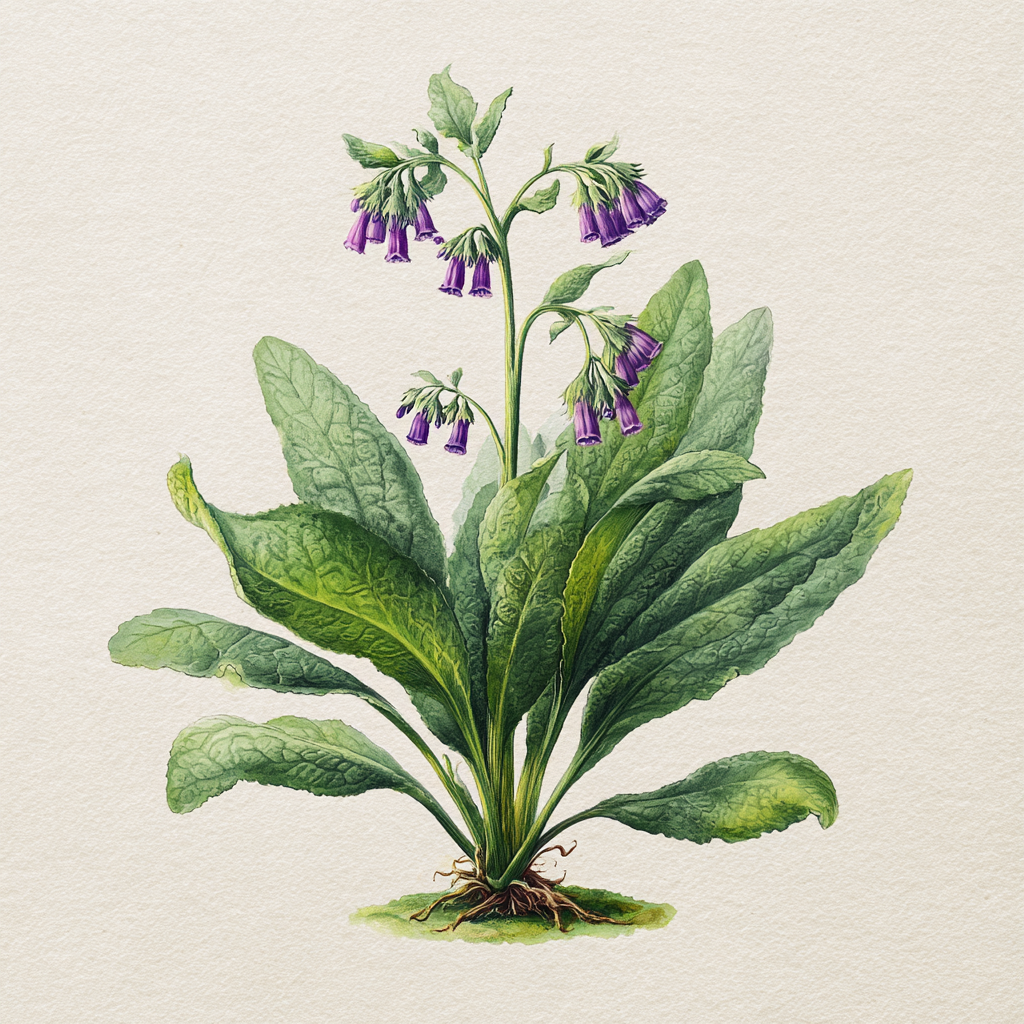
Coarse upright stems emerge from a crown and regrow quickly after cutting. Stems and leaves are covered with rough hairs.
Leaves
Large lance-shaped leaves with rough, bristly texture and strong veins. Basal leaves can become very large and make dense mulch material.
Flowers
Drooping clusters of tubular purple, pink, cream, or blue flowers attract bumblebees and other long-tongued pollinators.
Fruit
Produces small nutlets after flowering in fertile forms. Sterile Bocking types rarely set viable seed and are spread by crown or root cuttings.
Known Varieties
Common cultivars worth knowing
- Best for: permaculture, controlled plantings
Bocking 14
Sterile Russian comfrey selection widely used for mulch and liquid feed.
- Best for: biomass, large sites
Bocking 4
Sterile comfrey selection often grown for forage and biomass.
- Best for: contained wildlife areas
Common Comfrey
Seed-fertile Symphytum officinale with strong traditional garden history.
- Best for: chop-and-drop mulch
Russian Comfrey
Hybrid comfrey with vigorous growth and high biomass.
Loading photo submission…