Carrot
VegetableDaucus carota
Have seeds for this? Add to inventory →Carrots require deep, loose, stone-free soil to form straight roots, but reward patient growers with sweet, crunchy harvests. Sowing alongside companion herbs dramatically reduces pest pressure from carrot fly.
Native Range
- Origin
- Carrot is derived from Daucus carota, a wild species native across Europe, North Africa, and western Asia.
- Native Habitat
- Wild carrot grows in dry grasslands, field edges, roadsides, sandy soils, and other open disturbed habitats.
- Current Distribution
- Naturalized across many temperate regions, especially in disturbed habitats.
Growing Conditions
Sunlight
Full Sun
Water Needs
Moderate
Soil
Deep, loose, sandy loam; avoid rocky soil; pH 6.0 - 6.8
Spacing
2 - 3 inches after thinning
Days to Maturity
70 - 80 days from sowing
Growing Zones
Thrives in USDA Zones 3 - 10
Companion Planting
When to Plant
Direct Sow
3 - 5 weeks before last frost; succession sow every 3 weeks
Harvest
70 - 80 days; leave in ground in mild climates for sweetening
Phenology (Natural Timing Cues)
Direct Sow
Sow carrots when cool soil is open and the seed row can stay evenly moist until germination - the main failure mode is a surface that dries and crusts before seedlings emerge.
- Early dandelions are blooming (spring sowing).
- Soil is workable with a fine, crumbly surface.
- A mild, settled stretch of weather is likely rather than a dry, windy spell.
- Summer heat has eased and first cool nights have returned (fall sowing).
Start Dates (Your Location)
Based on your saved growing zone and this plant's timing notes.
Typical Last Frost
Set your growing zone to see personalized calendar dates.
Organic Growing Tips
Interplant with rosemary, sage, and chives to confuse carrot fly with strong aromatic compounds.
Cover beds with fine mesh immediately after sowing to create a physical barrier against carrot fly.
Sow thinly to reduce thinning, as thinning disturbs soil and releases the scent that attracts carrot fly.
Grow in raised beds with deep, sieved compost-enriched soil for the straightest, finest roots.
Common Pests
- Carrot Fly
- Aphids
- Wireworm
- Carrot Weevil
All pest management in Garden uses safe, organic, non-toxic methods only. No synthetic pesticides, ever.
Taxonomy
- Kingdom
- Plantae
- Family
- Carrot family (Apiaceae)
- Genus
- Daucus
- Species
- Daucus carota
Natural History
The cultivated carrot was selected from wild carrot (Daucus carota), a species native to Afghanistan and Central Asia, where the earliest domesticated forms were purple and yellow - not orange. These color forms moved westward through Persia, the Arab world, and into Europe over the first millennium CE. Orange carrots became dominant in Europe through Dutch plant breeding in the 16th-17th century; the popular story that they were bred to honor William of Orange has some historical basis but oversimplifies a longer selective process during which Dutch breeders developed sweeter, more productive orange types. The orange color comes from beta-carotene, which the human body converts to vitamin A - a nutritional significance not understood scientifically until the 20th century. Wild carrot, the direct ancestor of the cultivated form, still grows across Europe and North America as a common roadside and meadow plant known as Queen Anne's Lace - visually similar to cultivated carrot's second-year flowers but with a pale, fibrous, inedible root. The carrot family (Apiaceae) contains several dangerously toxic plants that can resemble wild carrot in leaf and flower, including poison hemlock, water hemlock, and fool's parsley.
Traditional Use
Carrots have a cultivation history stretching back at least 3,000 years from their Afghan origin, passing through Persian, Arab, and European food traditions before becoming one of the world's most widely grown vegetables. The shift from purple and yellow forms to the orange carrot now considered standard happened primarily through post-Renaissance European breeding.
Parts Noted Historically
Central Asian and Persian Cultivation Traditions - Root
The earliest cultivated carrots were purple and yellow, grown in Afghanistan, Persia, and the Arab world from at least the 10th century CE. Arabic agricultural writers including Ibn al-'Awwam described carrot cultivation in detail in the 12th century. These purple and yellow forms were the carrots of the medieval Arab and Persian kitchen; the orange carrot was a European development that only gradually displaced them.
European Kitchen Garden Traditions - Root
Orange carrots became the standard in northern and western Europe from the 17th century, grown as a kitchen staple for soups, stews, and root cellars. The French tradition of glazed carrots - carottes Vichy, simmered in butter, sugar, and water until glossy - is one of the most specific and enduring culinary preparations, appearing in French bourgeois cooking from the 18th century onward.
British Wartime Carrot Promotion - Root
During World War II, the British government promoted carrots as a health food and encouraged the claim that they improved night vision - partly to explain British pilots' improved interception rates without revealing the military secret that radar was responsible. The campaign produced a character called "Dr. Carrot" and significantly boosted carrot consumption. Though the night-vision claim was exaggerated as propaganda, beta-carotene does support eye health in genuine ways.
Historical Herbal and Folk Traditions - Seeds
Carrot seeds and wild carrot appear in European herbals primarily as diuretics. Wild carrot seeds were also historically noted in folk traditions across parts of Europe as a post-coital preparation - a use that has attracted some modern research interest but is not reliable and carries safety concerns. For the garden context, the cultivated root is straightforwardly a food with no significant cautions.
Cultivated carrot is food-safe in any quantity. The carrot family (Apiaceae) contains several dangerously toxic look-alike species including poison hemlock (Conium maculatum), water hemlock (Cicuta species), and fool's parsley (Aethusa cynapium). Wild carrot and Queen Anne's Lace should not be consumed without expert identification.
This information is provided for historical and educational purposes only and is not medical advice. Always consult a qualified healthcare professional before making decisions related to your health.
Morphology (Plant Structure & Identification)
Root System
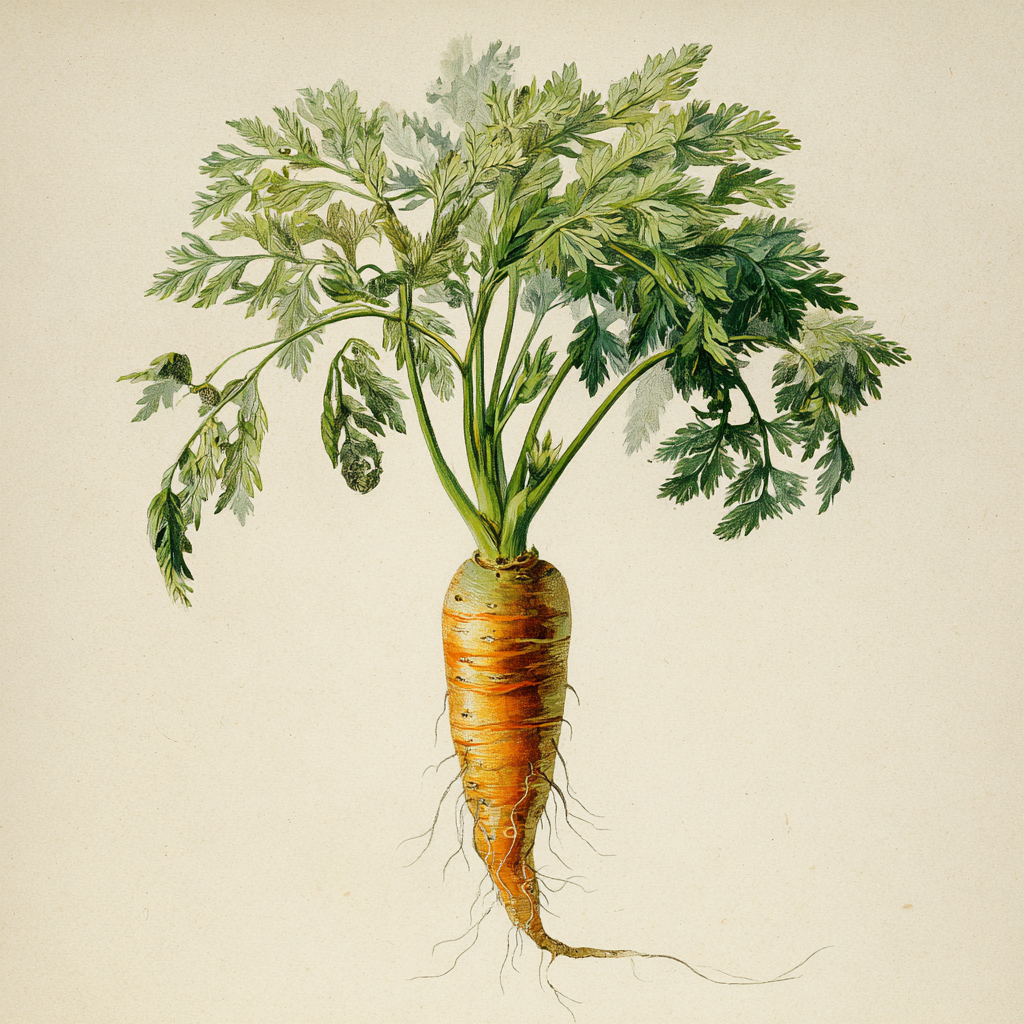
Deep swollen taproot with fine feeder roots along the sides. Forking, stunting, or twisting usually points to stones, compacted soil, fresh manure, or transplant disturbance.
Stem
Very short crown during the first growing season. In the second year, a tall branched flowering stem rises from the stored root.
Leaves
Finely divided, fern-like leaves with a soft texture and aromatic scent when crushed. Leaves emerge from the crown in a loose upright rosette.
Flowers
Second-year plants produce flat-topped umbels of many small white flowers. Flowering carrots resemble wild carrot and attract many small beneficial insects.
Fruit
Produces small ridged dry seeds after flowering. The harvested crop is the enlarged taproot, which varies from short and round to long and tapered.
Known Varieties
Common cultivars worth knowing
- Best for: general garden use
Danvers 126
Reliable orange carrot with broad shoulders and good performance in heavier soils.
- Best for: fresh eating
Nantes
Cylindrical, blunt-ended carrot with sweet flavor and crisp texture.
- Best for: deep beds, long roots
Imperator
Long tapered supermarket-style carrot that needs deep, loose soil.
- Best for: containers, clay soil
Parisian
Small round carrot that sizes well in shallow or heavier soil.
- Best for: fresh eating, visual interest
Purple Haze
Purple-skinned carrot with orange center and striking sliced color.
- Best for: roasting, cooked dishes
Atomic Red
Red carrot that develops strong color when cooked.
Related Articles
Loading photo submission…