Aronia
FruitAronia melanocarpa
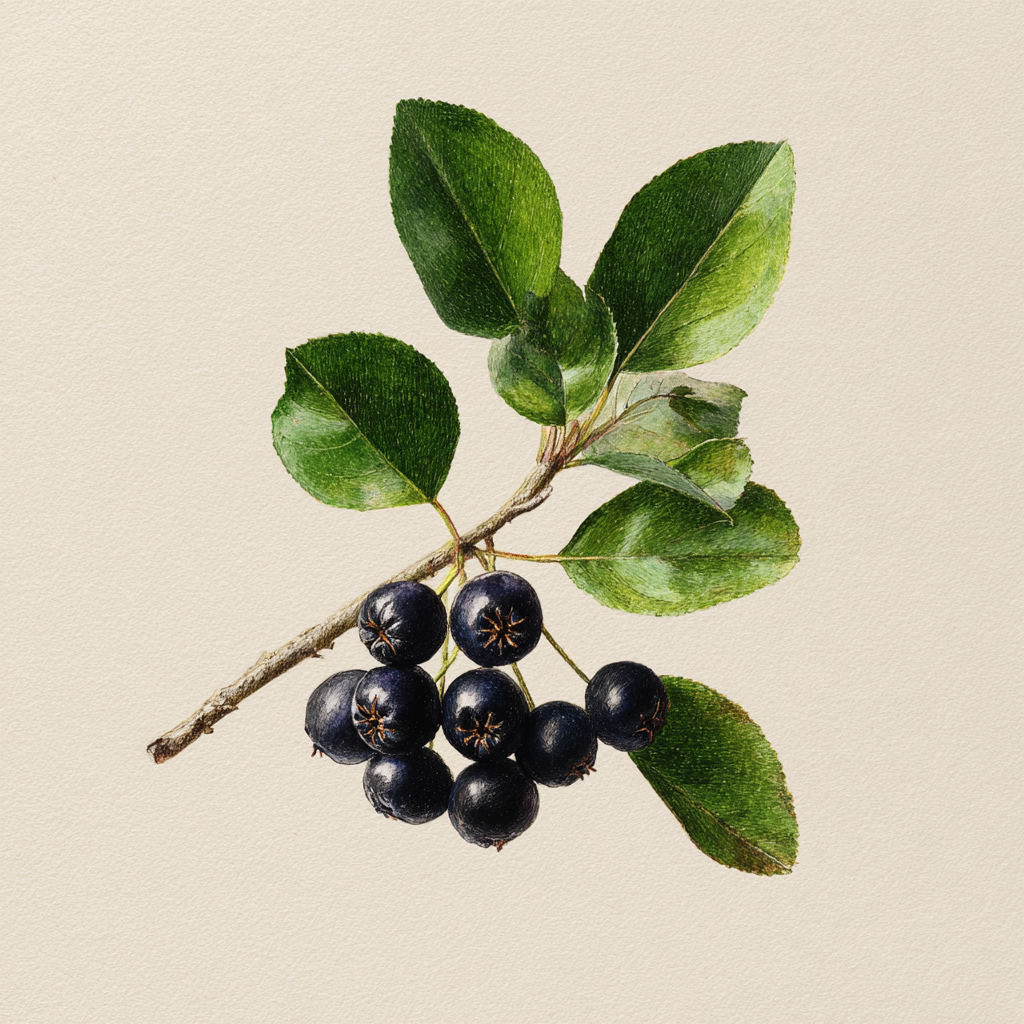
Have seeds for this? Add to inventory →Black chokeberry (Aronia melanocarpa) is a hardy, multi-stemmed deciduous shrub native to eastern North America, prized for its intensely dark, astringent berries rich in anthocyanins. It offers four-season garden interest: white spring blooms, glossy summer foliage, heavy clusters of near-black fruit, and brilliant red-orange fall color. Adaptable to a wide range of soils and climates, it is one of the most cold-hardy fruiting shrubs a gardener can grow.
Growing Conditions
Growing Conditions
Sunlight
Full Sun to Partial Shade
Water Needs
Low to Moderate
Soil
Adaptable; prefers moist, well-drained, slightly acidic loam but tolerates clay, sandy, and wet soils
Spacing
48 to 72 inches
Days to Maturity
Berries ripen late summer to early fall; expect first meaningful harvest in year 2-3
Growing Zones
Growing Zones
Thrives in USDA Zones 3 - 8
When to Plant
When to Plant
Transplant
Plant bare-root or container-grown shrubs in early spring or fall when plants are dormant or just breaking dormancy
Harvest
Harvest berry clusters in late August through October when fully black and slightly soft; flavor deepens after a light frost
Phenology (Natural Timing Cues)
Transplant
Aronia is best planted from nursery stock in early spring just as forsythia fades and soil is consistently workable, or in early fall while soil is still warm enough for root establishment before freeze. Spring planting gives the shrub a full growing season to anchor roots; fall planting timed too late risks frost-heave on young crowns. Wait for soil to drain cleanly after winter saturation before digging holes.
- Forsythia blooms fading and lilac buds swelling signal safe spring planting
- Soil draining cleanly and workable to a spade depth without pooling
- Overnight lows consistently above 28°F in fall for establishment window
- Leaf drop complete and shrubs fully dormant for fall bare-root planting
Start Dates (Your Location)
Average dates use your saved zone; readiness also checks your forecast when available.
Best Planting Window
Spring window
Early spring
Plant as soon as the soil is workable so roots establish before heat arrives.
Autumn window
Usually skip autumn planting
Use spring unless you have locally grown nursery stock and enough mild weather for roots to establish.
Planting Method
Plant nursery-grown aronia stock or rooted cuttings. Seed-grown plants are slow, variable, and usually not the best way to establish a productive planting.
Critical Timing Note
Plant while dormant and before bud break so roots establish before leaves demand water.
Use the average timing, but check your local forecast before planting.
Typical Harvest Window
August to October
Organic Growing Tips
Organic Growing Tips
Top-dress with mature compost each spring to feed soil biology and sustain steady growth without forcing lush, pest-prone flushes
Apply worm castings around the drip line in early spring to provide slow-release nutrients and beneficial microbial inoculants
Mulch heavily with wood chips or straw to retain moisture, suppress weeds, and gradually build organic matter as aronia prefers consistently moist root zones
Brew a compost tea with kelp and worm castings and foliar-feed in early summer to support fruit set without synthetic inputs
Prune out oldest canes at the base every few years to keep the shrub open and productive; cut wood makes excellent mulch material when chipped
Plant with nitrogen-fixing companions like clover as a living mulch beneath the canopy to gently enrich the soil between shrubs
Care Guidance
Optional seasonal guidance for what you can do, even when nothing is urgent.
Care Guidance
Watering
If dry weather lingers, let the top 2 inches start to dry before watering again. This plant often responds better to an occasional deep soak than to frequent light watering.
Feeding
If growth is strong, compost-rich soil often carries most of the load. If the plant starts looking pale or stalls, a light compost top-dressing or gentle organic feed may help.
Pruning
If pruning is needed, dormancy or the period just after harvest is often the simplest window. Dead, damaged, or crossing growth is usually the first place to start.
Seasonal care
In late fall, a light cleanup and fresh mulch can help if winter protection is useful in your climate. Leaving a little space around crowns and trunks often helps air move and keeps excess moisture from sitting there.
Known Varieties
Common cultivars worth knowing
Known Varieties
Viking
A compact, well-branched cultivar developed in Scandinavia with reliably large berry clusters and strong fall color; one of the most widely available and consistently productive selections for home gardens
Best for
General home garden production and ornamental use
Nero
A German-selected cultivar with very large, dark berries, high anthocyanin content, and a more compact, upright habit than the straight species; widely grown in European commercial and garden settings
Best for
Juicing, jam-making, and small-space gardens
McKenzie
A North American selection with exceptional cold-hardiness rated to zone 3 and vigorous suckering habit; noted for productive clusters and reliable fruiting in short-season climates
Best for
Cold-climate gardeners in zones 3-4
Autumn Magic
Selected primarily for spectacular red-purple fall foliage alongside good berry production; a strong dual-purpose ornamental and fruiting shrub
Best for
Ornamental hedging with edible harvest
Companion Planting
Companion Planting
Good companions
- blueberry
- native grasses
Support & insectary plants
Nearby plants that attract pollinators, beneficial insects, or improve soil health.
- elderberry
Attracts pollinators
- serviceberry
Attracts pollinators
- echinacea
Attracts pollinators and beneficial insects
- yarrow
Attracts beneficial insects and produces nutrient-rich mulch
Avoid planting near
No known conflicts
Common Pests
Common Pests
- aphids
- Japanese beetle
- spider mite
- leaf spot fungi
- fire blight
All pest management in Garden uses safe, organic, non-toxic methods only. No synthetic pesticides, ever.
Simple Ways to Use
Simple Ways to Use
Start here if you're not sure how to use this crop in the kitchen.
Quick recipes you can make right away
Aronia Syrup
Simmer aronia berries with a little water until they burst and release their juice, then strain and sweeten the liquid to taste. Use the syrup for drinks, pancakes, or stirred into yogurt.
Aronia Jam Base
Cook the berries with sugar for 10 to 15 minutes until the fruit softens and the mixture thickens enough to mound lightly on a spoon. Taste near the end, because the berries are often quite tart and a little astringent.
Aronia Muffin Fold-In
Fold the berries gently into muffin or quick-bread batter just before baking so they stay evenly spread. Use ripe berries so the finished bake tastes fruity instead of harshly tart.
How to Preserve
How to Preserve
Use this section to store or process extra harvest before it spoils.
Practical methods for extra harvest
Freeze aronia berries on a tray
Spread clean dry berries in a single layer and freeze them until hard before bagging so they stay loose instead of clumping. Use them later in syrup, baking, smoothies, or jam.
Make aronia jam or syrup
Cook the berries into jam or strain them into syrup, then refrigerate or freeze small batches unless you are following a tested preserving recipe for shelf-stable jars. Use a tested recipe and the full processing time if you plan to can them.
Dry aronia berries
Dry the berries at 135°F until they feel leathery with no wet juice remaining inside when pressed, usually several hours to a day depending on size. Cool them fully before storing so the jar stays dry.
New to preserving food?
New to freezing? Read the freezing guide.New to dehydrating? Read the dehydrating guide.How to Store
How to Store
Simple storage tips
Keep aronia berries cold in the refrigerator and use them within about 3 to 5 days.
Store them dry in a shallow container so the fruit on the bottom does not crush.
Do not wash them before storage, because extra surface moisture shortens fresh life.
Use softening or leaking berries first for syrup, jam, or freezing.
Freeze or cook ripe fruit quickly if you will not use it soon, because fresh quality drops fast.
How to Save Seed
How to Save Seed
Step-by-step seed saving
- 1
Aronia can be grown from seed, but named plants are usually propagated from suckers, cuttings, or nursery stock if you want similar fruit and growth habit.
- 2
If you save seed, crush fully ripe berries, rinse away the pulp, and keep the cleaned seeds that remain.
- 3
Dry the seeds briefly until surface moisture is gone, then store them in a cool dry place if you want to experiment.
- 4
Use suckers or nursery plants instead of seed if your main goal is to keep the same aronia selection.
Native Range
Native Range
- Origin
- Native to eastern North America.
- Native Habitat
- Wet thickets, bog edges, swamp margins, and moist open woodlands across eastern North America.
- Current Distribution
- Eastern North America; widely planted in native gardens, food forests, and conservation plantings for its wildlife value, edible berries, and exceptional fall color.
Taxonomy
Taxonomy
- Kingdom
- Plantae
- Family
- Rose family (Rosaceae)
- Genus
- Aronia
- Species
- melanocarpa
Morphology
Morphology
Root System
Aronia develops a fibrous, spreading root system and produces suckers freely from the crown, gradually forming a dense colony; division of sucker clumps is a reliable propagation method for home growers
Stem
Multi-stemmed shrub reaching 3-6 feet tall with upright, arching canes; older canes become woody and less productive and should be removed at the base every 3-4 years to renew vigor
Leaves
Glossy, dark green, finely serrated oval leaves with a distinctive dark midrib gland visible on the upper surface; fall color ranges from brilliant orange-red to deep burgundy and is a reliable ornamental signal that harvest is at or past peak
Flowers
White, five-petaled flowers appear in dense corymbs in mid-spring, attracting native bees and hoverflies; the shrub is largely self-fertile but cross-pollination with a second plant or cultivar improves berry set noticeably
Fruit
Dense pendant clusters of round, near-black berries 6-10 mm across ripen from green through purple to glossy black in late August to October; berries are ready to harvest when fully black and give slightly to pressure, and flavor improves markedly after the first light frost
Natural History
Natural History
Aronia melanocarpa is native to the bogs, swamps, and forest edges of eastern North America, ranging from Newfoundland south to the Appalachian mountains. Indigenous peoples of the Great Lakes region and Northeast used the berries as a food source, often drying them for winter stores. European botanical interest emerged in the 18th century when the plant was carried to Russia, where Soviet-era plant breeders developed high-yielding cultivars for commercial juice and food production beginning in the 1940s. Today Russia and Poland remain the world's largest producers. Aronia's tendency to sucker and colonize disturbed ground makes it a resilient, low-maintenance fruiting shrub and an ecologically valuable native hedge plant.
Traditional Use
Traditional Use
Indigenous communities of eastern North America documented aronia berries as a food and astringent preparation, with Chippewa and other Great Lakes peoples drying berries for winter provisions and poultices. In 20th-century Soviet and Eastern European folk practice, the dark juice and dried fruit were used in ethnobotanical contexts related to circulatory concerns, based on the fruit's high tannin and anthocyanin content. Contemporary phytochemical research has drawn attention to the berry's polyphenol profile, though historical folk use preceded any formal scientific characterization.
Parts Noted Historically
Great Lakes Indigenous peoples, including Chippewa (Ojibwe), 17th-19th century - fruit
Berries were harvested and dried for winter food stores; the astringent fruit was also documented in poultice contexts by early ethnobotanical recorders
Soviet and Eastern European folk botany, mid-20th century - fruit and juice
Following widespread cultivation introduced under Soviet agricultural programs, dried aronia berries and expressed juice were recorded in folk contexts associated with circulatory and vascular concerns in Russian and Polish ethnobotanical literature
The raw berries are intensely astringent and are generally unpleasant to eat in large quantities fresh; most culinary uses involve cooking, juicing, or drying. No significant toxicity is documented, but the high tannin content can cause digestive discomfort in large amounts.
This information is provided for historical and educational purposes only and is not medical advice. Always consult a qualified healthcare professional before making decisions related to your health.
Loading photo submission…