Elderberry
FruitSambucus canadensis
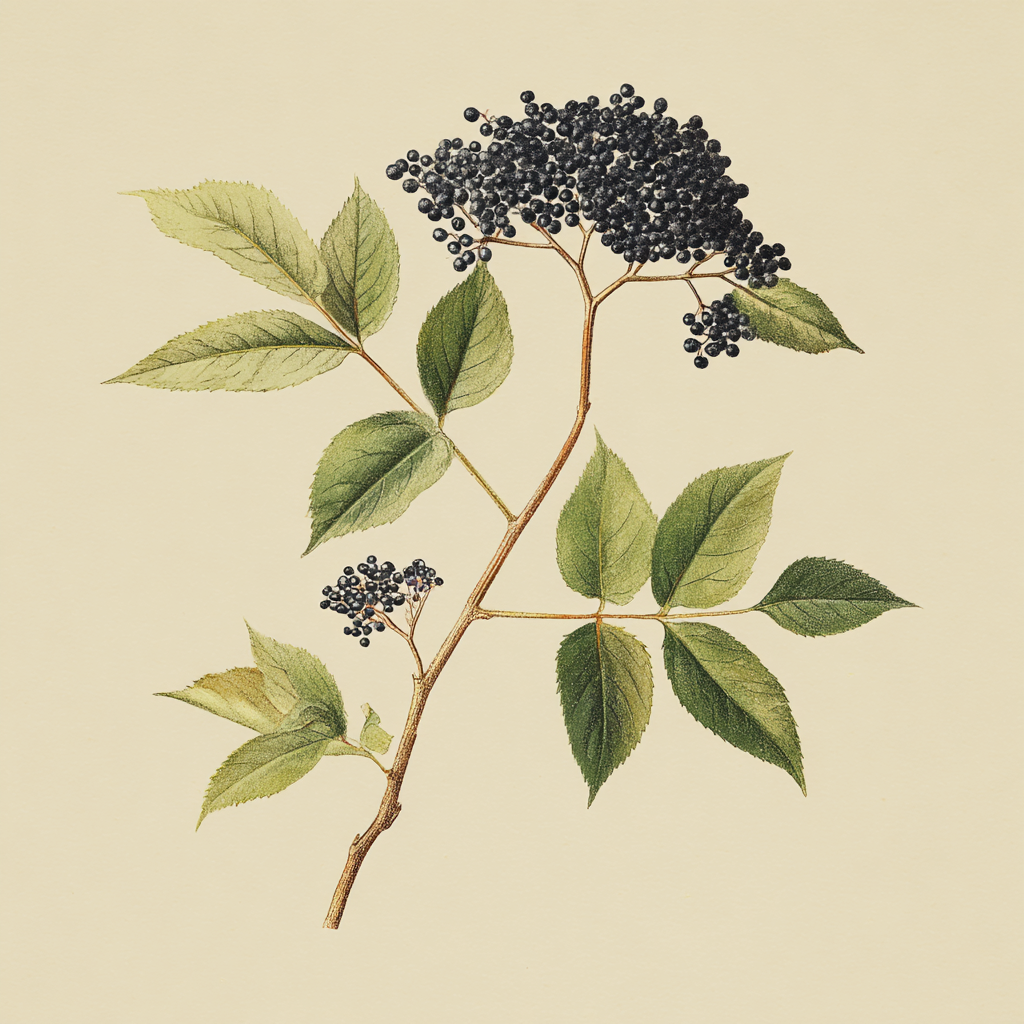
Have seeds for this? Add to inventory →American elderberry is a fast-growing, multi-stemmed native shrub prized for its large flat-topped clusters of creamy white flowers and heavy bunches of small dark purple berries. It thrives in moist, fertile soils and naturalizes readily along stream banks, woodland edges, and hedgerows. Both flowers and ripe berries are edible and widely valued for culinary and traditional uses.
Growing Conditions
Growing Conditions
Sunlight
Full Sun to Partial Shade
Water Needs
Moderate
Soil
Moist, fertile soil; tolerates clay and wet conditions; pH 5.5–6.5
Spacing
6–10 feet
Days to Maturity
Berries ripen late summer to early fall; first harvest typically in year 2
Growing Zones
Growing Zones
Thrives in USDA Zones 3 - 9
When to Plant
When to Plant
Transplant
Plant bare-root or potted nursery stock in early spring once soil is workable, or in fall before hard frost
Direct Sow
Plant bare-root or potted stock in early spring; hardwood cuttings root easily in late winter
Harvest
Harvest entire berry clusters when fully ripe and dark purple; remove berries from stems before use
Phenology (Natural Timing Cues)
Transplant
Elderberry establishes best when planted in early spring as soil becomes workable, giving roots the full growing season to anchor before summer heat. Fall planting also works in mild to moderate climates. Bare-root stock planted too late into warm dry soil struggles to establish, while potted stock offers more flexibility.
- Forsythia blooming or fading signals safe spring planting time
- Soil workable and draining cleanly without compacting underfoot
- Dandelions actively flowering and nighttime temperatures consistently above 32°F
- Leaf buds swelling on established deciduous shrubs nearby
Start Dates (Your Location)
Average dates use your saved zone; readiness also checks your forecast when available.
Best Planting Window
Spring window
Early spring
Plant as soon as the soil is workable so roots establish before heat arrives.
Autumn window
Usually skip autumn planting
Use spring unless you have locally grown nursery stock and enough mild weather for roots to establish.
Planting Method
Plant nursery-grown transplants. They establish faster and more reliably than starting this plant from seed.
Critical Timing Note
Plant while dormant and before bud break so roots establish before leaves demand water.
Use the average timing, but check your local forecast before planting.
Typical Harvest Window
August to October
Organic Growing Tips
Organic Growing Tips
Plant two varieties for cross-pollination and heavier yields.
Cut one-third of oldest canes to the ground each year to maintain vigorous new growth.
Never eat raw berries in large quantities; cook or dry before consuming.
Elderflowers make excellent free-range animal attractors - leave some clusters for wildlife.
Care Guidance
Optional seasonal guidance for what you can do, even when nothing is urgent.
Care Guidance
Watering
If the top 2 inches of soil feel dry, a deep watering at the base may help more than frequent light watering. In healthy soil, rain may cover much of what it needs.
Feeding
Extra feeding is rarely required if soil is healthy. If growth looks pale or slow, a light compost top-dressing is often enough before adding anything stronger.
Pruning
If pruning is needed, dormancy or the period just after harvest is often the simplest window. Dead, damaged, or crossing growth is usually the first place to start.
Seasonal care
In late fall, a light cleanup and fresh mulch can help if winter protection is useful in your climate. Leaving a little space around crowns and trunks often helps air move and keeps excess moisture from sitting there.
Pollination & Fruit Production
Pollination & Fruit Production
The pollination helper includes compatibility guidance for elderberry.
Need a compatible partner? Open the Fruit Tree Planner.Known Varieties
Common cultivars worth knowing
Known Varieties
- Bob Gordon
A Missouri-bred cultivar selected for very high berry yield and large individual cluster size; produces reliably in zones 4–8 and is the most widely recommended commercial and home-garden cultivar in North America.
Best for
Maximum berry yield and jam or juice production
- Adams
One of the oldest named American elderberry selections, Adams produces large clusters of berries on a vigorous shrub and has proven adaptability from zone 3 to 8; good pollinizer when paired with Bob Gordon or Nova.
Best for
Cold-hardy gardens and cross-pollination pairing
- Nova
A Canadian-bred cultivar with very large berries and early ripening; selected at the Nova Scotia Agricultural College for cold hardiness and consistent fruit size, making it valuable in zones 3–5.
Best for
Short-season and cold-climate gardens
- Ranch
A western-adapted cultivar with compact growth habit and good drought tolerance relative to other elderberries; useful where space is limited or conditions are drier than the species prefers.
Best for
Smaller gardens or drier climates
Companion Planting
Companion Planting
Good companions
- Fruit Trees
Support & insectary plants
Nearby plants that attract pollinators, beneficial insects, or improve soil health.
- Comfrey
Attracts beneficial insects and produces nutrient-rich mulch
- Yarrow
Attracts beneficial insects and produces nutrient-rich mulch
- Currants
Attracts pollinators and beneficial insects
- Gooseberry
Attracts pollinators
Avoid planting near
No known conflicts
Common Pests
Common Pests
- Elderberry Borer
- Aphids
- Spider Mites
- Powdery Mildew
All pest management in Garden uses safe, organic, non-toxic methods only. No synthetic pesticides, ever.
Simple Ways to Use
Simple Ways to Use
Start here if you're not sure how to use this crop in the kitchen.
Quick recipes you can make right away
Cooked Elderberry Syrup Base
Strip ripe berries from the stems, simmer them with a little water for 15 to 20 minutes until the berries burst and the juice runs dark, then strain out the skins and seeds. Sweeten the strained juice only after cooking, because raw elderberries should not be eaten.
Elderberry Jelly Base
Cook the berries with a splash of water until the fruit fully breaks down, then strain the juice and use it in a tested jelly recipe. Always discard stems and leaves, because they should not be cooked or eaten with the berries.
Cooked Elderberry Sauce
Simmer stripped berries until they burst and the mixture thickens slightly, then strain if you want a smoother sauce. Use the sauce only after the berries have been fully cooked through, not raw.
How to Preserve
How to Preserve
Use this section to store or process extra harvest before it spoils.
Practical methods for extra harvest
Freeze stripped berries
Remove as much stem material as you can, spread the berries on a tray, and freeze them until hard before bagging them. Freeze them only after cleaning well, because sorting tiny stems out of a frozen clump is much harder later.
Make elderberry syrup or jelly
Cook the berries until they burst and release dark juice, then strain and use the juice in a tested syrup or jelly recipe. Always cook elderberries before use and keep stems, leaves, and unripe berries out of the pot.
Dry elderberries
Strip ripe berries from the stems and dry them at 135°F until they are wrinkled, firm, and no longer sticky or wet inside. Cool them fully before storing, and remember they still need cooking before eating later.
New to preserving food?
New to freezing? Read the freezing guide.New to dehydrating? Read the dehydrating guide.How to Store
How to Store
Simple storage tips
Keep fresh elderberries refrigerated and use them within about 1 to 3 days, because the clusters soften quickly after harvest.
Strip berries from large stems as soon as you can, because sorting them is easier before the fruit begins to soften.
Do not wash them until you are ready to process them, because extra surface moisture speeds mold.
Freeze or cook ripe berries quickly instead of trying to hold them for a long fresh-storage window.
Discard leaves, thick stems, and unripe green berries instead of mixing them into the edible harvest.
How to Save Seed
How to Save Seed
Step-by-step seed saving
- 1
Elderberries are usually propagated more reliably by cuttings or suckers than by seed, especially if you want fruit similar to a named type.
- 2
If you want more of the same elderberry, root a cutting or dig and move a healthy sucker instead of saving seed.
- 3
Seeds can be saved for breeding or experimentation, but they are not the easiest or most consistent way to keep a good elderberry planting going.
Native Range
Native Range
- Origin
- Native to eastern and central North America, ranging from Nova Scotia and Manitoba south through Florida and the Great Plains to northeastern Mexico.
- Native Habitat
- Naturally colonizes moist, nutrient-rich disturbed ground, stream banks, woodland edges, and floodplain thickets, often growing in partial shade at forest margins.
- Current Distribution
- Widely distributed across its native North American range and broadly cultivated throughout temperate regions worldwide; naturalized in parts of Europe and the Pacific Northwest.
Taxonomy
Taxonomy
- Kingdom
- Plantae
- Family
- Muskroot family (Adoxaceae)
- Genus
- Sambucus
- Species
- canadensis
Morphology
Morphology
Root System
Elderberry produces a spreading, fibrous root system from a persistent woody crown that sends up multiple canes each season; the crown expands outward over time and can be divided every 4–5 years to propagate new plants.
Stem
Each season the crown pushes up hollow-pith canes that reach 6–12 feet; canes are most productive in their second and third years, so annual renewal pruning of the oldest third improves yield and keeps the shrub manageable.
Leaves
Large opposite pinnate leaves with 5–11 leaflets give the shrub a lush, coarse texture; yellowing or distorted new growth may signal aphid colonies clustered at shoot tips, while powdery white coating on leaves indicates mildew stress, most common in dense plantings with poor airflow.
Flowers
Flat-topped creamy white flower clusters (corymbs) up to 10 inches across appear in early summer and are excellent pollinator magnets; flowers are fragrant and edible but should be harvested before full browning for culinary use, and leaving some clusters for pollinators improves overall fruit set.
Fruit
Berry clusters hang in heavy, drooping heads and ripen from green through red to deep purple-black in late summer; harvest when all or nearly all berries in a cluster are fully dark, as partially ripe red berries still carry significant amounts of the compounds that cause digestive irritation raw.
Natural History
Natural History
Sambucus canadensis is native to eastern and central North America, growing naturally along stream banks, woodland margins, and disturbed moist ground from Nova Scotia to Florida and west to the Great Plains. Indigenous peoples across this range, including the Cherokee, Iroquois, and Ojibwe, used elderberries extensively for food and ceremony long before European settlement. Early colonists quickly adopted the plant, and European settlers recognized its similarity to the Old World elder (Sambucus nigra), which carried deep folkloric significance in England and Germany. Botanically, elderberry produces new canes from a persistent root crown each season, making vigorous annual renewal pruning the key to long-term productivity.
Traditional Use
Traditional Use
Elderberry has one of the longest documented histories of human use among North American and European native plants, with records spanning Indigenous North American traditions, medieval European herbalism, and early colonial medicine. Multiple Indigenous nations documented use of the berries, flowers, leaves, and bark for distinct purposes, while European herbalists recorded Sambucus nigra in parallel traditions that were transplanted to the New World. The plant appears in major early modern European herbals including those of John Gerard (1597) and Nicholas Culpeper (1653).
Parts Noted Historically
Cherokee and Iroquois peoples, eastern North America, pre-colonial through 19th century - berries and bark
Cherokee and Iroquois ethnobotanical records document elderberry berries used in food preparations and bark preparations applied externally, with bark also noted in ceremonial contexts; these uses were recorded by 19th-century ethnobotanists including Moerman's compilation of Native American plant use.
European herbalism, Gerard's Herball (1597) and Culpeper's Complete Herbal (1653) - flowers and berries
John Gerard and Nicholas Culpeper both documented elder flowers and berries in their herbals, describing their association with cooling and purging qualities according to humoral medical theory then current in England; Culpeper attributed the plant to Venus and described flower-water distillations as fashionable in early modern English households.
American colonial and folk medicine, 17th–19th century - flowers and berries
Elder flower and berry preparations appeared consistently in early American domestic manuals and farm almanacs, reflecting the transfer of English and German folk traditions to the New World, where Sambucus canadensis was quickly recognized as a serviceable local equivalent to European S. nigra.
Raw unripe elderberries, as well as the leaves, bark, and roots of all Sambucus species, contain cyanogenic glycosides that can cause nausea and vomiting if eaten in quantity; ripe berries are generally considered safe when cooked or dried, and cooking destroys most of the irritating compounds. Green or unripe berries should not be eaten raw.
This information is provided for historical and educational purposes only and is not medical advice. Always consult a qualified healthcare professional before making decisions related to your health.
Loading photo submission…