Sweet Potato
VegetableIpomoea batatas
Have seeds for this? Add to inventory →Sweet potatoes are warm-season vines grown for their sweet, nutritious tubers. They thrive in hot summers and are grown from slips rather than seeds, spreading vigorously as ground cover.
Native Range
- Origin
- Sweet potato is a tropical American domesticate of Ipomoea, with wild ancestry centered in the Americas.
- Native Habitat
- Wild relatives are twining vines of warm open ground, thickets, field margins, and frost-free disturbed habitats.
- Current Distribution
- Widely cultivated in warm climates; not native outside its region of origin.
Growing Conditions
Sunlight
Full Sun
Water Needs
Low
Soil
Loose, well-draining, sandy loam; pH 5.5 - 6.5
Spacing
12 - 18 inches
Days to Maturity
90 - 120 days from slip planting
Growing Zones
Thrives in USDA Zones 5 - 11
Companion Planting
When to Plant
Transplant
2 - 3 weeks after last frost, soil 65°F+
Harvest
90 - 120 days; harvest before first frost
Phenology (Natural Timing Cues)
Transplant
Sweet potatoes are the most warmth-dependent of common vegetable transplants - more so than tomatoes, peppers, or even eggplant. They are tropical vines pushed toward temperate cultivation through long growing seasons, and any cold check in the weeks after transplanting stalls them significantly. Slips planted into soil below 65°F often sit without rooting for weeks, during which they are vulnerable to rot. The critical marker is not just last frost date but genuine soil warmth: soil at 65°F or above several inches down, sustained daytime temperatures above 70°F, and nights that have stopped dropping below 55°F. In zones 5 and 6, this can mean waiting 2 - 3 weeks past the last frost date - which feels late, but sweet potatoes are fast-maturing once heat is established and early planting into cold soil actively harms final yield.
- Lilacs are well past bloom and early summer heat is settling in.
- Soil feels warm even several inches below the surface.
- Warm-season weeds and grasses are growing vigorously.
- Daytime temperatures are reliably above 70°F.
- New slip growth stays upright and firm through a full warm day without wilting.
Start Dates (Your Location)
Based on your saved growing zone and this plant's timing notes.
Best Planting Window
Spring window
After your last frost
Plant once frost risk has passed and spring conditions are settled.
Autumn window
Usually skip autumn planting
Use spring unless you have locally grown nursery stock and enough mild weather for roots to establish.
Planting Method
Use nursery-grown planting stock rather than treating this as a standard seed-starting crop.
Critical Timing Note
Plant after cold risk has passed so roots can establish without chilling or stalling.
Organic Growing Tips
Start slips 6 weeks before planting by suspending a sweet potato in water in a warm spot.
Grow in raised beds with loose soil amended with sand and compost for easy tuber expansion.
Plant thyme and oregano nearby to deter whiteflies and attract beneficial ground beetles.
Cure harvested tubers at 85°F and 90% humidity for 7 - 10 days to sweeten and harden skin.
Common Pests
All pest management in Garden uses safe, organic, non-toxic methods only. No synthetic pesticides, ever.
Taxonomy
- Kingdom
- Plantae
- Family
- Morning glory family (Convolvulaceae)
- Genus
- Ipomoea
- Species
- Ipomoea batatas
Natural History
Sweet potato (Ipomoea batatas) was domesticated in tropical South America, most likely in the region between southern Mexico and Venezuela, where the greatest genetic diversity of cultivated and wild relatives is found. Radiocarbon-dated remains from coastal Peru push domestication back to at least 8,000 BCE. One of the most extraordinary facts in the history of any crop plant is that sweet potato had already arrived in Polynesia - in Hawaii and Aotearoa New Zealand (where the Maori called it kumara) - centuries before any possible European contact, by around 1000-1200 CE. How it crossed the Pacific is a question that captivated plant geographers and historians for over a century. The most widely accepted hypothesis is that Polynesian navigators reached South America, obtained the plant, and carried it back west across the Pacific - a voyage of several thousand miles made without instruments. Genomic research published in Current Biology in 2020 confirmed that Polynesian sweet potatoes are genetically distinct from American ones but share a common origin from the same Ipomoea lineage, consistent with a single human-mediated transfer. Sweet potato arrived in Europe with Christopher Columbus's second voyage of 1493 - one of the first American food plants to reach Europe, predating the common potato by decades. Henry VIII of England reportedly ate sweet potatoes in spiced pies, and they were fashionable at the Tudor court as an exotic import. Portuguese traders spread the plant through Africa and Asia in the 16th century via their trade routes, and it became a major food security crop across sub-Saharan Africa and East Asia. In Japan, satsuma-imo (a specific cultivar type) became deeply embedded in food and cultural life from the Edo period onward.
Traditional Use
Sweet potato's most remarkable story is not culinary but geographical: a crop domesticated in South America that somehow crossed the Pacific to Polynesia a thousand years ago, leaving genetic traces that modern science can now read.
Parts Noted Historically
South American Domestication and Peruvian Archaeology - Storage roots
Archaeological sweet potato remains from coastal Peru dated to around 8,000 BCE make it one of the oldest documented cultivated crops in the Americas. The centre of genetic diversity for wild Ipomoea batatas relatives lies in the region from southern Mexico to the Orinoco basin, and the greatest diversity of cultivated forms is found in the Andean region of South America. Pre-Columbian Andean cultures including the Inca cultivated numerous varieties distinguished by flesh and skin colour, storage quality, and growing conditions, reflecting centuries of careful selection in complex highland and coastal agroecosystems.
Polynesian Kumara and the Trans-Pacific Transfer - Storage roots
The Maori word kumara for sweet potato matches closely with the Quechua word kumar or kumara used for the same plant in coastal Peru - a linguistic correspondence first noted by botanists in the 19th century. The 2020 genomic study in Current Biology analysed sweet potato samples from herbarium specimens going back to early European voyages and confirmed two distinct introduction events into Polynesia, both from South American sources, the older predating European contact by several centuries. This provides some of the strongest evidence for pre-Columbian contact between Polynesia and South America. The mechanism most historians accept is Polynesian navigators sailing east to South America on purpose - the same communities capable of navigating thousands of miles across the open Pacific.
Columbus, Tudor England, and European Introduction - Storage roots
Columbus brought sweet potatoes back from the Caribbean on his second voyage of 1493, and they were among the earliest American food plants to attract European interest. In Tudor England, sweet potatoes were an expensive imported luxury, and several accounts describe Henry VIII eating spiced sweet potato pies as an aphrodisiac - a reputation based on their sweetness and exotic origin. The plant was growing in Spain and Portugal by the 1520s-1530s, and Portuguese maritime trade routes disseminated it through West Africa, East Africa, India, and Southeast Asia within a few decades - arguably making sweet potato one of the fastest-spreading crops in history.
African, Japanese, and Asian Adoption - Roots and leaves
Portuguese traders introduced sweet potato to West Africa, East Africa, and coastal Asia in the 16th century, and it was adopted with remarkable speed across sub-Saharan Africa as a drought-tolerant, productive food security crop suited to soils and climates where other staples struggled. In Japan, the sweet potato arrived via Portuguese contact in the Ryukyu Islands (Okinawa) and spread to the mainland in the early Edo period (17th century). The Satsuma region of Kyushu became a major cultivation centre, giving the name satsuma-imo to Japanese sweet potato varieties. Japanese satsuma-imo - with their distinctive dry texture and strong sweetness - are culturally distinct from American sweet potatoes and remain a separate horticultural tradition.
This information is provided for historical and educational purposes only and is not medical advice. Always consult a qualified healthcare professional before making decisions related to your health.
Morphology (Plant Structure & Identification)
Root System
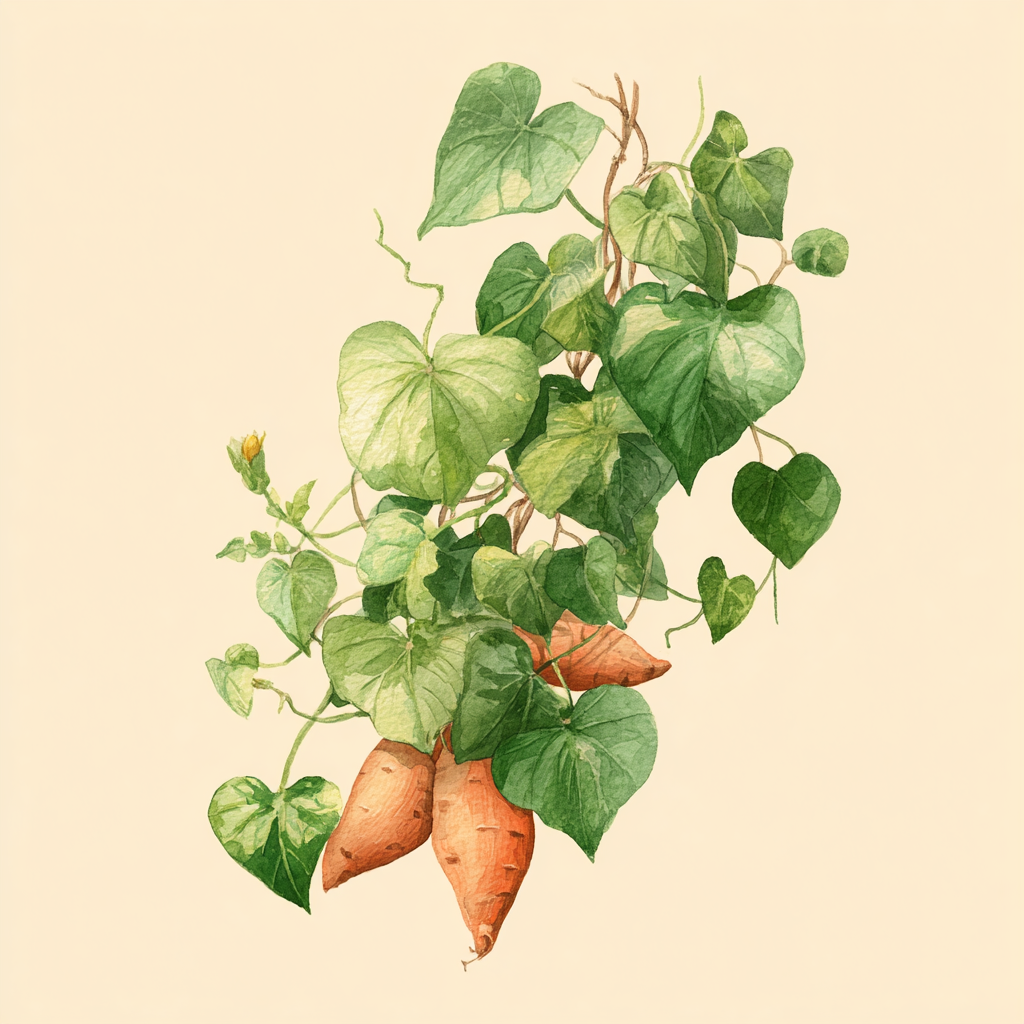
Fibrous roots form from slips, with some roots swelling into edible storage roots. Loose soil helps roots expand smoothly and makes harvest easier.
Stem
Trailing vines root at nodes when they contact moist soil. Vines can quickly cover bare ground and suppress weeds in warm weather.
Leaves
Heart-shaped to lobed leaves on long petioles, varying by variety. Leaves resemble ornamental morning glory relatives but grow from edible crop vines.
Flowers
Funnel-shaped lavender to pale purple flowers may appear in warm regions, though many varieties flower sparsely in cooler climates.
Fruit
Produces small capsules only when flowers set seed, which is uncommon in many gardens. The harvested crop is the swollen storage root, not a true tuber.
Known Varieties
Common cultivars worth knowing
- Best for: general garden use
Beauregard
Widely grown orange-fleshed variety with reliable yields and good adaptability.
- Best for: cooler climates, early harvests
Georgia Jet
Early orange-fleshed type often chosen for shorter seasons.
- Best for: storage, baking
Covington
Uniform orange-fleshed variety with good flavor and storage quality.
- Best for: roasting, specialty cooking
Murasaki
Purple-skinned, white-fleshed Japanese type with drier texture.
- Best for: warm climates, visual interest
Okinawan
Purple-fleshed type with dense texture and striking color.
Loading photo submission…