Radish
VegetableRaphanus sativus
Have seeds for this? Add to inventory →Radishes are among the fastest-maturing vegetables in the garden, ready to harvest in as little as 3 weeks. They make excellent companion plants and soil looseners, and their flowers attract beneficial insects.
Native Range
- Origin
- Radish is an Old World domesticate associated with wild Raphanus ancestry in the eastern Mediterranean and western Asia.
- Native Habitat
- Wild relatives occur in coastal ground, field edges, disturbed soils, and seasonally dry open habitats.
- Current Distribution
- Naturalized across many temperate regions, especially in disturbed habitats.
Growing Conditions
Sunlight
Full Sun
Water Needs
Moderate
Soil
Loose, well-draining loam; pH 6.0 - 7.0
Spacing
2 inches after thinning
Days to Maturity
22 - 30 days (small varieties); 50 - 70 days (daikon)
Growing Zones
Thrives in USDA Zones 2 - 10
Companion Planting
When to Plant
Direct Sow
4 - 6 weeks before last frost; succession sow every 2 weeks
Harvest
22 - 70 days; harvest promptly or roots become pithy
Phenology (Natural Timing Cues)
Direct Sow
Radishes are one of the fastest crops in the garden - small varieties are harvest-ready in 22 - 30 days - but that speed depends entirely on cool soil and steady moisture. When soil warms above 80°F, radishes shift energy from root formation to seed production, producing flowering stalks with no usable root. The spring window is narrow: from first workable soil until temperatures rise, which can be as little as 4 - 6 weeks in many climates. Sowing too early into frozen or waterlogged ground causes rot; sowing too late produces pithy, split, or bolted roots. Succession sowing in small batches every two weeks through the cool window spreads risk and provides steady harvests rather than a single glut that all bolts at once. An autumn window opens again as summer heat eases, and this is often the better season for daikon types that need longer to develop.
- Soil is workable and not frozen or waterlogged.
- Dandelions are not yet blooming or have just begun to open.
- Cool-season weeds like chickweed are actively germinating and growing.
- The weather pattern is stable and cool rather than in a warm spell.
- For autumn sowing: tomato and pepper foliage is beginning to show heat fatigue and nights are cooling.
Start Dates (Your Location)
Based on your saved growing zone and this plant's timing notes.
Typical Last Frost
Set your growing zone to see personalized calendar dates.
Organic Growing Tips
Sow radishes between slower crops as a space-filler and quick harvest while main crops develop.
Leave a few radishes to flower and set seed - they become excellent pollinator attractors.
Use radishes as a trap crop for flea beetles, protecting nearby brassicas.
Work a thin layer of compost into the top few inches of soil before each succession sow — radishes develop their best flavour and texture in biologically active, moisture-retentive soil rather than bare, compacted ground.
Common Pests
- Flea Beetle
- Root Maggot
- Aphids
- Cabbage White Caterpillar
All pest management in Garden uses safe, organic, non-toxic methods only. No synthetic pesticides, ever.
Taxonomy
- Kingdom
- Plantae
- Family
- Mustard family (Brassicaceae)
- Genus
- Raphanus
- Species
- Raphanus sativus
Natural History
Radish (Raphanus sativus) has one of the longest and most geographically complex cultivation histories of any root vegetable. Pliny the Elder recorded that radishes were so valued in Egypt that golden models of them were placed in temple offerings alongside models of onions and garlic, and ancient inscriptions list radishes, onions, and garlic among the rations paid to workers building the Great Pyramid at Giza - one of the earliest documented food-wage records in history. The genus name Raphanus derives from the Greek raphanos, meaning "quickly appearing," a direct reference to the plant's exceptional germination speed. European salad radishes and the large East Asian daikon are both Raphanus sativus but represent thousands of years of divergent selection: daikon (Raphanus sativus var. longipinnatus) has a documented cultivation history of at least 2,000 years in China and Japan, where large white roots reaching 30-50 cm became a staple winter vegetable. In medieval Japan, daikon was among the most culturally important vegetables, appearing in seasonal ceremonies and serving as the largest component of New Year food preparations. Black radishes (Raphanus sativus var. niger) represent a third distinct selection developed in Central and Eastern Europe, appearing in 16th-century European herbals as a recognized form quite different from the small red salad type. The rat-tail radish, grown for its long edible seed pods rather than any root, has a separate long history in South and Southeast Asian cuisines and in Central Asian cooking. The isothiocyanate compounds that give all radishes their characteristic pungency are released only when the root is cut or crushed - a defence mechanism that research has shown deters a range of insects and soil pathogens.
Traditional Use
Radish is among the oldest cultivated vegetables, with documented use across Egypt, Rome, China, and Japan stretching back over four thousand years - and its history splits cleanly between the small European salad radish and the large Asian daikon, two quite different culinary traditions from the same species.
Parts Noted Historically
Ancient Egypt and the Pyramid Workers - Root
Ancient Egyptian inscriptions at Giza record rations of radishes, onions, and garlic paid to pyramid construction workers - among the earliest written food-wage records in human history. Pliny the Elder, citing earlier Egyptian sources, noted that golden temple models of radishes were offered alongside onions and garlic, suggesting the vegetable held ceremonial as well as practical significance. Egyptian cultivation of radishes predates Greek and Roman cultivation, and the plant was well established in the Nile Delta region by 2000 BCE.
East Asian Daikon Tradition - Root and greens
Daikon - the large white radish of East Asian cooking - has a cultivation history in China and Japan going back at least 2,000 years and possibly much longer. In Japan, daikon became one of the defining winter vegetables, eaten fresh, pickled as takuan (in a preparation traditionally attributed to the monk Takuan Soho in the 17th century), simmered in winter stews, and grated fresh as oroshi daikon to accompany grilled fish. The New Year food tradition in Japan features daikon in ozoni soup and other ceremonial preparations. In China, large radishes were pickled, dried, and braised as staple winter provisions across most regions.
European Salad Radish and Kitchen Garden Writing - Root
The small round red or white salad radish is documented in classical Roman sources - Pliny catalogued several varieties - and by the 16th century it was a standard quick crop in European kitchen gardens. John Gerard described multiple radish forms in his 1597 Herball. The French breakfast radish tradition - long cylindrical radishes eaten raw with butter and salt - is documented from at least the 18th century and reflects the specific selection of elongated mild varieties suited to early-season French kitchen garden production. The defining growing instruction in European garden writing from the 16th century onward is consistent: harvest promptly before roots become woody and hollow.
South and Southeast Asian Pod Traditions - Pods and seeds
The rat-tail radish (Raphanus sativus var. caudatus) is grown specifically for its long, slender seed pods rather than any root, which remains thin and inedible. The pods reach 15-30 cm and are eaten raw, pickled, or stir-fried. This form has a documented history in South and Southeast Asian cooking, where it appears in Indian, Thai, and Indonesian cuisines. It reached European vegetable catalogues by the 18th century as a novelty. Radish seeds were also pressed for oil - Raphanus sativus var. oleifera is cultivated as an oilseed crop in parts of South Asia, though this use is largely separate from the culinary tradition.
This information is provided for historical and educational purposes only and is not medical advice. Always consult a qualified healthcare professional before making decisions related to your health.
Morphology (Plant Structure & Identification)
Root System
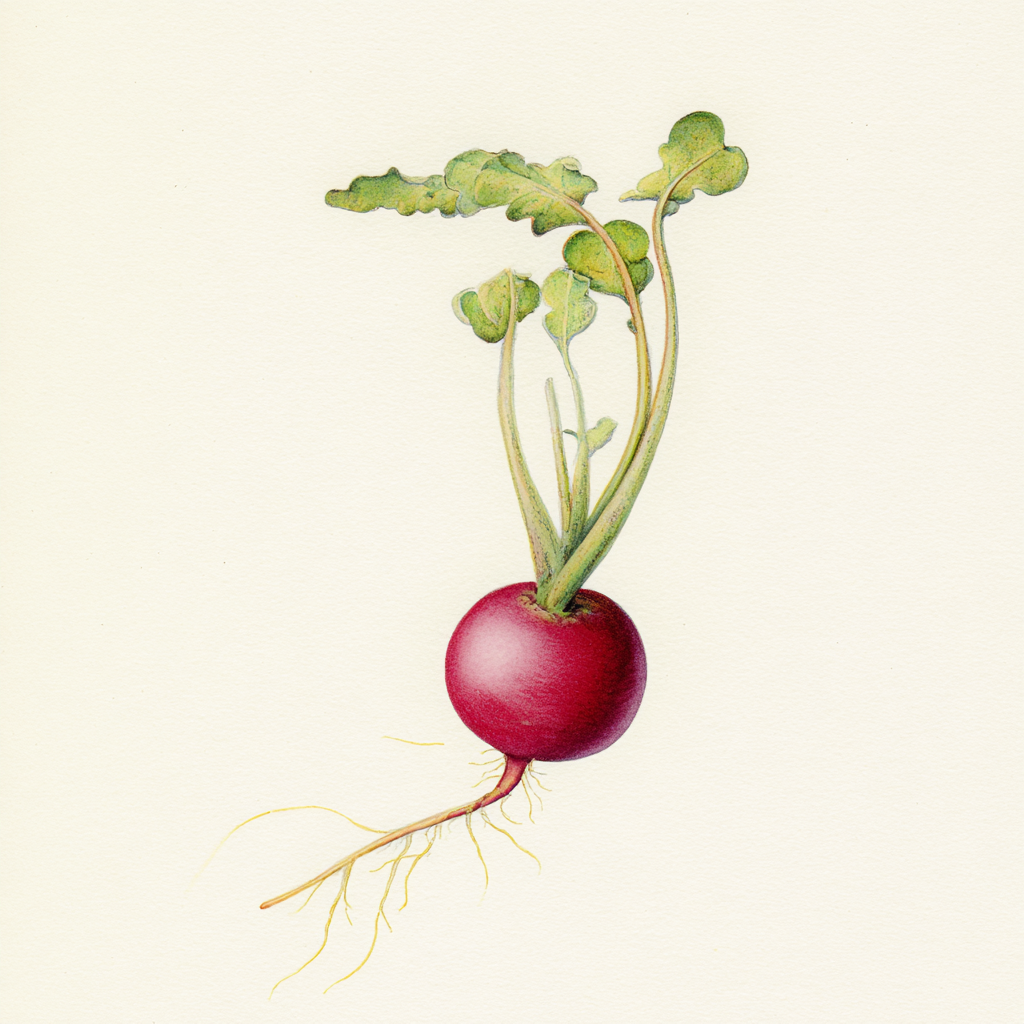
Swollen taproot with fine feeder roots. Small round varieties form quickly near the surface, while daikon types drive deeper and need loose soil.
Stem
Short crown during root formation, then an elongating flower stalk if plants bolt. Heat and crowding speed this shift.
Leaves
Rough, lobed, slightly hairy leaves in a basal rosette. Greens are often the first part damaged by flea beetles.
Flowers
Four-petaled white, pink, purple, or pale flowers appear on branched stems. Flowering plants attract beneficial insects and pollinators.
Fruit
Produces elongated seed pods after flowering; some varieties are grown for edible pods. The usual harvested crop is the crisp swollen taproot.
Known Varieties
Common cultivars worth knowing
- Best for: early spring harvests
Cherry Belle
Fast round red radish with crisp white flesh.
- Best for: fresh eating
French Breakfast
Oblong red-and-white radish with mild flavor and quick growth.
- Best for: fall crops, slicing
Watermelon
Storage radish with green-white skin and vivid pink interior.
- Best for: fall roots, cooking
Miyashige Daikon
Long white daikon type for deep loose soil and cool seasons.
- Best for: pods, hot weather novelty
Rat Tail
Grown for crisp edible seed pods rather than swollen roots.
Related Articles
Loading photo submission…