Pomegranate
FruitPunica granatum
Have seeds for this? Add to inventory →Pomegranates are drought-tolerant shrubs or small trees with spectacular orange flowers and jewel-like ruby seeds. They are among the easiest fruit trees to grow organically and remarkably pest-resistant once established.
Native Range
- Origin
- Pomegranate is native to western Asia, with long cultivation centered around Iran and adjacent regions.
- Native Habitat
- Dry rocky slopes, scrub, open woodland, and warm semi-arid valleys.
- Current Distribution
- Naturalized across many warm regions, especially near settlement and disturbed habitats.
Growing Conditions
Sunlight
Full Sun
Water Needs
Low
Soil
Well-draining loam or sandy loam; pH 5.5 - 7.0; tolerates poor soil
Spacing
10 - 15 feet
Days to Maturity
2 - 3 years to first significant harvest; fruit matures 6 - 7 months after flowering
Growing Zones
Thrives in USDA Zones 8 - 11
Companion Planting
When to Plant
Transplant
Spring after last frost; or autumn in mild climates
Harvest
Autumn; fruit is ripe when it sounds metallic when tapped
Phenology (Natural Timing Cues)
Transplant
Pomegranates establish best when soil is already warm and all risk of frost has passed, making them a true warm-season transplant unlike most fruit trees. Cold, wet root-zone conditions in the weeks after planting are the main failure mode - pomegranate roots sitting in soggy, cool soil before they have spread are highly susceptible to rot. Spring timing should be delayed past the last frost date and ideally until soil temperature is reliably above 60°F. In warm and mild-winter areas, autumn planting after peak summer heat has passed is an excellent alternative: the soil is still warm from summer, roots can spread before winter, and the plant faces far less heat and moisture stress than a spring-planted specimen during establishment. At the cool edge of the range (zone 8), spring planting is preferable because autumn-planted young trees with minimal root spread face winter cold before establishment is solid.
- Lilacs have faded and settled warm-season conditions have arrived.
- Soil temperature is reliably above 60°F.
- New growth on established plants and warm-season crops is active and vigorous.
- For autumn planting: summer heat has clearly eased, nights are cooling, but hard frost is still many weeks away.
Start Dates (Your Location)
Based on your saved growing zone and this plant's timing notes.
Best Planting Window
Spring window
After your last frost
Plant once frost risk has passed and spring conditions are settled.
Autumn window
Early autumn
Plant early enough for roots to grow before winter; avoid late planting into cold, wet soil.
Planting Method
Plant nursery-grown pomegranate stock or rooted cuttings. Seed-grown plants are slow, variable, and usually not the best way to establish a productive planting.
Critical Timing Note
Plant after cold risk has passed so roots can establish without chilling or stalling.
Organic Growing Tips
Once established, pomegranates are remarkably drought-tolerant - overwatering is a more common problem than under-watering.
Plant lavender and comfrey at the base to attract pollinators and build soil health through mulching.
Prune suckers from the base annually if growing as a tree rather than a multi-stemmed shrub.
In borderline zones, train against a warm south-facing wall and mulch roots deeply in winter.
Common Pests
All pest management in Garden uses safe, organic, non-toxic methods only. No synthetic pesticides, ever.
Taxonomy
- Kingdom
- Plantae
- Family
- Loosestrife family (Lythraceae)
- Genus
- Punica
- Species
- Punica granatum
Natural History
Pomegranate has a cultivation history extending back at least five thousand years, making it one of the oldest continuously cultivated fruit plants in the world. The genus name Punica reflects the Roman name for Carthage - the Romans called it malum punicum, the Carthaginian apple, because they associated the finest pomegranates with North African cultivation around Carthage (modern Tunisia), though the plant is native to the region from Iran through northern India. Archaeological evidence from the ancient Near East, including dried pomegranates found in 18th Dynasty Egyptian tombs and in the Bronze Age palace at Knossos, confirms its deep antiquity in Mediterranean and Near Eastern cultures. The Hebrew Bible names pomegranate as one of the shivat ha-minim, the seven species of the Promised Land (Deuteronomy 8:8), and the decorative elements of the columns of Solomon's Temple were described as pomegranate forms in 1 Kings 7:18. In Greek mythology Persephone ate six pomegranate seeds in the underworld, binding her to Hades for six months of each year and creating the seasons - one of the foundational origin myths of Western culture. The city of Granada in southern Spain takes its name directly from the pomegranate: granada in Spanish, and the fruit appears on the city's coat of arms to this day. Spanish colonists carried pomegranate to the Americas in the 16th century, where it naturalised and spread through subtropical regions including California and Mexico. The Wonderful variety, developed in California in the late 19th century, now accounts for the majority of commercial pomegranate production worldwide.
Traditional Use
Pomegranate carries five thousand years of symbolic weight alongside its food history - Hebrew scripture, Greek mythology, Islamic art, Ayurvedic medicine, and Spanish heraldry all reach for it to mean something beyond the fruit itself.
Parts Noted Historically
Ancient Egypt and the Near East - Fruit and rind
Dried pomegranates and pomegranate imagery appear in Egyptian tombs from the 18th Dynasty (1549-1292 BCE), including the tomb of Tutankhamun. The fruit was among the prestigious goods considered appropriate for the afterlife alongside oils, grains, and wine. Pomegranates appear in Egyptian wall paintings showing garden cultivation, and the Ebers Papyrus (c.1550 BCE), one of the oldest surviving medical documents, mentions pomegranate rind in formulations - among the earliest written records of the plant in a medical context. In the ancient Near East more broadly, pomegranate imagery was associated with fertility and abundance across Mesopotamian, Phoenician, and Hebrew cultures.
Greek Myth and Classical Cultivation - Fruit
The Persephone myth - in which she eats six pomegranate seeds in the underworld, binding her to Hades for half the year and creating the cycle of seasons - made pomegranate one of the most symbolically loaded fruits in Greek culture. Pomegranate appears in Homer's Odyssey in the garden of Alcinous, and Theophrastus and Pliny both catalogued cultivated varieties. The Romans carried it north and west through their empire, and Pliny described methods of storing pomegranates in sealed vessels of clay, a technique that extended the fruit's season.
Persian and Ayurvedic Medical Tradition - Fruit, rind, and flowers
Ibn Sina (Avicenna) devoted substantial attention to pomegranate in his Canon of Medicine (1025 CE), describing the sweet, sour, and semi-sweet varieties and their different humoral qualities and applications. He classified pomegranate rind as strongly astringent and useful for digestive complaints. Unani medicine, which drew on Ibn Sina's Canon, continued this tradition, and pomegranate rind preparations appear in Persian and Indian pharmacological texts through the medieval and early modern periods. In Ayurvedic medicine, pomegranate (dadima) was described in classical texts as useful for digestive and heart conditions, with the rind, seeds, flowers, and bark all given distinct roles.
Granada, Spain and the Americas - Fruit
The city of Granada, founded as a Moorish city (Medina Garnata) and taken by Ferdinand and Isabella in 1492, was named for the pomegranate and features it on its coat of arms - the same year Columbus sailed for the Americas. Spanish colonists carried pomegranate with them, and it established itself in California, Mexico, and the Caribbean during the 16th and 17th centuries. The Franciscan missions in California planted pomegranates, and the modern California commercial industry - now the basis for the global Wonderful variety - descends from these mission-era introductions. Mexico and parts of South America developed their own pomegranate food traditions, including the use of fresh arils as a garnish on dishes like chiles en nogada.
Pomegranate fruit and juice are safe foods with thousands of years of consumption history. Pomegranate juice interacts with some medications metabolised by cytochrome P450 enzymes - notably certain statins - in a way similar to grapefruit juice; people on these medications should check with their doctor.
This information is provided for historical and educational purposes only and is not medical advice. Always consult a qualified healthcare professional before making decisions related to your health.
Morphology (Plant Structure & Identification)
Root System
Woody root system adapted to dry, well-drained soils once established. Young plants need moisture until roots spread.
Stem
Multi-stemmed shrub or small tree with twiggy growth and occasional thorns. Suckers are common if trained as a tree.
Leaves
Small glossy narrow leaves, often emerging bronze and turning bright green. Plants are deciduous or semi-evergreen depending on climate.
Flowers
Showy orange-red tubular flowers with thick waxy petals. Some flowers are fruiting forms and others are more ornamental male-type flowers.
Fruit
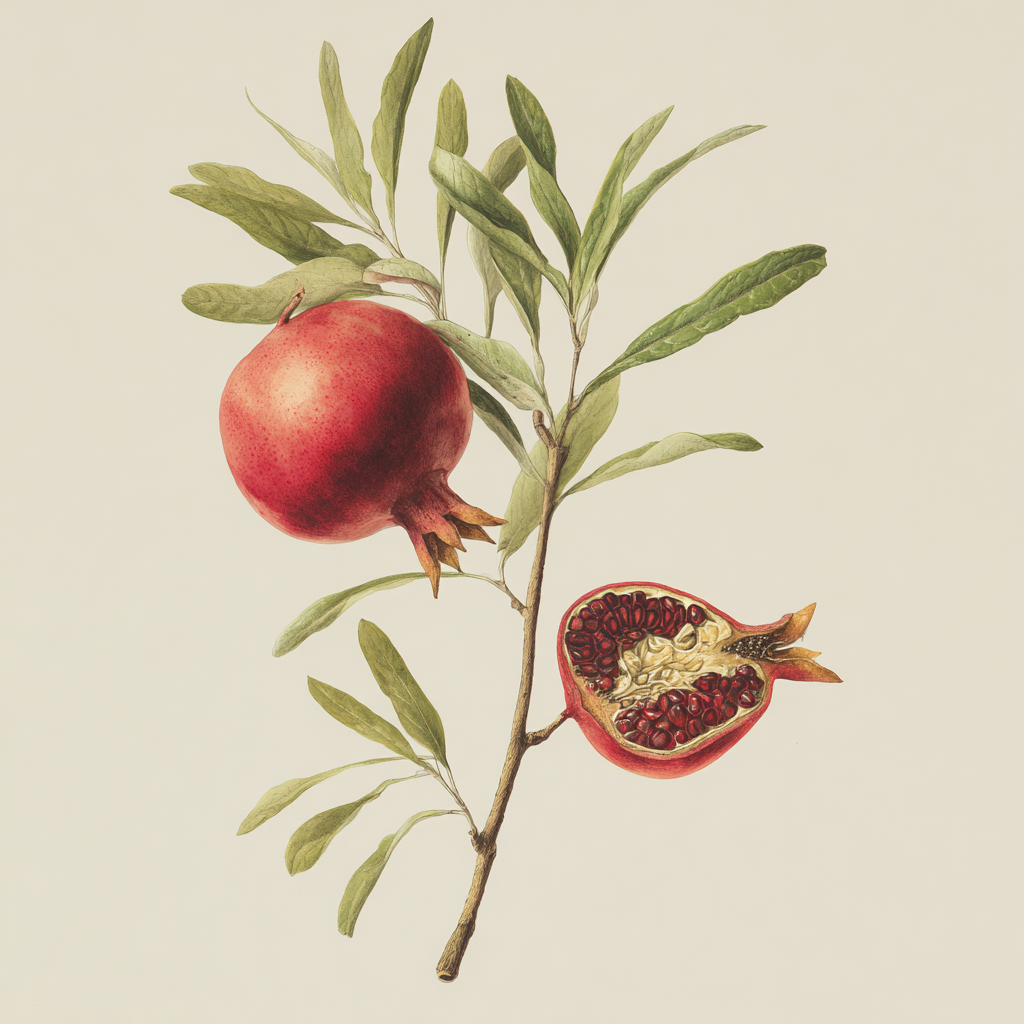
Round leathery fruit with a persistent crown-like calyx and many juicy arils around seeds. Rind color ranges from yellow-red to deep crimson.
Known Varieties
Common cultivars worth knowing
- Best for: juice, general use
Wonderful
Best-known commercial pomegranate with large red fruit and tart-sweet arils.
- Best for: fresh eating
Parfianka
Highly rated variety with soft seeds and balanced sweet-tart flavor.
- Best for: early harvests
Angel Red
Early variety with soft seeds and bright red juice.
- Best for: fresh eating
Eversweet
Sweet low-acid pomegranate with lighter-colored arils.
- Best for: borderline zones
Salavatski
Cold-hardy selection with good performance in marginal climates.
Loading photo submission…