
Hazelnut
FruitCorylus avellana
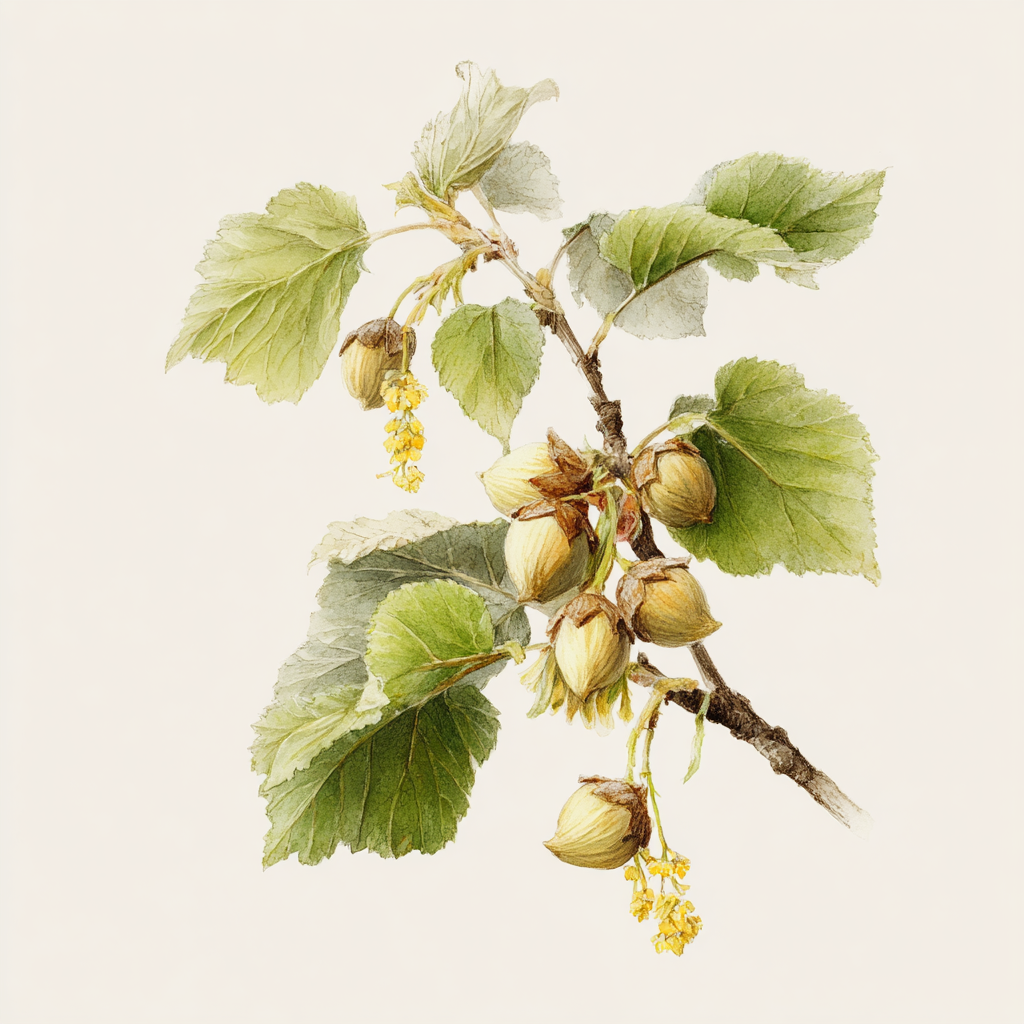
Have seeds for this? Add to inventory →Hazelnut is a multi-stemmed deciduous shrub native to Europe and western Asia, prized for its rich, oil-filled nuts and its role as an early-season pollen source for native bees. It produces distinctive catkins in late winter before the leaves emerge and ripens its papery-husked nuts in early autumn. In the home garden or food forest, hazelnut functions as a productive understory shrub and deep-rooted soil builder, adding organic matter while feeding people and wildlife.
Growing Conditions
Growing Conditions
Sunlight
Full Sun to Partial Shade
Water Needs
Moderate
Soil
Well-draining, fertile soil; pH 5.5–7.0
Spacing
10–15 feet
Days to Maturity
3–5 years to first significant harvest
Growing Zones
Growing Zones
Thrives in USDA Zones 4 - 9
When to Plant
When to Plant
Transplant
Plant bare-root or container stock in early spring or autumn while dormant
Harvest
Nuts fall or are shaken from the shrub when husks turn brown, typically late summer to autumn
Phenology (Natural Timing Cues)
Transplant
Hazelnut is best planted as bare-root or container-grown nursery stock while fully dormant - either in early spring before bud swell or in autumn after leaf drop. Planting during dormancy minimizes transplant shock and allows roots to begin settling before the shrub demands water and nutrients for leaf-out. Spring planting in cold zones should happen as soon as soil is workable; planting into frozen or waterlogged ground delays establishment and invites root disease. Autumn planting in mild zones lets roots colonize the surrounding soil before winter, resulting in noticeably stronger growth the following season.
- Forsythia blooming or buds just beginning to swell signals the early spring planting window
- Soil is fully workable and no longer frozen or waterlogged
- Native catkins elongating on wild shrubs indicate the shrub is near or at bud break - plant before this stage for best dormant establishment
- In autumn, leaf drop is complete and overnight temperatures are consistently below 45°F
Start Dates (Your Location)
Average dates use your saved zone; readiness also checks your forecast when available.
Best Planting Window
Spring window
Early spring
Plant as soon as the soil is workable so roots establish before heat arrives.
Autumn window
Early autumn
Plant early enough for roots to grow before winter; avoid late planting into cold, wet soil.
Planting Method
Plant nursery-grown hazelnut stock or rooted cuttings. Seed-grown plants are slow, variable, and usually not the best way to establish a productive planting.
Critical Timing Note
Plant while dormant and before bud break so roots establish before leaves demand water.
Use the average timing, but check your local forecast before planting.
Typical Harvest Window
September to October
Organic Growing Tips
Organic Growing Tips
Plant two or more varieties for cross-pollination and better nut set.
Coppice old stems periodically to encourage vigorous new growth.
Mulch heavily around the base to suppress weeds and retain moisture.
Care Guidance
Optional seasonal guidance for what you can do, even when nothing is urgent.
Care Guidance
Watering
If the top 2 inches of soil feel dry, a deep watering at the base may help more than frequent light watering. In healthy soil, rain may cover much of what it needs.
Feeding
Extra feeding is rarely required if soil is healthy. If growth looks pale or slow, a light compost top-dressing is often enough before adding anything stronger.
Pruning
If pruning is needed, dormancy or the period just after harvest is often the simplest window. Dead, damaged, or crossing growth is usually the first place to start.
Seasonal care
In late fall, a light cleanup and fresh mulch can help if winter protection is useful in your climate. Leaving a little space around crowns and trunks often helps air move and keeps excess moisture from sitting there.
Known Varieties
Common cultivars worth knowing
Known Varieties
Jefferson
An Oregon State University release bred specifically for resistance to Eastern Filbert Blight, the most serious disease threat to hazelnuts in North America. Produces large, high-quality nuts on a vigorous shrub and is the leading commercial and home-garden variety for the Pacific Northwest.
Best for
Pacific Northwest gardens and any region where Eastern Filbert Blight is established
Wepster
Another OSU blight-resistant release with excellent nut flavor and reliable production; slightly earlier ripening than Jefferson and a good cross-pollinator when paired with it.
Best for
Cross-pollination partner for Jefferson in blight-endemic regions
Barcelona
The traditional commercial hazelnut of the Pacific Northwest, producing large, round nuts with excellent flavor; highly susceptible to Eastern Filbert Blight and best suited to gardens outside the blight range.
Best for
High nut quality where blight is not present
Corylus americana (American Hazelnut)
The native North American species, smaller-nutted than European selections but exceptionally cold-hardy and naturally resistant to Eastern Filbert Blight. Valuable for food forest plantings, restoration hedgerows, and gardens in zones 4–5 where European varieties struggle.
Best for
Cold-climate food forests, wildlife habitat, and blight-resistant hedgerows
Eta and Theta (hybrid)
OSU hybrid selections crossing Corylus avellana and Corylus cornuta for blight resistance combined with improved nut size over pure American hazelnut; suited to a wider geographic range than European-only selections.
Best for
Upper Midwest and cold-zone growers seeking blight resistance with larger nut size
Companion Planting
Companion Planting
Good companions
None noted
Support & insectary plants
Nearby plants that attract pollinators, beneficial insects, or improve soil health.
Avoid planting near
No known conflicts
Common Pests
Common Pests
- Eastern Filbert Blight
- Aphids
- Squirrels
- Filbert Weevil
All pest management in Garden uses safe, organic, non-toxic methods only. No synthetic pesticides, ever.
Simple Ways to Use
Simple Ways to Use
Start here if you're not sure how to use this crop in the kitchen.
Quick recipes you can make right away
Toasted Hazelnuts
Spread shelled hazelnuts on a tray and roast at 350°F for 10 to 15 minutes until they smell nutty and the skins begin to crack. Rub them in a towel while still warm to remove loose skins, then cool them before storing or eating.
Chopped Hazelnut Topping
Toast the nuts until fragrant, cool them completely, and chop them finely for oatmeal, salads, or baked fruit. Wait until the nuts are cool before chopping, because warm nuts crush into paste more easily.
Hazelnut Butter
Roast shelled nuts until fragrant, cool them slightly, and process them until they first turn crumbly and then smooth into a thick butter. Stop and scrape down the bowl as needed, and keep blending until the mixture loosens on its own instead of staying dry and sandy.
How to Preserve
How to Preserve
Use this section to store or process extra harvest before it spoils.
Practical methods for extra harvest
Dry and cure hazelnuts
Spread freshly harvested nuts in a single layer in a dry airy place for 2 to 4 weeks until the kernels feel firm and the shells sound dry instead of damp when shaken. Do not pile them deeply, because trapped moisture can lead to mold.
Freeze shelled nuts
Shell fully dry nuts, pack them into airtight freezer bags or jars, and freeze them to hold flavor longer. Let containers come to room temperature before opening so condensation does not settle on the nuts.
Roast and store kernels
Roast dry kernels at 350°F until fragrant, cool them completely, and store them in airtight jars in the refrigerator or freezer. Cool them fully before sealing, or leftover heat will create condensation in the container.
New to preserving food?
New to freezing? Read the freezing guide.New to dehydrating? Read the dehydrating guide.How to Store
How to Store
Simple storage tips
Dry harvested hazelnuts thoroughly before long storage, because even slightly damp nuts can mold inside the shell.
Store fully dry in-shell nuts in a cool, dry place with airflow, or shell them and refrigerate or freeze for the best flavor life.
Keep shelled kernels away from heat and light, because the oils turn rancid faster once the shell is gone.
Crack a sample nut before storing the whole batch and make sure the kernel tastes sweet and nutty, not bitter, stale, or rubbery.
Discard any nuts that smell musty, feel damp inside, or show mold on the shell or kernel.
How to Save Seed
How to Save Seed
Step-by-step seed saving
- 1
Hazelnuts grown from seed may not match the parent well, so seed is not the practical way to keep a named or especially productive hazelnut true.
- 2
If you want more of the same hazelnut, use layering, suckers, or nursery stock from that cultivar instead of planting nuts.
- 3
Save nuts for planting only if you want to breed or experiment, not if you want the same nut quality or growth habit back.
Native Range
Native Range
- Origin
- Corylus avellana is native to Europe and western Asia, with a natural range stretching from the British Isles and Scandinavia east through the Caucasus to northern Iran and Turkey.
- Native Habitat
- Wild hazelnut thrives at the edges of deciduous woodland, in scrubby hedgerows, and on the margins of river valleys, typically growing as an understory shrub in mixed oak and ash communities on moderately fertile, well-drained soils.
- Current Distribution
- Widely cultivated across temperate Europe, North America, Turkey, and New Zealand; naturalized in parts of the northeastern United States and Pacific Northwest. Turkey remains the world's largest commercial producer, supplying the majority of global hazelnut trade.
Taxonomy
Taxonomy
- Kingdom
- Plantae
- Family
- Birch family (Betulaceae)
- Genus
- Corylus
- Species
- Corylus avellana
Morphology
Morphology
Root System
Hazelnut develops a dense, fibrous surface root system that spreads widely beneath the drip line rather than driving a deep taproot; this means it competes strongly with nearby shallow-rooted plants and is sensitive to soil compaction and cultivation within its root zone. Suckers arise freely from the base and must be removed regularly unless layering propagation is intended.
Stem
The shrub produces multiple upright stems from a central stool, typically reaching 6–15 feet in height with an open, vase-like form. Stems carry distinctive smooth, glandular-hairy young bark that ages to gray-brown. Periodic coppicing - cutting stems close to the base in a rotation - stimulates vigorous regrowth and is the traditional management style for both nut production and structural wood harvest.
Leaves
Leaves are broadly rounded with a doubly serrated margin and a slightly rough texture, emerging after the catkins fade in spring. Yellowing or browning leaf edges in summer often indicate drought stress or potassium deficiency; powdery mildew can appear on leaves in humid, crowded conditions but rarely affects nut production significantly.
Flowers
Hazelnut is monoecious, carrying both sexes on the same plant but flowering in a dissociated sequence that largely prevents self-fertilization. Long, pendulous yellow male catkins open in late winter - often February or March in temperate zones - releasing wind-carried pollen. Female flowers are tiny, bright red, and spider-like, emerging from separate buds on the same stems days to weeks later. A second genetically distinct plant within roughly 50 feet is needed for reliable pollination and nut set.
Fruit
Each nut is enclosed in a leafy, involucre husk that turns from green to papery brown as the nut matures. Nuts are ready to harvest when the husk begins to loosen and the nuts fall naturally or release easily when the branches are shaken. Nuts left on the ground are quickly taken by squirrels and jays; spreading tarps or netting beneath the shrub at harvest time recovers the crop efficiently. Freshly harvested nuts should be cured in a single layer in a cool, airy location for 1–2 weeks before storage.
Natural History
Natural History
Corylus avellana has one of the longest relationships with human food culture in Europe. Hazelnut shells are among the most common botanical remains found at Mesolithic and Neolithic archaeological sites across Britain and northern Europe, where they appear in quantities suggesting deliberate harvesting and possibly managed coppice stands as early as 9,000 years ago. The genus name Corylus derives from the Greek korylos, meaning helmet, a reference to the leafy involucre - the papery husk - that partially encases each nut. Roman writers including Pliny the Elder described the hazel in cultivation, and it appears throughout Norse and Celtic tradition as a tree of wisdom and otherworldly knowledge, featuring prominently in Irish mythology as the nine sacred hazel trees overhanging the Well of Wisdom. In medieval Europe, hazelnut coppice was formally managed in rotation across large woodland estates; the flexible young poles were essential for wattle fencing, charcoal, and hurdle making, making the hazel simultaneously a food and structural resource. The shrub's botanical behavior matters deeply to growers: hazelnut is wind-pollinated, with male catkins opening in late winter weeks before the microscopic red female flowers appear on the same or a neighboring plant, requiring two genetically different individuals for reliable nut set. This unusual timing - flowering in February or March before any leaf emerges - makes hazelnut one of the earliest pollen sources of the year for queen bumblebees emerging from winter dormancy. The American hazelnut (Corylus americana) is a closely related native species valuable in North American food forest and restoration plantings, and breeders have crossed both species to develop blight-resistant hybrid varieties suited to the Pacific Northwest and upper Midwest.
Traditional Use
Traditional Use
Hazelnut has a long presence in European folk botanical traditions, with recorded uses spanning leaves, bark, and nuts. The plant appears in medieval herbal manuscripts and early modern European herbals primarily in the context of the nuts as a nourishing food, while leaves and bark were documented in folk practice across Britain, Germany, and Scandinavia. Hazelnut does not carry the weight of formal pharmacopoeia use, but it is well represented in ethnobotanical records as a household plant with practical non-food applications.
Parts Noted Historically
Medieval European herbal tradition, including Hildegard of Bingen's 12th-century Physica - nuts
Hildegard described hazelnuts as strengthening to the brain and noted their value as a substantial food for people engaged in physical labor; the nuts appear consistently in medieval European dietary texts as a rich, sustaining food rather than a botanical medicine.
British and German folk botanical records, 16th–19th century - leaves and bark
English and German herbalists including John Gerard in his 1597 Herball recorded hazel bark and leaves as astringent materials noted in folk practice; Gerard described the nuts as nourishing but also documented folk belief that the shells and husks had drawing and binding properties when applied externally.
Scandinavian and Celtic folk tradition - catkins and nuts
In Irish and Scandinavian folk tradition, the hazel was closely associated with wisdom and divination rather than medicine; hazel rods were used in dowsing and ritual contexts, and the nuts held symbolic status in mythology, placing the plant in a cultural rather than strictly medicinal frame.
Hazelnut is a major tree nut allergen; individuals with tree nut allergies may experience severe reactions. The pollen is also a well-documented cause of seasonal allergic rhinitis across Europe and North America. The nuts, leaves, and bark are not known to be toxic to humans in ordinary food quantities.
This information is provided for historical and educational purposes only and is not medical advice. Always consult a qualified healthcare professional before making decisions related to your health.
Related Articles
Related Articles
Loading photo submission…