
Cosmos
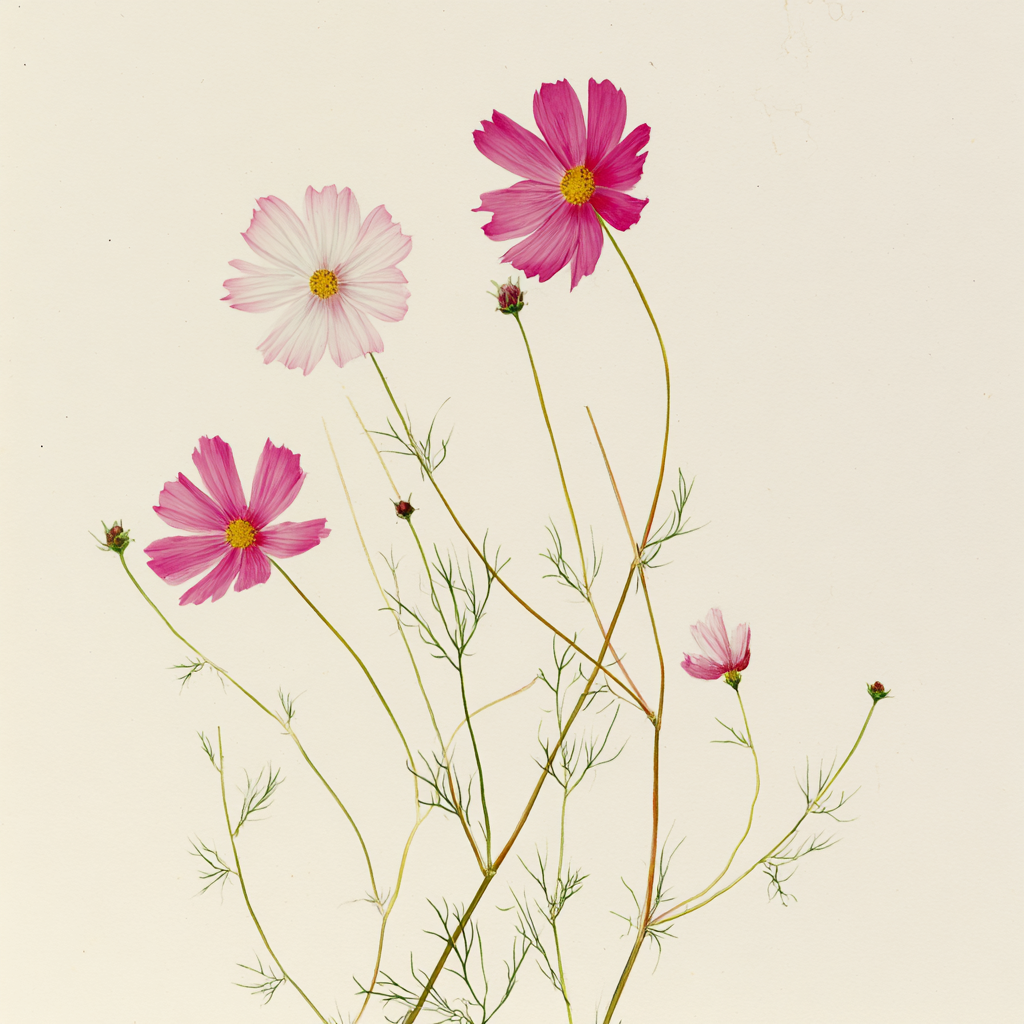
FlowerCosmos bipinnatus
Have seeds for this? Add to inventory →Cosmos are airy, fast-growing annuals with ferny foliage and jewel-toned flowers that bloom prolifically through summer and autumn. They are outstanding lacewing and parasitic wasp attractors and produce far more beneficial insect activity per square foot than most garden flowers.
Native Range
- Origin
- Garden cosmos is native to Mexico.
- Native Habitat
- Open meadows, grasslands, field edges, roadsides, and sunny disturbed soils.
- Current Distribution
- Widely cultivated in gardens worldwide; not native outside its region of origin.
Growing Conditions
Sunlight
Full Sun
Water Needs
Low
Soil
Well-draining loam; pH 6.0 - 8.0; thrives in poor to average soil
Spacing
12 - 24 inches
Days to Maturity
50 - 60 days from direct sow to flower
Growing Zones
Thrives in USDA Zones 3 - 11
Companion Planting
When to Plant
Direct Sow
After last frost; can direct sow in autumn in mild climates
Harvest
Cut stems frequently to extend flowering; self-seeds freely
Phenology (Natural Timing Cues)
Direct Sow
Direct sow cosmos after the last cold spell once soil is warming reliably. Cosmos grows fast enough from a post-frost direct sowing that indoor starts are rarely worthwhile.
- Lilacs are fading.
- Tender annual weeds are germinating and growing steadily.
- Night temperatures stay above 50°F.
Start Dates (Your Location)
Based on your saved growing zone and this plant's timing notes.
Typical Last Frost
Set your growing zone to see personalized calendar dates.
Organic Growing Tips
Sow in poor soil - rich soil produces enormous plants with few flowers.
Allow to self-seed freely around the garden; cosmos creates a self-sustaining beneficial insect habitat.
Let spent cosmos stalks and roots decompose in place over winter — their biomass feeds earthworms, their fine root channels improve soil structure, and self-sown seedlings reappear the following spring as established companions.
Cut regularly for bouquets - constant cutting stimulates more flower production through autumn.
Common Pests
All pest management in Garden uses safe, organic, non-toxic methods only. No synthetic pesticides, ever.
Taxonomy
- Kingdom
- Plantae
- Family
- Daisy family (Asteraceae)
- Genus
- Cosmos
- Species
- Cosmos bipinnatus
Natural History
Cosmos bipinnatus is native to Mexico and Guatemala, where wild species grow in high-altitude grasslands and disturbed volcanic soils of the Mexican highlands, typically above 1,500 meters. The genus name comes from the Greek word for order and harmony, applied by the Spanish botanist Antonio José Cavanilles when he formally described the plant in 1791 from specimens grown at the Royal Botanical Garden of Madrid - seeds had reached Spain from Mexico during the 18th century via the colonial plant exchange. The plant's tolerance for poor, dry soil reflects its origin in thin montane substrates where richer competitors cannot outpace it. Cosmos bipinnatus is unusual among annual ornamentals in flowering most prolifically when nitrogen is low - a well-documented horticultural fact explained by its evolution in lean highland soils where luxury nutrients were largely absent.
Traditional Use
Cosmos carries a history of botanic discovery, Spanish colonial plant exchange, and the rapid global spread of a flower from Mexican highland habitats to gardens on every continent - a journey completed within a century of its formal description.
Parts Noted Historically
Mexican Highland Origin - Flowers
Wild Cosmos species were part of the highland Mexican flora encountered by Spanish colonizers. The cultivated plant was formally documented and named by Cavanilles in 1791 at the Madrid Botanical Garden from seeds that had traveled the colonial plant exchange route from New Spain. Mexican folk names for wild Cosmos species were recorded by early naturalists, though the cultivated ornamental quickly diverged from any local plant knowledge once European breeders began selecting for larger, more varied flowers.
Victorian and Edwardian Ornamental Horticulture - Flowers
After Cavanilles' formal description, Cosmos spread rapidly through European ornamental gardening in the early 19th century. By the mid-Victorian period it was well established as a cutting and informal border flower. William Robinson's influential 1870 The Wild Garden promoted Cosmos as a model of naturalistic planting - easy to grow, self-sowing, and producing flowers without the labor of formal bedding schemes.
Beneficial Insect Habitat in Organic Gardening - Flowers
In the 20th-century organic gardening movement, Cosmos gained recognition as one of the most ecologically productive annual flowers available. Research documented its open disc flowers as accessible to small parasitic wasps and hoverflies whose larvae feed on aphids and caterpillar eggs. This ecological role gave it a second purpose beyond ornament in the design literature of regenerative and organic gardens from the 1970s onward.
This information is provided for historical and educational purposes only and is not medical advice. Always consult a qualified healthcare professional before making decisions related to your health.
Morphology (Plant Structure & Identification)
Root System
Fibrous annual roots that grow quickly in warm soil and tolerate lean conditions.
Stem
Tall slender branching stems that can become airy or floppy in rich soil.
Leaves
Finely divided, feathery foliage that gives plants a light, fern-like texture.
Flowers
Daisy-like composite heads with broad ray florets in pink, white, crimson, or bicolor shades around a yellow disk.
Fruit
Long narrow dark achenes that mature in dry spent flower heads and self-sow readily.
Known Varieties
Common cultivars worth knowing
- Best for: meadow-style plantings
Sensation
Tall classic mix with pink, rose, and white single flowers.
- Best for: containers and front beds
Sonata
Compact cosmos series with large flowers on shorter plants.
- Best for: novel flower form
Sea Shells
Tubular rolled petals in pink, white, and rose shades.
- Best for: cut flowers
Double Click
Semi-double to double blooms on tall cutting stems.
- Best for: small spaces
Xanthos
Compact pale yellow cosmos with softer color than most types.
- Best for: dramatic color
Rubenza
Deep ruby flowers aging to muted rose.
Loading photo submission…