Cilantro
HerbCoriandrum sativum
Have seeds for this? Add to inventory →Cilantro is a fast-cycling cool-season herb beloved in the kitchen and extraordinarily valuable in the garden for attracting beneficial insects. Its delicate white flowers draw hoverflies, parasitic wasps, and lacewings that prey on common garden pests.
Native Range
- Origin
- Coriander is an Old World annual herb associated with Mediterranean and western Asian native and early cultivated ranges.
- Native Habitat
- Open disturbed ground, field margins, dry slopes, and seasonally cool Mediterranean habitats.
- Current Distribution
- Widely cultivated in suitable growing regions worldwide; not native outside its region of origin.
Growing Conditions
Sunlight
Full Sun
Water Needs
Moderate
Soil
Well-draining loam; pH 6.2 - 6.8
Spacing
6 - 8 inches
Days to Maturity
21 - 28 days to first leaf harvest; 45 - 70 days to seed (coriander)
Growing Zones
Thrives in USDA Zones 3 - 10
Companion Planting
Keep Away From
When to Plant
Direct Sow
2 weeks before last frost; succession sow every 3 weeks
Harvest
Harvest leaves from 3 weeks; harvest seeds when they turn tan and start to drop
Phenology (Natural Timing Cues)
Direct Sow
Direct sow cilantro in cool windows - transplant stress and heat both trigger early bolting and shorten leaf harvest. Small successions every 2-3 weeks extend the season far better than one large sowing.
- Early dandelions are beginning to bloom (spring sowing).
- Soil is workable, cool, and evenly moist.
- Cool-season weeds are growing actively.
- Summer heat has eased and first cool nights have returned (fall sowing).
Start Dates (Your Location)
Based on your saved growing zone and this plant's timing notes.
Typical Last Frost
Set your growing zone to see personalized calendar dates.
Organic Growing Tips
Succession sow every 3 weeks to ensure continuous fresh leaf harvest, as plants bolt quickly.
Allow some plants to flower and set seed - the flowers attract lacewings and hoverflies to your plot.
Harvest seeds (coriander) when the plant turns brown and seeds rattle when shaken.
Sow into beds enriched with compost — cilantro grown in biologically active soil bolts later, tastes better, and benefits the soil biology with its fine root network as it decomposes between successions.
Common Pests
All pest management in Garden uses safe, organic, non-toxic methods only. No synthetic pesticides, ever.
Taxonomy
- Kingdom
- Plantae
- Family
- Carrot family (Apiaceae)
- Genus
- Coriandrum
- Species
- Coriandrum sativum
Natural History
Coriandrum sativum is among the oldest documented cultivated spice plants. Seeds identified as coriander have been recovered from Egyptian tombs dating to around 1000 BCE, and the plant is mentioned in the Ebers Papyrus of approximately 1550 BCE. It likely originated in the eastern Mediterranean or western Asia and spread early via trade routes into South Asia and China, where it is recorded in Han dynasty texts. The word coriander entered English through Latin coriandrum and before that Greek koriandron, with ancient sources noting the leaves' distinctive smell - some comparing it to bedbugs, a reference that may relate to the word's likely Greek derivation. The modern perception of cilantro's aroma as either fresh and citrusy or soapy and unpleasant is now understood to correlate with variation near the OR6A2 olfactory receptor gene, identified in genetic research published around 2012. Spanish colonization brought coriander to the Americas in the 16th century, where it merged into existing food cultures so thoroughly that cilantro leaf became synonymous with Mexican and Latin American cuisine within a few generations.
Traditional Use
Coriander has documentary evidence spanning more than 3,500 years and a culinary range that crosses more cultures than almost any other spice plant - from Egyptian tombs to Roman legions, Mughal spice markets, and Mexican street food stalls.
Parts Noted Historically
Ancient Egyptian and Classical Antiquity - Seeds
Coriander seeds were placed in Egyptian tombs, listed in the Ebers Papyrus, and described by Dioscorides in his De Materia Medica as useful in cooling preparations. Roman cookbooks - particularly Apicius - incorporated coriander seed widely, and it was among the spices Roman soldiers carried to season food and preserve wine on campaign.
South Asian Spice Tradition - Seeds and leaves
Coriander appears in ancient Ayurvedic texts as both a cooking spice and a cooling digestive. In Indian cuisine, ground coriander seed became one of the foundational spices of dal, curry pastes, and spice blends. The fresh leaf, called dhania, functions separately as a garnish herb across South and Southeast Asian cooking - botanically the same plant used in entirely different ways.
Mughal Court Cuisine - Seeds
Ground and whole coriander seeds formed part of the complex spice blends documented in Mughal court cooking of the 16th and 17th centuries. The Ain-i-Akbari, the administrative record of Akbar's court compiled in the 1590s, documented spice use in imperial kitchens, placing coriander among the regular culinary staples alongside cumin and turmeric.
Mexican and Latin American Cuisines - Leaves
Spanish colonization introduced both coriander seed and cilantro leaf to the Americas in the 16th century, where the fresh leaf was absorbed into Mesoamerican food culture with remarkable speed. By the 18th century, cilantro was thoroughly integrated into Mexican salsas, soups, and market cooking. In modern Mexico, per-capita cilantro consumption is among the highest in the world for any herb.
Cilantro's divergent taste perception - fresh and citrusy to most people, soapy to others - reflects genetic variation near the OR6A2 olfactory receptor gene and is not an allergy or sensitivity.
This information is provided for historical and educational purposes only and is not medical advice. Always consult a qualified healthcare professional before making decisions related to your health.
Morphology (Plant Structure & Identification)
Root System
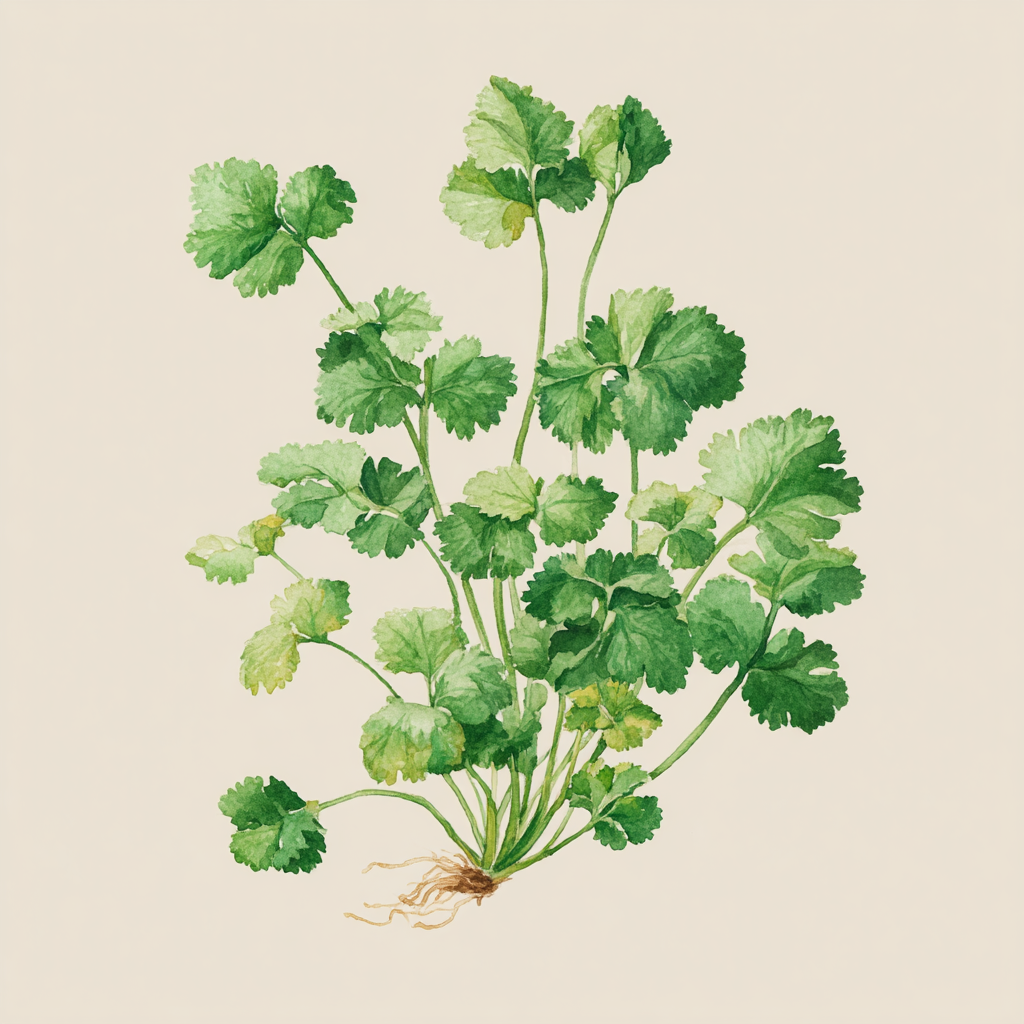
Slender taproot that dislikes disturbance. Direct-sown plants usually grow more steadily and bolt less abruptly than transplanted ones.
Stem
Soft branching stems form a leafy rosette first, then elongate into airy flowering stems as plants bolt.
Leaves
Lower leaves are broad, lobed, and cilantro-like; upper leaves become finer and more feathery before flowering. Leaves have a distinctive fresh citrusy aroma to some people.
Flowers
Small white to pale pink flowers in flat umbels attract hoverflies, parasitic wasps, and other beneficial insects.
Fruit
Round tan seeds form after flowering and are harvested as coriander. Seeds split into two halves when crushed.
Known Varieties
Common cultivars worth knowing
- Best for: fresh leaves
Santo
Widely grown cilantro selected for leaf production and slower bolting.
- Best for: cut-and-come-again
Calypso
Slow-bolting variety with dense regrowth after cutting.
- Best for: successions
Leisure
Reliable garden cilantro with good leaf yields.
- Best for: containers, garnishes
Delfino
Fine fern-like leaves with cilantro flavor and ornamental texture.
- Best for: seed harvest
Moroccan Coriander
Type often grown for seed production with strong coriander aroma.
Loading photo submission…