Tarragon
HerbArtemisia dracunculus
Have seeds for this? Add to inventory →French tarragon is a refined perennial herb with a distinctive anise-pepper flavour prized in classic cooking. It grows slowly but is long-lived, and its aromatic foliage deters pests from neighbouring vegetables.
Native Range
- Origin
- Wild Artemisia dracunculus originates across western and central North America, extending from the Canadian prairies south through the western United States, with related populations throughout temperate Eurasia.
- Native Habitat
- Native to open dry to mesic grasslands, prairie edges, steppe environments, riparian terraces, rocky slopes, and well-drained open ground where it forms scattered colonies through rhizomatous spread.
- Current Distribution
- Wild native populations persist across western and central North America and Eurasia, while the sterile French culinary form is cultivated in gardens and herb farms worldwide, maintained entirely through vegetative propagation.
Growing Conditions
Sunlight
Full Sun
Water Needs
Low
Soil
Well-draining, lean loam; pH 6.0 - 7.3
Spacing
18 - 24 inches
Days to Maturity
Harvest lightly from year 1; French tarragon does not produce viable seed - propagate by division
Growing Zones
Thrives in USDA Zones 4 - 10
Companion Planting
Good Companions
Keep Away From
No known antagonists
When to Plant
Transplant
Spring from divisions or purchased plants; do not start from seed (Russian tarragon)
Harvest
Harvest tips of young growth; strongest flavour before flowering
Phenology (Natural Timing Cues)
Transplant
French tarragon is propagated only from divisions or cuttings - not from seed, which produces the inferior Russian form - and divisions establish best in the early spring window when the crown is just resuming growth. The root system is shallow and woody, making it susceptible to the same cold, wet conditions that affect other Mediterranean herbs, but the early spring window before full warmth arrives is actually ideal: divisions face minimal competition from drought or heat while roots spread into cool, moist soil. In hot climates, planting before summer heat settles is important because unrooted divisions struggle once soil temperature rises and drying becomes a factor. Division is also the method for rejuvenating plants that have become woody and sparse at the centre, typically every 3 - 4 years.
- Forsythia is beginning to bloom.
- Soil is workable and drains cleanly - not cold and saturated.
- Tarragon shoots or nearby perennial herb crowns are just breaking dormancy.
- Nights are still cool but no longer regularly freezing.
Start Dates (Your Location)
Based on your saved growing zone and this plant's timing notes.
Best Planting Window
Spring window
Spring
Plant early enough for roots to settle before summer heat.
Autumn window
Usually skip autumn planting
Use spring unless you have locally grown nursery stock and enough mild weather for roots to establish.
Planting Method
Plant divisions from a healthy parent plant. Divisions preserve the established plant’s traits better than seed.
Critical Timing Note
Keep divisions watered through establishment and protect them from harsh sun until new growth resumes.
Organic Growing Tips
Only grow French tarragon (not Russian) for culinary use - Russian tarragon has no real flavour.
French tarragon must be propagated by division or cuttings, never from seed.
Plant near eggplant and peppers to deter pests with its aromatic essential oils.
Cut back to a few inches in autumn; mulch lightly to protect roots through winter.
Common Pests
All pest management in Garden uses safe, organic, non-toxic methods only. No synthetic pesticides, ever.
Taxonomy
- Kingdom
- Plantae
- Family
- Daisy family (Asteraceae)
- Genus
- Artemisia
- Species
- Artemisia dracunculus
Natural History
French tarragon (Artemisia dracunculus var. sativa) is a sterile cultivar that cannot set seed and must be propagated by division or cuttings - a botanical peculiarity that means every French tarragon plant in cultivation is a clone descended from a single original selection whose exact origin is unknown. The species epithet dracunculus means "little dragon" in Latin, explained variously by the shape of the tangled roots (resembling a dragon or serpent) and by the plant's folk use in treating snake and scorpion bites - a connection that runs through medieval European herbalism and the Doctrine of Signatures. The genus Artemisia was named for Artemisia, queen of Halicarnassus in ancient Caria (modern southwestern Turkey), a botanist and physician said to have used plants of this genus medicinally in the 4th century BCE - though the genus is also strongly associated with the goddess Artemis and lunar herb traditions. Artemisia dracunculus is native across a broad range from Siberia and Central Asia to northern Mexico, and the seed-bearing Russian form grows wild across this entire territory. The cultivated sterile French form is believed to have been introduced to France via Arab botanical trade during the medieval period, possibly arriving with returning Crusaders in the 12th-13th centuries. Tarragon appears in French culinary writing by the 16th century, and by the 17th century it was established as one of the canonical fines herbes (alongside chervil, chives, and parsley) of classic French cuisine. Auguste Escoffier's late 19th-century codification of French haute cuisine gave tarragon a specific and prominent role - béarnaise sauce, sauce à l'estragon, poulet à l'estragon - that it has not lost.
Traditional Use
Tarragon carries the double distinction of being a sterile plant whose entire cultivated lineage is a single ancient clone, and a member of the Artemisia genus that also includes absinthe and artemisinin - two of the most historically significant plant compounds in Western and Chinese medicine respectively.
Parts Noted Historically
Little Dragon Etymology and Folk Beliefs - Leaves and roots
The dracunculus name generated a persistent folk medicine association: the plant was used in medieval European traditions for snake bites, scorpion stings, and "biting" ailments on the logic that a dragon plant would counter serpent poison. This Doctrine of Signatures thinking appears in Arabic medical texts that reached Europe through the medieval translation movement in Toledo and Palermo. Ibn Sina (Avicenna) mentioned estragon in his Canon of Medicine (1025 CE) under its Arabic name tarhun, describing it as a digestive and noting its flavour-enhancement role in food rather than emphasising the dragon-bite uses that European herbals later emphasised.
The Artemisia Genus in History - Leaves
Tarragon's genus Artemisia connects it to two of the most significant medicinal plants in history. Artemisia absinthium (wormwood) was the key flavoring in absinthe, the alcoholic beverage blamed for madness among 19th-century European artists - later shown to result from alcohol content rather than the thujone in wormwood, but generating a decades-long controversy about plant-derived psychoactivity. Artemisia annua (sweet wormwood) contains artemisinin, now the world's most important antimalarial drug, for the discovery of which Tu Youyou won the Nobel Prize in Medicine in 2015. Tarragon itself contains little thujone compared to wormwood and has no significant psychoactive or antimalarial properties, but it shares the Artemisia family history.
Arab Introduction and Medieval France - Leaves
The most likely route for French tarragon's arrival in France runs through the Arab botanical transmission of the 9th-13th centuries that brought many Eastern Mediterranean and Central Asian plants into European cultivation via Spain and Sicily. The Arab name tarhun is closer to the French estragon than any Latin form, suggesting the word arrived with the plant via Arabic. Whether the specific sterile French cultivar was selected in the Arab world, brought by Crusaders, or developed later by French gardeners is unknown - the absence of a seed-bearing form means there is no wild population to trace genetically.
Fines Herbes and Escoffier's French Cuisine - Leaves
French tarragon became embedded in classical French cooking between the 16th and 19th centuries, reaching its canonical form in Auguste Escoffier's Le Guide Culinaire (1903). Escoffier elevated béarnaise sauce - a reduction of white wine, tarragon vinegar, shallots, and fresh tarragon, mounted with egg yolks and butter - to the status of one of the great French sauces. Tarragon is also essential to sauce verte, sauce gribiche, and the classic chicken preparation poulet à l'estragon. The French emphasis on freshness reflects the fact that dried tarragon loses most of its distinctive estragole-rich aroma, and that the frozen and dried versions sold commercially bear little resemblance to fresh leaves harvested from a properly grown French tarragon plant.
Culinary tarragon leaves are safe for normal cooking use. Estragole, the primary flavour compound in French tarragon, is present in several common herbs and has been studied as a potential carcinogen at very high doses, but culinary-level exposure through normal cooking is not considered a risk.
This information is provided for historical and educational purposes only and is not medical advice. Always consult a qualified healthcare professional before making decisions related to your health.
Morphology (Plant Structure & Identification)
Root System
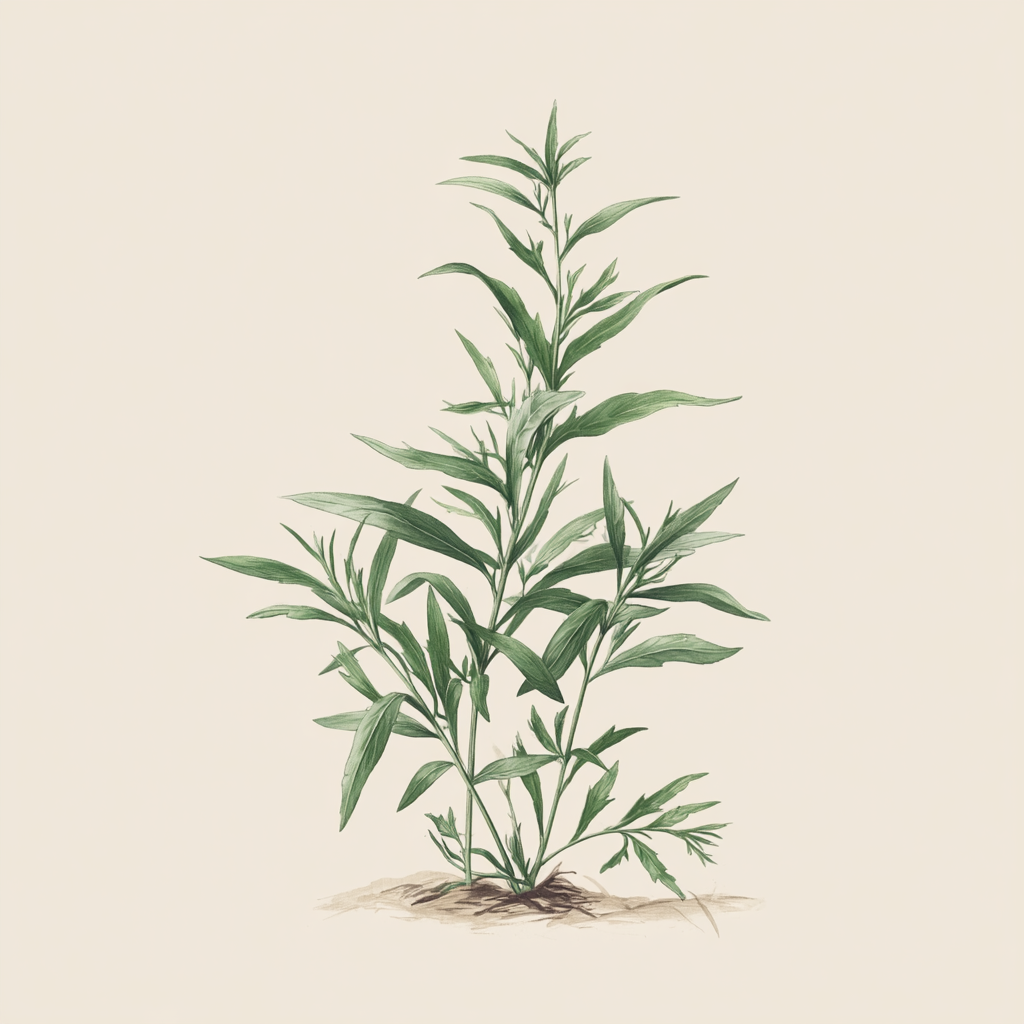
Fibrous perennial roots and short rhizomes form slowly expanding clumps. Divisions establish best in well-drained soil.
Stem
Slender upright to arching stems that become lightly woody near the base with age. Plants can flop if overfed or shaded.
Leaves
Narrow smooth green leaves with a clear anise-like aroma when crushed. French tarragon leaves are more aromatic than Russian tarragon.
Flowers
Small greenish to yellowish flower heads may appear, but French tarragon rarely produces viable seed.
Fruit
Viable seed is not expected from true French tarragon. Propagation is by division or cuttings to preserve flavor.
Known Varieties
Common cultivars worth knowing
- Best for: cooking
French Tarragon
Sterile culinary form with the strongest classic tarragon flavor.
- Best for: ornamental or pollinator use, not fine cooking
Russian Tarragon
Seed-grown type with vigorous growth but weak flavor.
- Best for: hot climates, tarragon substitute
Mexican Tarragon
Tagetes lucida, a different plant with anise-like flavor and yellow flowers.
- Best for: culinary herb beds
French Improved
Nursery selection of French tarragon chosen for strong leaf aroma.
Loading photo submission…