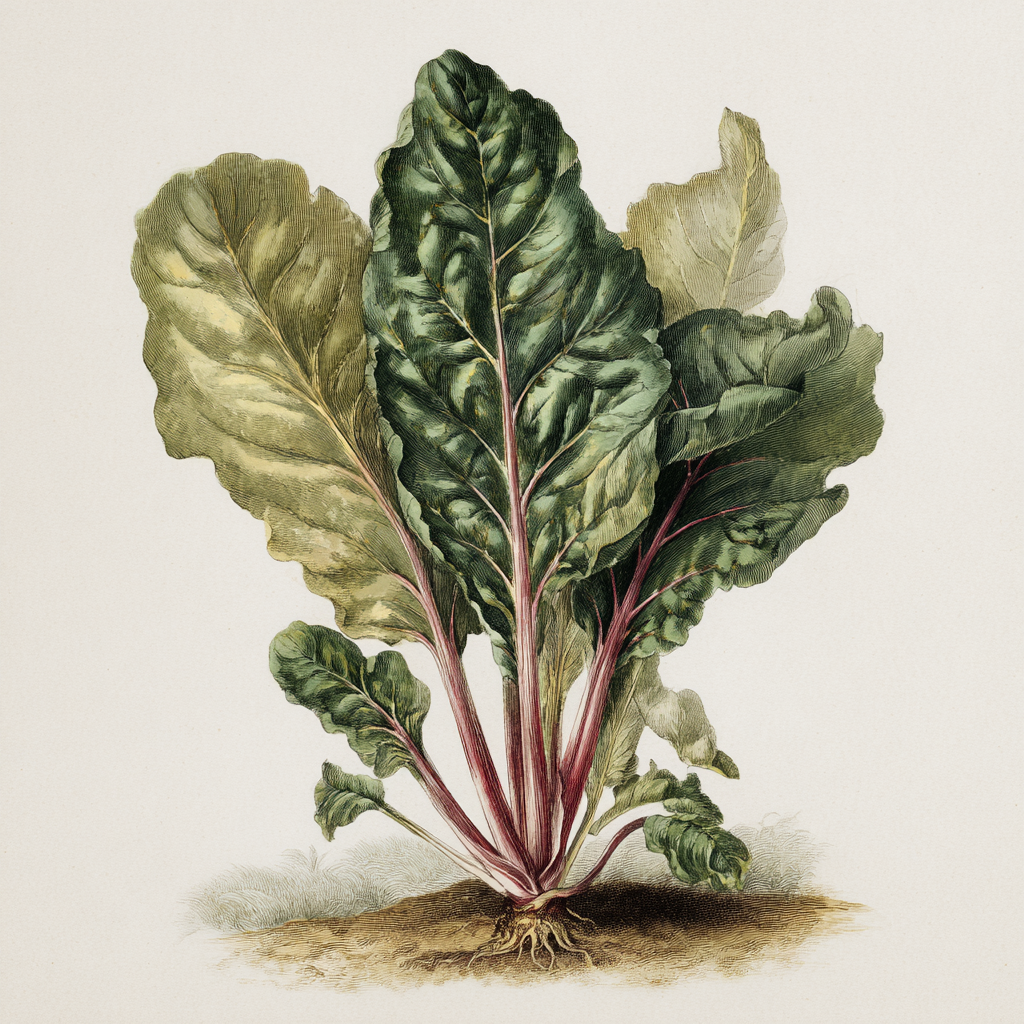
Swiss Chard
VegetableBeta vulgaris var. cicla
Have seeds for this? Add to inventory →Swiss chard is a versatile, heat-tolerant leafy green that bridges the gap between cool-season and warm-season gardening. Its brilliantly coloured stems add ornamental value to kitchen gardens while providing nutritious harvests.
Native Range
- Origin
- Beet and chard descend from Beta vulgaris, whose wild sea beet relatives are native around Mediterranean, Atlantic European, and western Asian coasts.
- Native Habitat
- Wild beet grows on coastal shingle, salt-influenced margins, cliffs, and disturbed maritime soils.
- Current Distribution
- Cultivated globally; does not occur as a native plant in this form.
Growing Conditions
Sunlight
Full Sun
Water Needs
Moderate
Soil
Rich, well-draining loam; pH 6.0 - 7.0
Spacing
6 - 12 inches
Days to Maturity
50 - 60 days from sowing
Growing Zones
Thrives in USDA Zones 3 - 11
Companion Planting
When to Plant
Direct Sow
2 - 4 weeks before last frost
Harvest
Cut outer leaves from 30 days; plant continues producing through season
Phenology (Natural Timing Cues)
Direct Sow
Swiss chard occupies a useful niche as a leafy green that bridges the gap between cool-season and warm-season crops - it is more heat-tolerant than spinach or lettuce, but it still establishes best in cool to mild weather rather than midsummer heat. Unlike spinach, chard does not bolt easily in long days (it is a biennial that only bolts in its second year), so heat reduces leaf quality rather than ending the plant suddenly. This means timing is less critical than for spinach, but the harvest quality is clearly better from plants that experienced at least some cool weather during establishment. A late-summer sowing that hits its stride during cooler autumn weather typically produces the crispest, most flavourful leaves of the season.
- Dandelions are blooming and soil is workable.
- Cool-season greens like spinach and lettuce are growing steadily.
- Soil temperature is between 50 - 85°F.
- For late-summer sowing: summer heat is beginning to ease and first cool nights are returning.
Start Dates (Your Location)
Based on your saved growing zone and this plant's timing notes.
Typical Last Frost
Set your growing zone to see personalized calendar dates.
Organic Growing Tips
Harvest outer leaves regularly to encourage fresh, tender new growth from the centre.
Apply neem oil at dusk at the first sign of leaf miner tunnelling to interrupt the pest cycle — applying after pollinators have finished foraging avoids harming them.
Mulch around plants to suppress weeds and keep slugs away from tender leaf bases.
Chard tolerates more heat than spinach - plant it as a summer substitute when spinach bolts.
Common Pests
All pest management in Garden uses safe, organic, non-toxic methods only. No synthetic pesticides, ever.
Taxonomy
- Kingdom
- Plantae
- Family
- Amaranth family (Amaranthaceae)
- Genus
- Beta
- Species
- Beta vulgaris var. cicla
Natural History
Swiss chard (Beta vulgaris var. cicla) is a leaf beet - selected over centuries for large leaves and thick coloured stalks rather than a swollen root. The entire Beta vulgaris species originated around the Mediterranean coastlands, where the wild ancestor, sea beet (Beta vulgaris subsp. maritima), grows in coastal saltmarshes and cliffs from the Canary Islands to the Caspian Sea. Sea beet has been gathered and eaten for thousands of years, and it is the common ancestor of chard, garden beet, sugar beet, and mangel-wurzel. The name "Swiss chard" is genuinely puzzling: the plant has no particular Swiss origin. Various theories have been proposed - that 19th-century English seed catalogues used "Swiss" to distinguish it from French varieties, that a Swiss botanist (possibly Koch) described it prominently in a reference work, or simply that the label was a marketing convention. French cooks call it blette or bette; Italians call it bietola; and in Britain it was long known simply as "seakale beet" or "silver beet." John Parkinson described coloured-stem beet forms in Theatrum Botanicum (1640), and by the Victorian period chard was established in British kitchen gardens as a valued summer green. The Bright Lights variety - a mix of yellow, orange, pink, red, and white-stemmed plants - was introduced by Johnny's Selected Seeds and won an All-America Selections award in 1998, introducing a generation of gardeners to chard's ornamental possibilities alongside its productivity.
Traditional Use
Swiss chard's history is inseparable from the broader Beta vulgaris story - the same species that gave the world beet root, sugar beet, and mangel-wurzel, all selected from the same wild sea beet ancestor along the Mediterranean coast.
Parts Noted Historically
Sea Beet and Mediterranean Origins - Leaves
Wild sea beet grows along Mediterranean and Atlantic coastlines and is still found on British seashores today. It was gathered as a coastal food plant long before agriculture, and its leaves are edible raw or cooked. The transition from wild coastal gathering to cultivated garden plant happened gradually across multiple Beta vulgaris subspecies. Classical Greek and Roman writers describe beet-family plants under various names, and the distinction between leaf forms, root forms, and wild forms was not always clearly drawn in ancient texts.
Greek and Roman Cultivation - Leaves and stems
The Greek writer Athenaeus, in Deipnosophistae (early 3rd century CE), mentioned beet as a table vegetable, and the Roman agricultural writer Columella described cultivation of beet greens in the 1st century CE. Pliny the Elder discussed several beet forms in Naturalis Historia, distinguishing white and dark varieties. In Roman cooking, beet greens were dressed with garum (fish sauce) and oil - a preparation not entirely unlike modern Italian bietola aglio e olio. Leaf beet forms were likely the primary cultivated form for much of classical antiquity, with swollen root beets coming to prominence later through continued selection.
The Swiss Naming Puzzle and Parkinson's Record - Leaves and stalks
John Parkinson's Theatrum Botanicum of 1640 described beet forms with coloured stems as a recognized category of kitchen garden plant. By this period, selection had clearly produced both white-stemmed and red-stemmed varieties alongside the root beet. The "Swiss" label appears to have entered English usage in the 19th century, possibly through seed trade convention or through the wide distribution of a Swiss botanical reference. Whatever its origin, the name stuck while the French bette and Italian bietola better reflect the plant's actual cultural homes.
Victorian Kitchen Garden and Modern Ornamental Use - Leaves and stalks
Swiss chard became a valuable Victorian kitchen garden crop precisely because it fills the gap between the cool-season crops that bolt in summer and the heat-loving crops that are not yet producing - a role spinach cannot fill once temperatures rise. Garden writers of the 19th century, including Shirley Hibberd in Profitable Gardening (1863), described chard as an underappreciated kitchen standby. The development of highly coloured stem varieties in the 20th century, culminating in seed mixes like Bright Lights and Rainbow, gave chard a second life as an ornamental edible and kitchen garden showpiece.
This information is provided for historical and educational purposes only and is not medical advice. Always consult a qualified healthcare professional before making decisions related to your health.
Morphology (Plant Structure & Identification)
Root System
Fibrous roots with a modest taproot, less swollen than beet. Plants regrow well when outer leaves are harvested without damaging the crown.
Stem
No tall edible stem during the leafy stage; thick petioles form the colorful stalks gardeners harvest with the leaves.
Leaves
Large glossy leaves with crumpled texture and prominent veins. Stalk colors range from white to yellow, orange, pink, and red depending on variety.
Flowers
Second-year plants produce tall branching seed stalks with small greenish flowers. Bolting ends the best leaf harvest period.
Fruit
Produces clustered beet-like seed structures. The harvested crop is the leaf blade and thick petiole rather than a fleshy fruit.
Known Varieties
Common cultivars worth knowing
- Best for: ornamental edible beds
Bright Lights
Mix of colorful stems in yellow, pink, orange, red, and white.
- Best for: cooking greens
Fordhook Giant
Large white-stemmed chard with heavy yields and broad leaves.
- Best for: visual interest
Ruby Red
Red-stemmed variety with dark green leaves and strong color contrast.
- Best for: edible landscaping
Peppermint
Striped pink-and-white stems with attractive leaves.
- Best for: spinach substitute
Perpetual Spinach
Leaf beet with thinner stems and spinach-like leaves.
Related Articles
Loading photo submission…