Pear
FruitPyrus communis
Have seeds for this? Add to inventory →Pear trees are long-lived, productive fruit trees that ripen fruit off the tree. They need cross-pollination with a compatible variety and are somewhat more cold-tolerant and disease-resistant than apples when properly sited.
Native Range
- Origin
- European pear is a cultivated complex associated with wild Pyrus lineages of eastern Europe, western Asia, and the Caucasus.
- Native Habitat
- Open woods, scrub, woodland margins, rocky slopes, and foothill habitats.
- Current Distribution
- Cultivated globally; does not occur as a native plant in this form.
Growing Conditions
Sunlight
Full Sun
Water Needs
Moderate
Soil
Deep, well-draining, fertile loam; pH 6.0 - 7.0
Spacing
15 - 20 feet (standard); 10 - 15 feet (semi-dwarf)
Days to Maturity
3 - 5 years to first significant harvest
Growing Zones
Thrives in USDA Zones 4 - 9
Companion Planting
When to Plant
Transplant
Bare-root trees in late autumn to early spring while dormant
Harvest
Harvest before fully ripe and ripen indoors; ripe pears bruise easily
Phenology (Natural Timing Cues)
Transplant
Pear trees establish best from dormant bare-root stock planted while the tree is still fully dormant or only just beginning to break. Roots spread most efficiently when soil temperature is rising but canopy demand is still low - the window from forsythia bloom to pear bud break is the target. Trees planted after leaves have emerged face a canopy that is actively transpiring while roots have not yet spread into surrounding soil, leading to drought stress that slows establishment. At the other end, trees planted into waterlogged or still-frozen soil will sit without rooting until conditions improve, and the root ball can begin to deteriorate in the meantime. Planning pollination partners before planting is essential because many pear varieties need a compatible second variety within range - an important constraint that cannot be corrected later without major replanting.
- Forsythia is beginning to bloom or early dandelions are just opening.
- Pear buds are swelling but have not yet opened into leaf or flower.
- Soil is workable and draining cleanly - not sticky or waterlogged.
- Hard freezes are becoming infrequent, though light frost may still occur.
- For autumn planting: deciduous trees have dropped most of their leaves.
Start Dates (Your Location)
Based on your saved growing zone and this plant's timing notes.
Best Planting Window
Spring window
Late winter to early spring
Plant while dormant, before buds break and before active top growth begins.
Autumn window
Late autumn after leaf drop
Plant while dormant, after leaves have dropped and before the ground freezes.
Planting Method
Plant a grafted bare-root nursery tree. Seed-grown fruit trees are not true-to-type, so nursery stock is the reliable path to known fruit quality.
Critical Timing Note
Plant while dormant and before bud break so roots establish before leaves demand water.
Typical Harvest Window
August to September
Organic Growing Tips
Harvest pears slightly underripe and ripen at room temperature - tree-ripened pears go mushy at the core.
Apply compost tea as a foliar spray to improve disease resistance against fire blight and scab.
Encourage parasitic wasps with umbel-flowering companions like yarrow and calendula.
Prune to an open vase shape for airflow and spray kaolin clay as a pest barrier in spring.
Common Pests
- Pear Psylla
- Codling Moth
- Fire Blight
- Pear Scab
- Aphids
All pest management in Garden uses safe, organic, non-toxic methods only. No synthetic pesticides, ever.
Taxonomy
- Kingdom
- Plantae
- Family
- Rose family (Rosaceae)
- Genus
- Pyrus
- Species
- Pyrus communis
Natural History
Pear appears in Homer's Odyssey, written around 800 BCE, as one of the fruits in the garden of the Phaeacian king Alcinous - making it one of the oldest orchard trees named in Western literature. Theophrastus, the Greek botanist writing in the 4th century BCE, distinguished cultivated pears from wild, and by the time Pliny the Elder wrote his Naturalis Historia in 77 CE he could list 41 named pear varieties under cultivation in Roman orchards. Roman colonists carried pear cultivation throughout Europe, and monastic orchards during the medieval period preserved and continued selecting from these Roman varieties. The unusual ripening characteristic of most European pears - they must be harvested firm and ripened off the tree, or they go mealy from the inside out - has shaped cultivation practice for millennia and generated a substantial culture of storage and timing knowledge. The gritty texture found in some varieties comes from sclereids, also called stone cells, clusters of hardened cells distributed unevenly through the flesh; modern breeding has progressively reduced stone cell content in dessert varieties. Perry - the fermented drink made from specific perry pear varieties - has its own geography concentrated in Herefordshire, Gloucestershire, and the Welsh Marches in England, and in Normandy in France. Perry pear varieties like the Blakeney Red, Barland, and Thorn are distinct from dessert pears: highly tannic, astringent, and mostly unpleasant to eat raw, but capable of producing complex fermented drinks when properly handled. Some perry pear trees in the Welsh Marches are documented as more than 200 years old and still productive - making them among the longest-lived fruit trees in cultivation.
Traditional Use
Pear carries over three thousand years of orchard history in Western culture, and its story runs through Homer's Greece, Pliny's Rome, the monastery orchards of medieval Europe, and the cider-making traditions of the Welsh Marches and Normandy.
Parts Noted Historically
Homer and Classical Cultivation - Fruit
The garden of Alcinous described in Homer's Odyssey (around 800 BCE) lists pears alongside figs, olives, and pomegranates - one of the earliest literary references to a cultivated orchard in Western literature. By the time Theophrastus wrote Historia Plantarum in the 4th century BCE, he was already distinguishing numerous cultivated pear types from wild, and Roman horticultural writers expanded on this significantly. Pliny the Elder's list of 41 named pear varieties in 77 CE reflects centuries of Roman selection for size, flavour, ripening time, and storage quality. Roman orchardists also noted the importance of harvesting pears before full ripeness and ripening them in cool storage - an insight that anticipates the modern ethylene-management practices of commercial fruit handling by two thousand years.
Medieval Monastic Orchard Selection - Fruit
When Roman orchard culture was absorbed into monastic agriculture during the early medieval period, pear trees came with it. Monastery orchards across France, Germany, and Britain maintained and selected pear varieties through the period when classical texts were largely lost to broader European culture. The Williams Bon Chrétien pear - known in North America as Bartlett after Enoch Bartlett who distributed it there in the early 19th century - originated in England, possibly as early as the 1760s, from a source that may have been a much older monastic or cottage garden tree. The Comice and Bosc varieties emerged from 19th-century French and Belgian horticultural breeding programs that were themselves building on centuries of monastery and estate orchard practice.
Perry and the Welsh Marches Tradition - Fruit
Perry - fermented pear cider - has been made in Herefordshire, Gloucestershire, and the Welsh Marches since at least the Roman period, and probably before. The specific perry pear varieties of this region - Blakeney Red, Barland, Thorn, Merrylegs, and dozens of others - are distinct cultivars selected over centuries specifically for fermentation qualities rather than eating. They are intensely tannic and astringent raw, but convert to complex, sometimes sparkling drinks when fermented by skilled makers. Some individual perry pear trees in this region are recorded as exceeding 200 years of age and producing fruit continuously, making them among the oldest productive fruit trees in Britain. Normandy has a parallel perry and cider tradition using different varieties developed under different climatic conditions.
Harvest Timing Culture - Fruit
Pear cultivation generated a distinct knowledge culture around harvest timing because of the fruit's unusual ripening physiology. Unlike apples, which can be left to ripen fully on the tree, most European pear varieties develop a mealy, gritty core if tree-ripened - a process caused by the breakdown of stone cells under excess ethylene as the fruit matures fully on the branch. Experienced orchard workers learned to harvest pears at the correct stage of firmness and to finish ripening them at specific temperatures - cool storage for long-keeping varieties like Comice and Bosc, room temperature for quick-ripening varieties like Bartlett. This knowledge, accumulated over centuries, was formalised in 19th-century horticultural literature and is still the basis of commercial pear handling today.
Pear fruit is safe food with a continuous consumption history extending over three thousand years. Pear seeds contain small amounts of amygdalin, as do apple seeds, and should not be consumed in quantity; they are not culinary or garden material.
This information is provided for historical and educational purposes only and is not medical advice. Always consult a qualified healthcare professional before making decisions related to your health.
Morphology (Plant Structure & Identification)
Root System
Woody root system usually grafted onto pear or quince rootstock. Rootstock affects size, soil tolerance, and bearing age.
Stem
Deciduous tree with upright branching in many varieties and spur-bearing fruiting wood. Young shoots can be thorny on some pears.
Leaves
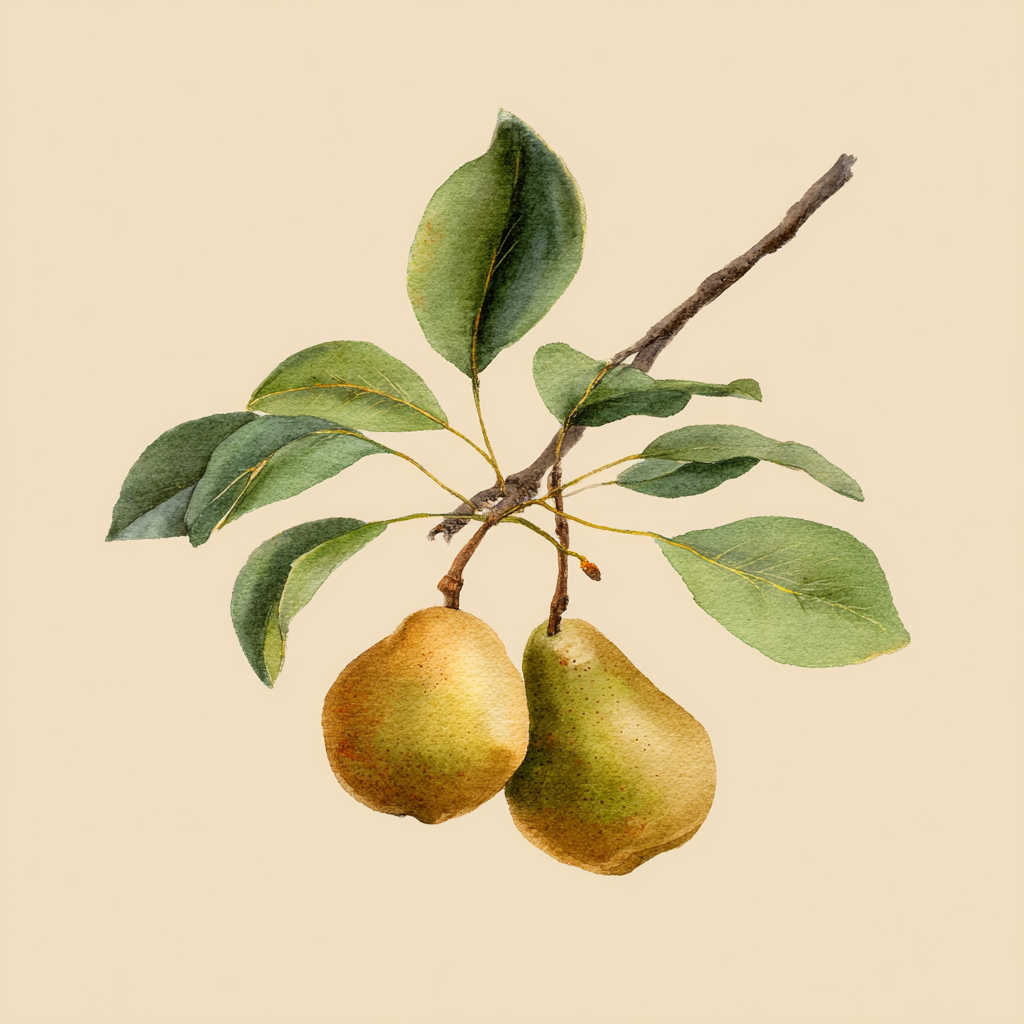
Glossy oval leaves with fine teeth, often smoother and shinier than apple leaves.
Flowers
White five-petaled flowers open in clusters, usually around apple bloom or slightly earlier. Many varieties need cross-pollination.
Fruit
Pome fruit with a narrow neck or rounded form depending on variety. Flesh ripens from firm to melting, crisp, or gritty depending on type.
Known Varieties
Common cultivars worth knowing
- Best for: fresh eating, canning
Bartlett
Classic European pear with aromatic yellow fruit.
- Best for: baking, poaching
Bosc
Brown russet pear with firm dense flesh.
- Best for: fresh eating
Comice
Large dessert pear with rich buttery texture.
- Best for: storage, fresh eating
Anjou
Green or red pear with good storage and mild flavor.
- Best for: snacking, pickling
Seckel
Small very sweet pear with old orchard history.
Loading photo submission…