Peach
FruitPrunus persica
Have seeds for this? Add to inventory →Peach trees are warm-climate stone fruits that produce luscious, fragrant fruit and are largely self-fertile. They fruit on the previous year's growth, so annual pruning is essential to maintain production.
Native Range
- Origin
- Peach is native to China, where wild and early cultivated lineages occur in northern and northwestern regions.
- Native Habitat
- Rocky slopes, dry valleys, woodland margins, and foothill habitats.
- Current Distribution
- Widely cultivated in temperate fruit-growing regions; not native outside its region of origin.
Growing Conditions
Sunlight
Full Sun
Water Needs
Moderate
Soil
Well-draining, fertile loam; pH 6.0 - 6.8
Spacing
15 - 20 feet
Days to Maturity
2 - 4 years to first significant harvest
Growing Zones
Thrives in USDA Zones 5 - 9
Companion Planting
When to Plant
Transplant
Bare-root trees in late winter while dormant
Harvest
When fruit gives slightly to pressure and smells fragrant; early morning harvest is best
Phenology (Natural Timing Cues)
Transplant
Plant bare-root peach trees while still fully dormant or only just breaking dormancy - the early spring window when forsythia blooms and soil is becoming workable. Trees planted with dormant roots establish faster than those planted after leaf-out begins, when the canopy is already drawing on root reserves. Site selection is as important as timing: peaches need excellent airflow to reduce disease pressure, and a frost-pocket site will lose blossoms in cold springs even if the tree is perfectly healthy.
- Forsythia is beginning to bloom.
- Peach buds are swelling but have not yet opened into flowers or leaves.
- Soil is workable and draining cleanly - not sticky or waterlogged.
- Hard freezes are becoming infrequent, though light frosts may still occur.
Start Dates (Your Location)
Based on your saved growing zone and this plant's timing notes.
Best Planting Window
Spring window
Late winter to early spring
Plant while dormant, before buds break and before active top growth begins.
Autumn window
Usually skip autumn planting
Use spring unless you have locally grown nursery stock and enough mild weather for roots to establish.
Planting Method
Plant a grafted bare-root nursery tree. Seed-grown fruit trees are not true-to-type, so nursery stock is the reliable path to known fruit quality.
Critical Timing Note
Plant while dormant and before bud break so roots establish before leaves demand water.
Typical Harvest Window
July to August
Organic Growing Tips
Apply copper-based spray in autumn and again in late winter to prevent peach leaf curl — use sparingly, as copper accumulates in soil over time and can harm earthworms and soil biology at high concentrations.
Plant a guild of comfrey, yarrow, and chives around the base to suppress weeds and attract beneficials.
Thin fruit to 6-inch spacing when pea-sized to ensure larger, higher-quality peaches.
Prune annually in late winter to keep the centre open and maintain fruiting wood.
Common Pests
- Peach Leaf Curl
- Aphids
- Scale
- Oriental Fruit Moth
- Brown Rot
All pest management in Garden uses safe, organic, non-toxic methods only. No synthetic pesticides, ever.
Taxonomy
- Kingdom
- Plantae
- Family
- Rose family (Rosaceae)
- Genus
- Prunus
- Species
- Prunus persica
Natural History
The peach's species name, Prunus persica, enshrines a geographical misunderstanding: the plant is native to China, not Persia, but it reached ancient Greece via the Persian trade routes and Alexander the Great's campaigns around 300 BCE, so Greeks assumed Persia was its homeland. The actual centre of origin is northwest China - the provinces of Gansu and Shaanxi still harbour wild relatives (Prunus davidiana) in rocky hillside habitats. Chinese cultivation of peach almost certainly extends back at least 4,000 years; carbonised peach stones have been found at Neolithic sites in the Yangtze River valley. In Chinese mythology the peach was the fruit of immortality, tended in the garden of Xi Wangmu, the Queen Mother of the West, whose peach trees flowered every three thousand years and whose fruit conferred eternal life on whoever ate it. When the peach arrived in Europe it spread quickly under the Roman empire - Pliny described several varieties in the 1st century CE. Spanish colonists introduced it to the Americas in the 16th century, and it naturalised and spread so rapidly that early European explorers moving inland often mistook it for a native North American species. Indigenous peoples across the Southeast adopted it within a generation or two of contact, cultivating it in orchards and incorporating it into their foodways with remarkable speed. In the United States, Georgia's commercial peach industry was built substantially on a single variety: Elberta, developed by Samuel Rumph of Marshallville, Georgia in the 1870s from a Chinese Cling seedling. Its combination of size, flavour, freestone pit, and shipping durability made it the dominant American commercial peach for nearly a century.
Traditional Use
Peach carries more than four thousand years of cultivation history across China, the Persian world, Rome, and the Americas - a span that encompasses mythology, imperial agriculture, colonial botany, and the commercial orchard industry of the modern South.
Parts Noted Historically
Chinese Mythology and Early Cultivation - Fruit and flowers
In Chinese tradition, the peach is the definitive fruit of longevity and immortality. Xi Wangmu, Queen Mother of the West and one of the most important figures in Chinese cosmology, tended a garden of peach trees in the Kunlun Mountains whose fruit ripened every three thousand years and granted eternal life. Peach imagery appears in jade carvings, ceramic decoration, and festival foods from at least the Han dynasty (202 BCE - 220 CE) through to the present, making it one of the most persistently symbolic fruits in any culture. Alongside this mythology ran practical cultivation: Chinese horticulturalists selected hundreds of varieties over millennia, developing both clingstone and freestone types, yellow and white flesh, and a range of ripening times from early summer to autumn.
Roman Cultivation and Mediterranean Spread - Fruit
Pliny the Elder's Naturalis Historia (77 CE) described the peach as a recent arrival from Persia - he called it malum persicum (Persian apple) - and noted that it had spread quickly through Roman orchards. Roman writers described peaches as a luxury fruit, expensive and perishable, consumed fresh at wealthy tables. By the later empire peach cultivation had spread through Gaul and into Britain, though it remained a warm-wall or sheltered-garden crop in northern climates. Medieval European monastic orchards continued this tradition, growing peach trees against south-facing walls and recording named varieties in manuscripts from the Carolingian period onward.
Indigenous North American Adoption - Fruit
When Spanish missionaries and colonists introduced peach to Florida and the Southeast in the 16th century, the fruit spread faster than colonisation itself. By the time English explorers moved inland in the early 17th century, they found Indigenous peoples growing extensive peach orchards throughout the Appalachian region and the Southeast, some large enough to produce cider. John Lawson, exploring the Carolinas in 1700, described peach orchards so abundant among Indigenous settlements that he initially believed the peach was native to North America. The speed of adoption - within one or two generations of first contact - reflected how well the peach suited local climates and how readily Indigenous agricultural knowledge adapted to new species.
Georgia Commercial Cultivation and the Elberta Era - Fruit
Georgia's identity as the Peach State was built largely on one variety: Elberta, created by Samuel Henry Rumph of Marshallville, Georgia in the 1870s as a chance seedling from a Chinese Cling cross. Rumph named it after his wife, Clara Elberta Moore. The variety combined large size, yellow freestone flesh, attractive appearance, and - critically - the ability to survive the new railcar shipping routes from Georgia to northern markets without excessive bruising. Rumph and his wife designed a ventilated refrigerated railcar specifically for peach shipping, and by the 1890s Elberta peaches were moving to New York and Chicago in volume. The variety dominated American commercial production for most of the first half of the 20th century and remains in cultivation today.
Peach fruit is safe food with a continuous cultivation history of thousands of years. Peach pits contain amygdalin, a cyanogenic glycoside that hydrolyses to hydrogen cyanide; kernels should not be eaten in quantity. Leaves and bark also contain cyanogenic compounds and are not food material.
This information is provided for historical and educational purposes only and is not medical advice. Always consult a qualified healthcare professional before making decisions related to your health.
Morphology (Plant Structure & Identification)
Root System
Woody root system usually grafted to rootstock. Roots need drainage and are vulnerable in heavy wet soils.
Stem
Small to medium deciduous tree with smooth young bark and an open branching habit. Productive fruiting wood is mostly last year's growth.
Leaves
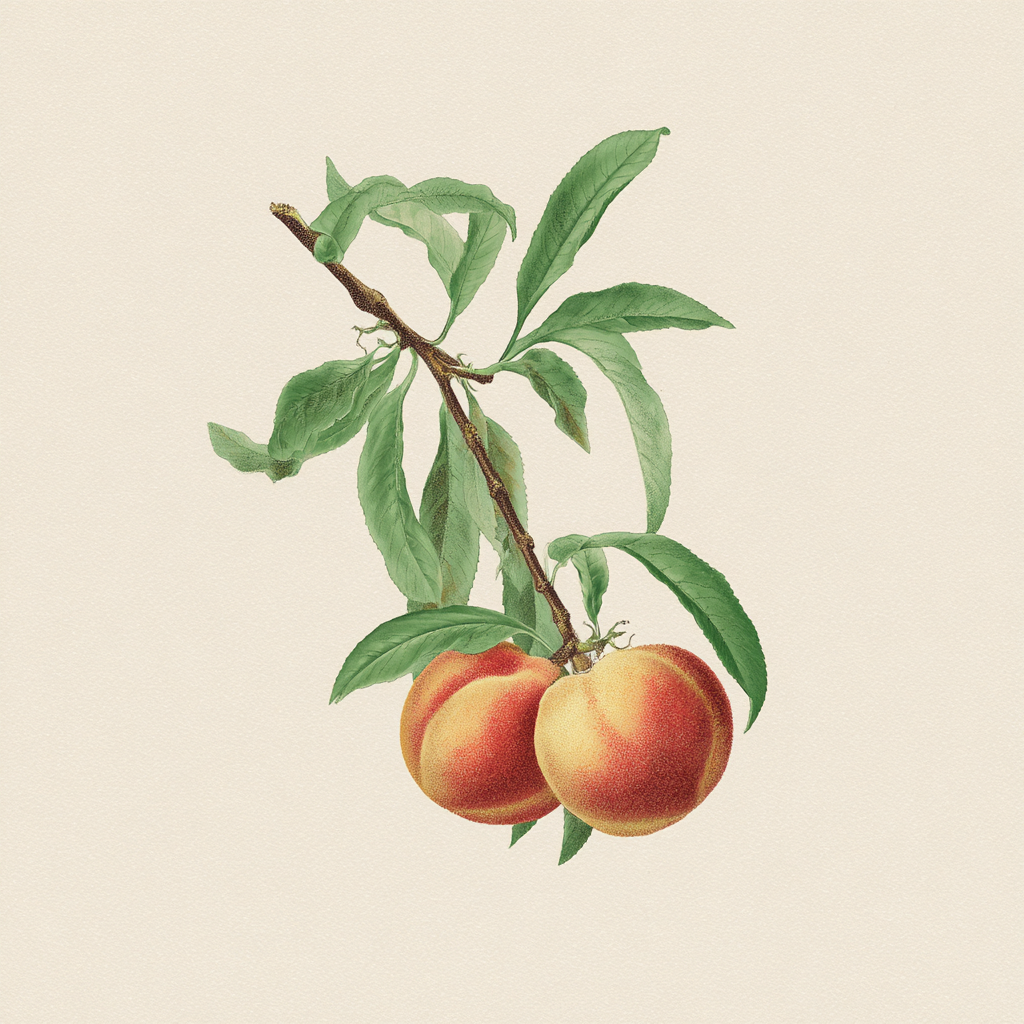
Long narrow lance-shaped leaves with fine teeth, giving peach trees a lighter texture than apple or pear.
Flowers
Showy pink blossoms open before or with leaf emergence. Flowers are often self-fertile but vulnerable to late freezes.
Fruit
Fuzzy stone fruit with yellow or white flesh and a central pit. Freestone and clingstone types differ in how flesh separates from the pit.
Known Varieties
Common cultivars worth knowing
- Best for: general garden use
Redhaven
Classic freestone peach with reliable crops and good flavor.
- Best for: preserving
Elberta
Historic yellow freestone peach known for canning and fresh eating.
- Best for: northern gardens
Contender
Cold-hardy peach with good bud survival in colder regions.
- Best for: cold regions
Reliance
Very cold-hardy peach with dependable crops in marginal climates.
- Best for: fresh eating, novelty fruit
Saturn
Flat donut peach with sweet white flesh.
Loading photo submission…