Jerusalem Artichoke
VegetableHelianthus tuberosus
Have seeds for this? Add to inventory →Jerusalem artichoke is a vigorous North American native perennial grown for its knobby, sweet tubers and towering sunflower-like stems. Despite its name, it has no connection to Jerusalem or artichokes-the name is thought to derive from the Italian 'girasole,' meaning sunflower. It is one of the most productive and cold-tolerant root crops available to temperate gardeners, thriving in zones 3–10 with minimal care.
Growing Conditions
Growing Conditions
Sunlight
Full Sun
Water Needs
Low to Moderate
Soil
Tolerates most soils; well-draining preferred; pH 5.8–7.0
Spacing
12–18 inches
Days to Maturity
120–150 days from planting
Growing Zones
Growing Zones
Thrives in USDA Zones 3 - 10
When to Plant
When to Plant
Direct Sow
Plant tubers in spring after last frost, 3–5 inches deep
Harvest
Dig tubers after first frost when foliage dies back; can be left in ground through winter
Phenology (Natural Timing Cues)
Transplant
Jerusalem artichokes are planted as tubers directly in the ground in spring, once the soil has thawed and is workable. Planting too early into cold, waterlogged soil invites rot before sprouting; planting too late shortens the season for maximum tuber development. Wait until the soil is consistently workable and draining cleanly, roughly when dandelions are in full bloom and forsythia is fading. Each tuber section with at least one eye will sprout readily once soil temps reach 40°F.
- Forsythia blooms are fading and dandelions are fully open
- Soil is workable to 5 inches and draining cleanly after rain
- Soil temperature at planting depth reaches 40°F or above
- Tender annual weeds are beginning to germinate at the soil surface
Start Dates (Your Location)
Average dates use your saved zone; readiness also checks your forecast when available.
Use the average timing, but check your local forecast before planting.
Typical Harvest Window
October to December
Organic Growing Tips
Organic Growing Tips
Contain spread by planting in a raised bed or using a buried barrier.
Leave some tubers in the ground over winter for perennial harvests.
The tall stems and bright flowers attract bees late in the season when little else is blooming.
Care Guidance
Optional seasonal guidance for what you can do, even when nothing is urgent.
Care Guidance
Watering
If dry weather lingers, let the top 2 inches start to dry before watering again. This plant often responds better to an occasional deep soak than to frequent light watering.
Feeding
Extra feeding is rarely required if soil is healthy. If growth looks pale or slow, a light compost top-dressing is often enough before adding anything stronger.
Seasonal care
In late fall, a light cleanup and fresh mulch can help if winter protection is useful in your climate. Leaving a little space around crowns and trunks often helps air move and keeps excess moisture from sitting there.
Harvest timing
Harvests often cluster around October to December. If fruit, leaves, or roots start looking ready, color, size, firmness, and scent usually tell you more than the calendar alone.
Known Varieties
Common cultivars worth knowing
Known Varieties
Stampede
An early-maturing selection producing relatively smooth, rounded tubers that are easier to clean than the typical knobby types. Matures earlier than most, making it practical for shorter-season gardens.
Best for
Short-season climates; cooks who want easier preparation
Clearwater
A smooth-skinned white-fleshed variety with mild flavor and less pronounced inulin effects than older heirloom types, according to grower reports.
Best for
Cooks sensitive to digestive effects of inulin
Red Fuseau
A long, smooth French heirloom with red-tinged skin and a more uniform shape than common types; widely preferred in European cooking for its relatively clean surface and nutty flavor.
Best for
Kitchen use; market gardens; reduced prep time
Companion Planting
Companion Planting
Common Pests
Common Pests
All pest management in Garden uses safe, organic, non-toxic methods only. No synthetic pesticides, ever.
Simple Ways to Use
Simple Ways to Use
Start here if you're not sure how to use this crop in the kitchen.
Quick recipes you can make right away
Roasted Jerusalem Artichokes
Scrub the tubers well, cut larger ones into chunks, toss them with oil and salt, and roast at 425°F for 25 to 35 minutes until browned at the edges and tender in the center. Stir once halfway through so the pieces roast instead of steaming.
Jerusalem Artichoke Soup Base
Simmer chopped tubers with onion and broth for 20 to 25 minutes until fully soft, then blend until smooth. Start with a modest serving if this is your first time eating them, because some people find them very gas-forming.
Sauteed Jerusalem Artichokes
Slice the scrubbed tubers and cook them in a skillet with oil for 8 to 10 minutes until the slices brown lightly and soften. Add a splash of water and cover briefly if the centers still feel firm.
How to Preserve
How to Preserve
Use this section to store or process extra harvest before it spoils.
Practical methods for extra harvest
Store tubers in cold soil or refrigerator
Leave tubers in the ground and dig as needed through cold weather, or brush off loose soil and store them in the refrigerator if the ground is not a good storage place. Use stored tubers before they shrivel, because they lose moisture faster than potatoes.
Freeze blanched slices
Slice the tubers, blanch them 2 minutes, then chill them fully in cold water so they stop cooking. Dry them well before freezing on a tray, then bag them once solid for soups or sautés.
Freeze cooked soup or mash
Cook the tubers until fully soft, mash or blend them, and cool completely before freezing in small containers. Freeze in meal-size portions so you can thaw only what you need later.
New to preserving food?
New to freezing? Read the freezing guide.How to Store
How to Store
Simple storage tips
The best storage is often in the ground until needed, especially in cold weather, because the tubers shrivel faster once dug.
If you dig them all at once, keep them cold and slightly humid in the refrigerator or another root-cellar-like space.
Do not wash them before storage, because extra moisture shortens their keeping quality.
Use small, nicked, or softening tubers first for soup or roasting.
Start with small servings if you are new to them, because some people find them harder on digestion than other tubers.
How to Save Seed
How to Save Seed
Step-by-step seed saving
- 1
Jerusalem artichokes are usually propagated from tubers rather than from seed, and most growers replant part of the harvest each year.
- 2
Choose a few sound tubers with visible eyes from your best harvest and keep them for replanting.
- 3
Store the saved tubers cold and slightly humid, or leave some in the ground if your climate and soil allow.
- 4
Use this tuber-saving method if you want to keep the same patch going from year to year.
Native Range
Native Range
- Origin
- Native to central and eastern North America, where it was cultivated and spread by Indigenous peoples across a broad range extending from the Great Plains to the Atlantic seaboard well before European contact.
- Native Habitat
- Naturally colonizes disturbed soils, woodland edges, floodplain margins, and prairie openings; thrives in full sun with moderate moisture but tolerates a wide range of conditions.
- Current Distribution
- Now widely naturalized across Europe, Asia, and Australia as well as its native North American range; commonly found as a weed or garden escape along roadsides, riverbanks, and waste ground throughout the temperate world. Cultivated globally as a food and forage crop.
Taxonomy
Taxonomy
- Kingdom
- Plantae
- Family
- Daisy family (Asteraceae)
- Genus
- Helianthus
- Species
- Helianthus tuberosus
Morphology
Morphology
Root System
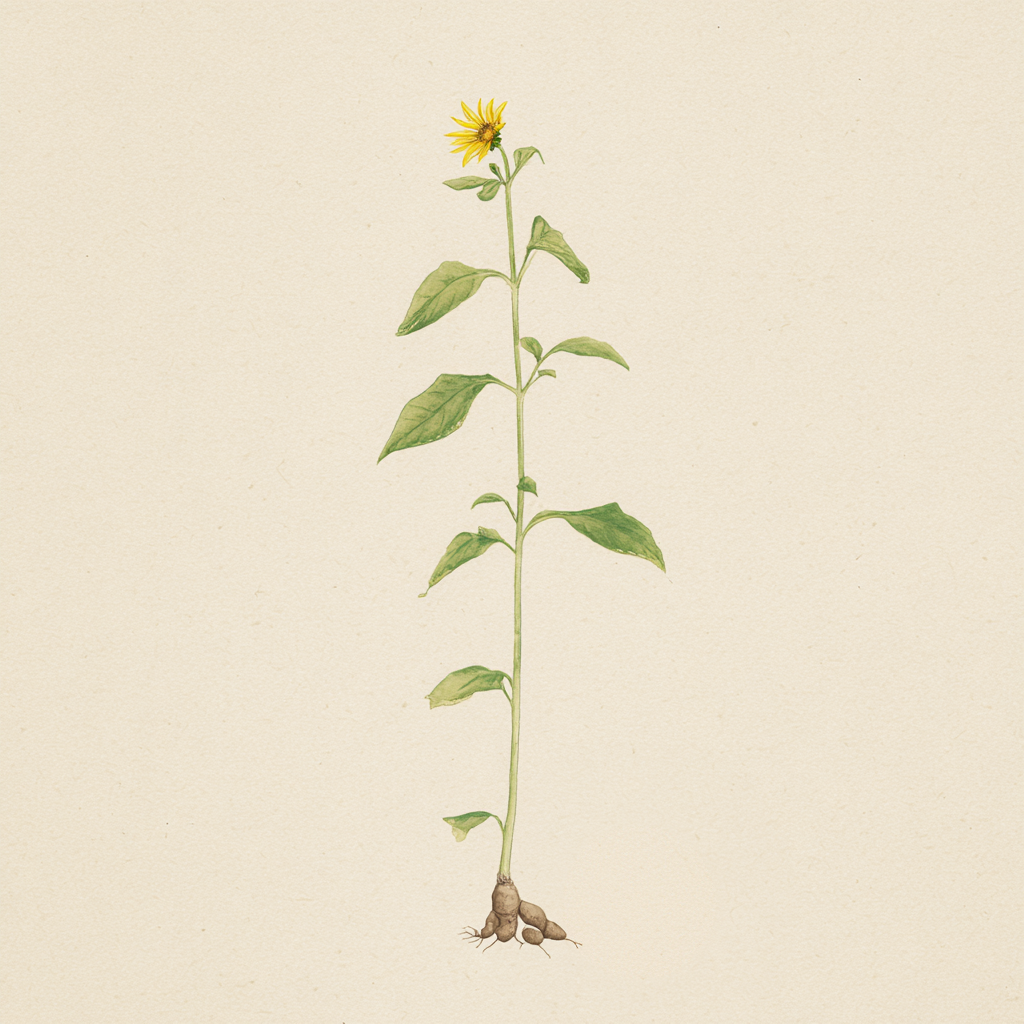
Produces a spreading network of shallow rhizomes bearing knobbly tubers at the tips; tubers range from golf-ball to fist-sized and vary by variety. Any tuber fragment left in the soil after harvest will re-sprout, making thorough harvesting the primary means of population control.
Stem
Upright, branching, and rough-hairy, reaching 6–10 feet tall in full sun with rich soil. Stems are thick enough to provide windbreak function in polycultures but should be cut to the ground in autumn to prevent harboring overwintering pests and disease.
Leaves
Large, coarse, lance-ovate leaves with a sandpaper texture; alternate in the upper portion and opposite lower on the stem. Yellowing and wilting foliage in late summer is normal senescence rather than disease, but sudden collapse before frost may indicate Sclerotinia crown rot.
Flowers
Bright yellow composite flower heads 2–3 inches across, resembling small sunflowers, appearing in late summer to early fall. The flowers are a critical late-season nectar source for bees and beneficial wasps; they are insect-pollinated but rarely set viable seed under cultivation. Do not deadhead if supporting pollinators is a priority.
Fruit
Rarely sets seed in cultivation. The edible crop is entirely the underground tubers. Tubers are mature when foliage yellows and dies back after frost; flavor and sweetness improve significantly after one or two hard frosts as inulin begins converting to fructose.
Natural History
Natural History
Helianthus tuberosus is native to central and eastern North America, where it was cultivated by numerous Indigenous peoples long before European contact. The Abenaki, Huron, and many other nations grew it as a reliable starchy staple, and the plant was thoroughly established in Indigenous agricultural systems from the Great Plains to the Atlantic coast. French explorer Samuel de Champlain encountered it growing among the Wampanoag people near Cape Cod in 1605 and brought tubers back to France, where it quickly became a fashionable food novelty before falling out of favor with European elites after the potato took over. The Italian community in France gave it the name 'girasole articiocco'-sunflower artichoke-which English speakers corrupted into 'Jerusalem.' It spread rapidly through European gardens and was naturalized across much of Europe and Asia by the 17th century, and it now grows as a weed or escape along roadsides, riverbanks, and disturbed ground across much of the temperate world. Botanically, the plant is a true sunflower relative, producing tall composite flower heads and developing a network of shallow rhizomes tipped with tubers that can spread aggressively if not managed. The tubers store carbohydrate primarily as inulin rather than starch, which makes them low on the glycemic index but also responsible for the vigorous gas production that gave the plant its earthy culinary reputation. Frost sweetens the tubers by beginning the conversion of inulin to fructose, which is why post-frost harvest is both a practical and a flavor recommendation.
Traditional Use
Traditional Use
Jerusalem artichoke was primarily a food plant in Indigenous North American cultures, but its tubers and other parts were recorded in ethnobotanical contexts for various practical uses. European herbalists of the 17th and 18th centuries also documented observations about its effects, largely in relation to its unusual carbohydrate content and the digestive consequences well-known to consumers.
Parts Noted Historically
Various Indigenous peoples of eastern North America, documented by early European explorers and later ethnobotanists including Moerman's Native American Ethnobotany database - tubers
Tubers were recorded as a primary food source among numerous nations including the Abenaki, Ojibwe, and Potawatomi; in some records they were also noted in poultice contexts for localized external application to swollen or sore areas.
European herbalists and physicians, 17th century, including John Parkinson's Paradisi in Sole (1629) - tubers
Parkinson described the tubers as causing 'windiness in the stomach' and noted their nourishing quality, reflecting the widely observed effect of inulin fermentation in the gut that made the plant both prized and notorious in early modern European kitchens.
The high inulin content of raw or cooked tubers causes significant intestinal gas in most people; this effect diminishes with gradual introduction or long slow cooking. No toxicity is associated with normal food use. Individuals with fructose intolerance should approach this crop with caution.
This information is provided for historical and educational purposes only and is not medical advice. Always consult a qualified healthcare professional before making decisions related to your health.
Related Articles
Related Articles
Loading photo submission…