Asparagus
VegetableAsparagus officinalis
Have seeds for this? Add to inventory →Asparagus is a long-lived perennial vegetable that takes 2 - 3 years to establish but then produces for 20 years or more. It is one of the earliest crops to emerge in spring and a treasured cornerstone of the productive kitchen garden.
Native Range
- Origin
- Asparagus is native to Europe, western Asia, and North Africa.
- Native Habitat
- Coastal dunes, dry grasslands, scrub, river terraces, sandy soils, and open well-drained habitats.
- Current Distribution
- Naturalized across many temperate regions, especially in disturbed habitats.
Growing Conditions
Sunlight
Full Sun
Water Needs
Moderate
Soil
Deep, well-draining, sandy loam; pH 6.5 - 7.0
Spacing
18 inches in rows; 4 feet between rows
Days to Maturity
First harvest in year 3; do not harvest at all in year 1 - 2
Growing Zones
Thrives in USDA Zones 3 - 9
Companion Planting
When to Plant
Transplant
Plant 1-year crowns in early spring as soon as soil is workable
Harvest
From year 3 onwards; cut spears when 6 - 8 inches tall
Phenology (Natural Timing Cues)
Transplant
Plant asparagus crowns as early in spring as the soil can be worked - the goal is to get them in while still dormant, before soil warmth pushes active shoot production. Buy and plant promptly; crowns deteriorate quickly in storage.
- Soil is workable and drains cleanly after rain.
- Forsythia is beginning to bloom or has just started.
- Perennial crowns in nearby beds are just beginning to push new shoots.
- Daytime ground frosts are ending but air is still cool.
Start Dates (Your Location)
Based on your saved growing zone and this plant's timing notes.
Best Planting Window
Spring window
Early spring
Plant as soon as the soil is workable so roots establish before heat arrives.
Autumn window
Usually skip autumn planting
Use spring unless you have locally grown nursery stock and enough mild weather for roots to establish.
Planting Method
Plant healthy crowns. Seed is possible for some crops, but crowns establish faster and reach useful harvest size sooner.
Critical Timing Note
Do not harvest the first year; let crowns build a strong root system before taking spears.
Typical Harvest Window
April to June
Organic Growing Tips
Plant tomatoes nearby - they share a mutual benefit where each deters the other's key pests.
Top-dress beds with 2 - 3 inches of compost each autumn to feed the deep root system.
Do not harvest any spears in years 1 and 2 - allow full fern growth to build crown energy.
Mulch beds heavily to suppress weeds; weeding disturbs shallow asparagus roots and sets plants back.
Common Pests
- Asparagus Beetle
- Slugs
- Fusarium Crown Rot
- Aphids
All pest management in Garden uses safe, organic, non-toxic methods only. No synthetic pesticides, ever.
Taxonomy
- Kingdom
- Plantae
- Family
- Asparagus family (Asparagaceae)
- Genus
- Asparagus
- Species
- Asparagus officinalis
Natural History
Asparagus officinalis is native to coastal dunes, sandy grasslands, and open scrub around the Mediterranean and across western and central Asia, where its strong preference for sharp drainage and deep, loose soil directly reflects these wild habitats. The species name officinalis signals its historical place in apothecary stores alongside other economically important plants. The Romans prized it intensely: Emperor Augustus Caesar coined the phrase "velocius quam asparagi coquuntur" (faster than asparagus is cooked) as a byword for swift action, and the agricultural writer Columella gave detailed instructions for establishing asparagus beds. The tradition of mounding earth over emerging spears to exclude light - producing white asparagus - became central to French, Dutch, and German cultivation from at least the 16th century and remains the dominant form in continental Europe today. In Britain, the Vale of Evesham in Worcestershire developed a distinct asparagus culture tied to specific soils and traditions of seasonal selling that persist to the present. Wild asparagus is still gathered in spring along Mediterranean coastlines, and the plant's brief annual harvest window - a few weeks before spears must be allowed to fern - is a direct expression of a perennial biology built around channeling energy into deep root reserves rather than continuous above-ground growth.
Traditional Use
Asparagus has been one of the most consistently prized spring vegetables in European food culture for over two thousand years, valued for the brevity of its season as much as for its flavor. Its cultivation history ranges from Roman luxury cooking to the strictly observed seasonal traditions of modern Germany, and its roots carried a practical household reputation in European herbal medicine for centuries alongside its culinary one.
Parts Noted Historically
Ancient Roman Culinary Traditions - Spears
Asparagus was a luxury crop in Roman gardens, mentioned by Cato, Columella, and Pliny, and featured in several recipes in Apicius. Roman growers developed forcing techniques to produce out-of-season spears. Emperor Augustus is reported to have kept fast couriers designated to carry fresh asparagus to mountain snow for rapid chilling - a detail that gives some measure of how highly it was regarded.
European White Asparagus Traditions - Spears
From at least the 16th century, French, Dutch, and German growers developed the practice of mounding soil over emerging spears to exclude light, producing white asparagus with a milder, more tender character. In Germany the Spargelzeit (asparagus season, late April to 24 June) is a major seasonal event with dedicated menus, festivals, and Spargelkönigin (asparagus queen) ceremonies in producing regions. White asparagus remains culturally dominant across much of continental Europe.
British Asparagus Traditions - Spears
The Vale of Evesham in Worcestershire has been one of England's primary asparagus-growing regions since the 17th century. British asparagus was historically associated with luxury and a strictly brief market season, and regional pride in local asparagus runs deep in producing areas. The British season mirrors the continental tradition in its strict seasonal character, typically running from late April to the summer solstice.
European Herbal and Apothecary Traditions - Roots and spears
Asparagus roots appear in European herbals from the medieval period through the 18th century, valued primarily as a diuretic. The officinalis designation in the species name reflects this historical place in apothecary stores. These references are culinary-adjacent rather than strictly medicinal - older writers often treated asparagus as a food with notable household utility rather than a medicine proper.
Asparagus spears are food-safe in any quantity. The effect on urine odor after eating is caused by asparagusic acid metabolites and is entirely harmless. Notably, the ability to detect the smell is itself genetically variable - a significant portion of the population cannot perceive it at all.
This information is provided for historical and educational purposes only and is not medical advice. Always consult a qualified healthcare professional before making decisions related to your health.
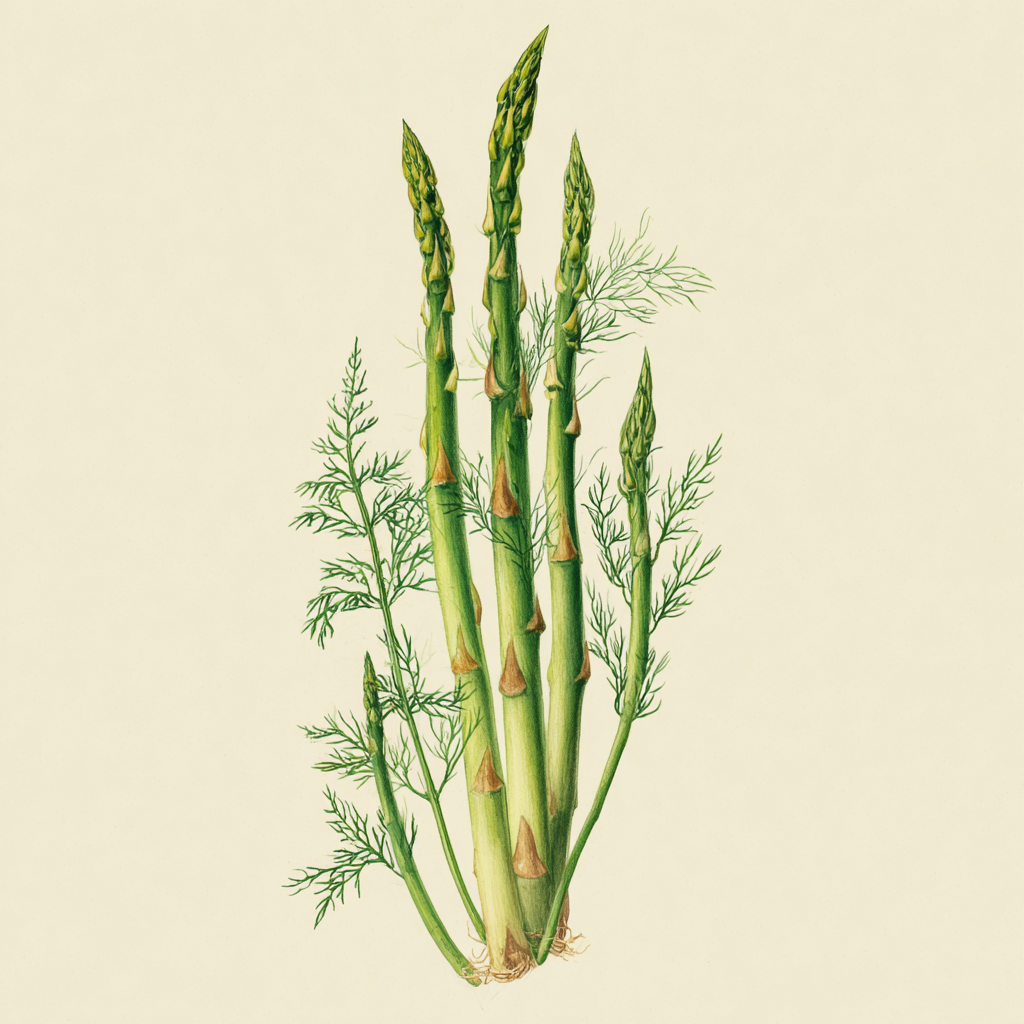
Morphology (Plant Structure & Identification)
Root System
Perennial crown with thick storage roots and finer feeder roots. Crowns expand over time and resent deep disturbance once established.
Stem
Edible spears are young shoots emerging from the crown. Unharvested spears elongate into tall branching fern-like stems.
Leaves
True leaves are tiny scales; the green ferny parts are fine cladodes that photosynthesize and feed the crown.
Flowers
Small bell-shaped greenish to yellow flowers appear on mature fern growth. Plants are usually male or female, with female plants forming berries.
Fruit
Female plants produce small red berries containing seeds. The harvested crop is the young spear before it branches.
Known Varieties
Common cultivars worth knowing
- Best for: productive beds
Jersey Knight
Mostly male hybrid with strong yields and good disease resistance.
- Best for: large harvests
Jersey Giant
Vigorous hybrid known for thick spears and dependable production.
- Best for: traditional plantings
Mary Washington
Older open-pollinated standard with good flavor and broad availability.
- Best for: fresh eating, color
Purple Passion
Purple spear variety with sweeter flavor and tender texture.
- Best for: cold regions
Millennium
Cold-hardy modern variety bred for strong performance in northern climates.
Loading photo submission…