Turnip
VegetableBrassica rapa var. rapa
Have seeds for this? Add to inventory →Turnips are fast-maturing cool-season root vegetables that offer both edible roots and nutritious greens. They are exceptionally cold-hardy and can be harvested through light frosts.
Native Range
- Origin
- Turnip is a cultivated root form of Brassica rapa, a species native across parts of Europe and western Asia.
- Native Habitat
- Open disturbed ground, field edges, river margins, roadsides, and seasonally cool habitats.
- Current Distribution
- Naturalized across many temperate regions, especially in disturbed habitats.
Growing Conditions
Sunlight
Full Sun
Water Needs
Moderate
Soil
Well-draining loam; pH 6.0 - 7.5
Spacing
4 - 6 inches after thinning
Days to Maturity
45 - 60 days from sowing
Growing Zones
Thrives in USDA Zones 2 - 10
Companion Planting
When to Plant
Direct Sow
4 - 6 weeks before last frost; again in late summer for autumn harvest
Harvest
45 - 60 days; harvest small for sweetness
Phenology (Natural Timing Cues)
Direct Sow
Turnips behave like radishes in their heat sensitivity but with a longer maturity window (45 - 60 days versus 22 - 30 for radishes), which makes timing both more forgiving and more important to plan. The root quality that makes turnips worth growing - sweet, crisp, and mild when young - is only achieved in cool conditions; heat makes roots pithy, bitter, and tough even before they bolt. The spring window is defined by how quickly summer heat will arrive after planting: in most climates, sowing 4 - 6 weeks before last frost gives enough time for roots to size up before heat degrades them. An autumn sowing - timed to mature during the cool weeks of September and October - typically produces the best quality, and turnips left in the ground after light frost are noticeably sweeter than those harvested before.
- Early dandelions are blooming or just beginning.
- Soil is workable with a loose, crumbly surface.
- Cool-season weeds are growing steadily.
- For autumn sowing: summer heat has eased and first cool nights are returning. Count back 50 - 60 days from the first expected hard frost to find the sow date.
Start Dates (Your Location)
Based on your saved growing zone and this plant's timing notes.
Typical Last Frost
Set your growing zone to see personalized calendar dates.
Organic Growing Tips
Use row covers from sowing to prevent root maggot fly from laying eggs at the base.
Sow densely and harvest thinnings as nutritious turnip greens.
Autumn-sown turnips left in the ground sweeten considerably after frost.
Rotate with non-brassica crops each year to prevent clubroot buildup in the soil.
Common Pests
- Flea Beetle
- Root Maggot
- Cabbage White Caterpillar
- Aphids
All pest management in Garden uses safe, organic, non-toxic methods only. No synthetic pesticides, ever.
Taxonomy
- Kingdom
- Plantae
- Family
- Mustard family (Brassicaceae)
- Genus
- Brassica
- Species
- Brassica rapa var. rapa
Natural History
Turnip (Brassica rapa subsp. rapa) is one of the oldest cultivated brassica crops in Eurasia, though its precise domestication history is complicated by the fact that Brassica rapa encompasses turnip, Chinese cabbage, pak choi, and several other distinct vegetables selected from the same wild species complex. The European turnip was likely domesticated in northern Europe or the Mediterranean from wild Brassica rapa, which grows widely as a weed of disturbed ground. It was a dietary staple across Europe for centuries before the potato arrived from the Americas in the 16th-17th centuries, filling the role of a starchy, calorie-dense winter root that could be stored in root cellars. The Roman agronomist Columella gave detailed turnip cultivation instructions in De Re Rustica (1st century CE), and Pliny the Elder ranked turnip alongside grain, oil, and wine as one of the most important provisions of Roman life. In medieval Europe, the phrase "turning" or "turn-eating" contributed to the vegetable's name in some regional dialects. A grim historical chapter: the "Steckrübenwinter" (turnip winter) of 1916-17 in Germany during World War One saw the German civilian population reduced to eating turnips as the primary food source after the British naval blockade cut off other imports and grain harvests failed. Estimates suggest the turnip became the near-sole food for hundreds of thousands of Germans, and the famine conditions contributed to over 700,000 civilian deaths. In a lighter vein: in Scotland and Ireland, the original Halloween lantern was not a pumpkin but a carved neep (turnip or swede), hollowed out and lit with a candle to ward off evil spirits - a tradition that predated North American pumpkin carving and was brought by Irish and Scottish emigrants to the Americas.
Traditional Use
Turnip was the potato of pre-Columbian Europe - the reliable starchy root that stood between peasant populations and winter hunger - and its history includes both the long ordinariness of an everyday staple and the extraordinary privation of the German turnip winter of 1916.
Parts Noted Historically
Roman and Classical Agriculture - Root
Pliny the Elder's Naturalis Historia (77 CE) gave turnip a prominent place, ranking it as one of the most important provisions of Roman life alongside grain, olive oil, and wine. Columella's De Re Rustica devoted detailed attention to turnip cultivation, planting times, and storage methods, evidence that it was a crop taken seriously in Roman agricultural science rather than a peasant afterthought. The Romans grew both round and elongated turnip forms and were aware of the difference between turnips grown for human consumption and those grown for livestock fodder - a distinction still relevant in modern agriculture.
Pre-Potato European Winter Staple - Root and greens
Before the potato displaced it from the 18th century onward, the turnip was one of the foundational winter provisions of European peasant and working-class diets. It could be grown quickly in cool weather, stored through winter in root cellars or clamps, and fed to livestock as well as people, making it a critical element of the pre-industrial European food system. The poem "The Deserted Village" by Oliver Goldsmith (1770) laments the disappearance of the rural subsistence life in which turnips were a central provision. When Charles "Turnip" Townshend introduced turnip cultivation into English agricultural rotations in the early 18th century, he was building on an ancient practice while systematising it for improved soil management.
The German Turnip Winter (Steckrübenwinter) - Root
The winter of 1916-17 in Germany became known as the Steckrübenwinter - turnip winter - after the British naval blockade, combined with failed grain harvests, reduced the German civilian diet to little beyond turnips and bread made partly from turnip flour. Ration cards allocated turnips as the primary food, and recipes for turnip coffee, turnip jam, and turnip bread circulated in German newspapers. Historians estimate over 700,000 German civilians died from famine-related causes during the war, with the turnip winter a central chapter in this suffering. The episode fixed turnip as a symbol of deprivation in 20th-century German cultural memory in a way that other European countries, where the potato had more firmly displaced it, did not share.
Southern US Turnip Greens Tradition - Leaves
In the American South - particularly in African-American and Appalachian foodways - turnip greens developed into a significant culinary tradition quite separate from the root's European role. Slow-cooked in pot liquor (the cooking liquid from greens, ham hocks, or smoked meat) and seasoned with vinegar and hot sauce, turnip greens are a foundational dish in Southern cooking. The tradition has deep roots in the food culture of enslaved people, who often received root vegetables and leafy greens as rations and developed recipes of remarkable quality from limited ingredients. This cooking tradition is documented from the antebellum period onward and remains central to Southern foodways today.
This information is provided for historical and educational purposes only and is not medical advice. Always consult a qualified healthcare professional before making decisions related to your health.
Morphology (Plant Structure & Identification)
Root System
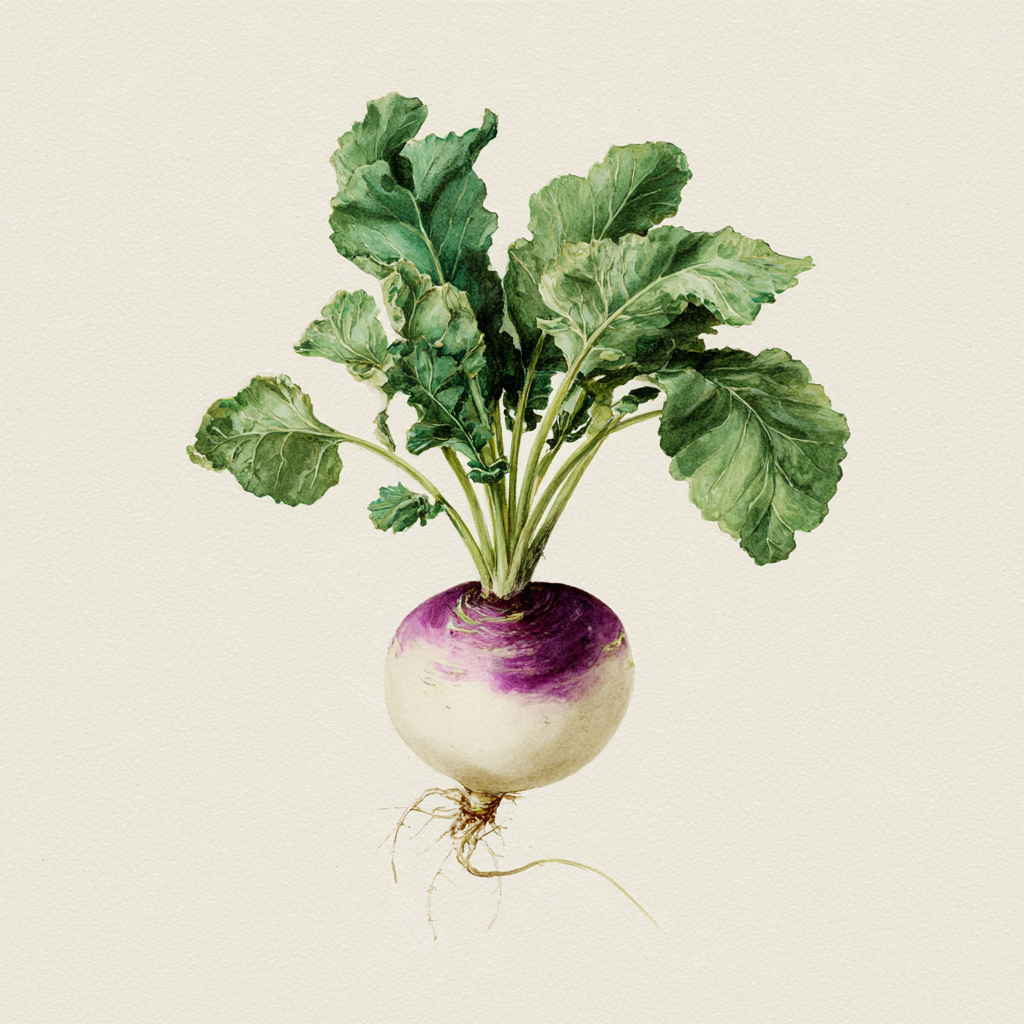
Swollen taproot with fine feeder roots. Roots are round, flattened, or elongated depending on variety and become woody if crowded or drought-stressed.
Stem
Short crown during root and leaf growth. Flowering stems elongate quickly when plants bolt in heat or after overwintering.
Leaves
Rough, lobed green leaves form an open rosette. Greens can be harvested young, but heavy cutting reduces root sizing.
Flowers
Yellow four-petaled brassica flowers appear on branched stalks if plants bolt or overwinter.
Fruit
Produces slender seed pods after flowering. The harvested crop may be the swollen root, the leafy greens, or both.
Known Varieties
Common cultivars worth knowing
- Best for: roots, storage
Purple Top White Globe
Classic storage turnip with white root and purple shoulders.
- Best for: fresh eating
Hakurei
Small white salad turnip with mild flavor and tender texture.
- Best for: quick spring crops
Tokyo Cross
Fast hybrid white turnip with uniform roots.
- Best for: roasting, storage
Golden Ball
Yellow-fleshed heirloom with mild sweet flavor.
- Best for: turnip greens
Seven Top
Grown mainly for greens rather than roots.
Loading photo submission…