Oregano
HerbOriganum vulgare
Have seeds for this? Add to inventory →Oregano is a vigorous Mediterranean perennial herb with powerfully aromatic foliage that deters pests and attracts beneficial insects throughout the season. Its white and pink flowers are especially attractive to bees, hoverflies, and parasitic wasps.
Native Range
- Origin
- Oregano is native across much of Europe, North Africa, and temperate Asia.
- Native Habitat
- Dry grasslands, sunny banks, rocky slopes, open woods, and well-drained calcareous soils.
- Current Distribution
- Naturalized across many temperate regions, especially in disturbed habitats.
Growing Conditions
Sunlight
Full Sun
Water Needs
Low
Soil
Well-draining, lean soil; pH 6.0 - 8.0
Spacing
12 - 18 inches
Days to Maturity
Harvest lightly from first year; allow to flower freely from year 2
Growing Zones
Thrives in USDA Zones 4 - 10
Companion Planting
Good Companions
Keep Away From
No known antagonists
When to Plant
Transplant
Spring after last frost
Direct Sow
After last frost on surface; needs light to germinate
Harvest
Harvest before flowering for culinary use; leave flowers for pollinators
Phenology (Natural Timing Cues)
Direct Sow
Surface sow oregano after the coldest spring swings have passed and the seedbed can be kept lightly moist through germination. Oregano seed is tiny and needs light to germinate, so it must sit at or barely below the surface - pressed into a firm seedbed rather than covered. Germination takes 2 - 3 weeks and requires patience; do not abandon the seedbed if nothing appears in the first week.
- Peak dandelion bloom has passed.
- Soil surface stays mildly warm and does not crust hard between waterings.
- Perennial herb beds are showing steady new growth.
- Risk of prolonged cold, wet weather has clearly passed.
Transplant
Transplant oregano after settled mild weather arrives and the planting site drains freely. Oregano is a Mediterranean perennial that thrives in lean, well-draining conditions and establishes far better in lean-to-average soil than in rich, wet beds. Plant before the hottest part of summer so roots can anchor during mild conditions. Early autumn transplanting is also reliable in most climates.
- Dandelion bloom is past peak.
- Soil is workable and no longer cold or persistently wet.
- New oregano growth on established plants is firm and strongly aromatic.
- Planting site drains visibly within a day of rain.
Start Dates (Your Location)
Based on your saved growing zone and this plant's timing notes.
Best Planting Window
Spring window
After your last frost
Plant once frost risk has passed and spring conditions are settled.
Autumn window
Usually skip autumn planting
Use spring unless you have locally grown nursery stock and enough mild weather for roots to establish.
Planting Method
Use nursery-grown planting stock rather than treating this as a standard seed-starting crop.
Critical Timing Note
Plant after cold risk has passed so roots can establish without chilling or stalling.
Organic Growing Tips
Allow oregano to flower - it becomes a powerful beneficial insect hub attracting parasitic wasps.
Cut back hard in early spring to encourage vigorous fresh growth and prevent woodiness.
Grow in lean, well-draining soil — over-rich compost produces lush but flavourless growth; a light mulch of fine bark around the base improves moisture retention in hot spells without promoting the soft growth that invites disease.
Harvest in dry weather in the morning after dew dries for the best essential oil concentration.
Common Pests
- Aphids
- Spider Mites
- Leaf Miners
All pest management in Garden uses safe, organic, non-toxic methods only. No synthetic pesticides, ever.
Taxonomy
- Kingdom
- Plantae
- Family
- Mint family (Lamiaceae)
- Genus
- Origanum
- Species
- Origanum vulgare
Natural History
The genus name Origanum comes from the Greek oros (mountain) and ganos (joy or brightness) - "joy of the mountain" - reflecting where the plant thrives in its native Mediterranean habitat: dry, rocky hillsides in full sun. The Romans carried it throughout their empire, and it arrived in Britain via that route. The species Origanum vulgare is highly variable across its range; the subspecies grown in Greek and Italian kitchen gardens - subsp. hirtum, sometimes called Greek oregano - is intensely aromatic due to high concentrations of carvacrol and thymol in the leaf oils. The subspecies naturalised in northern Europe and North America (subsp. vulgare) is a different plant in practice: nearly odourless, with low phenol content, which explains why North American gardeners for generations found "oregano" disappointing in flavour. A related confusion runs through culinary history - marjoram (Origanum majorana) and oregano were used interchangeably by many older writers, including John Gerard, who listed them under shared names in his 1597 Herball. The two are distinct in flavour chemistry: marjoram is sweeter and less pungent, oregano sharper and more resinous. The explosion of pizza culture in the United States after World War Two drove oregano imports from 200,000 pounds in 1948 to over 10 million pounds by 1956 - roughly a 5,000% increase in eight years - introducing most Americans to the herb for the first time.
Traditional Use
Oregano has been a culinary and household herb in Mediterranean cultures for over two millennia, valued as much for flavour and food preservation as for any formal medicinal application. Its aromatic oils - carvacrol and thymol - give it genuine antimicrobial properties that ancient cooks exploited without knowing the chemistry.
Parts Noted Historically
Ancient Greek and Roman Use - Leaves and flowering tops
Hippocrates mentioned oregano as a remedy for respiratory and digestive complaints in the 4th century BCE. Dioscorides, writing in De Materia Medica around 65 CE, described it as warming and drying - useful for coughs and as a digestive bitter. The Roman cookbook Apicius includes oregano as a standard seasoning for meat dishes, sauces, and preserved foods, where its antimicrobial oils would have helped inhibit spoilage. Greek and Roman brides and grooms were traditionally crowned with oregano garlands, making it a plant associated with happiness as well as the table.
Medieval European Physic Gardens - Leaves
Oregano was listed among the useful herbs in Charlemagne's Capitulare de Villis around 812 CE, which specified plants to be grown on imperial estates throughout the Frankish kingdom. John Gerard described it in his 1597 Herball as effective for "such as cannot brooke their meate," grouping it with marjoram under shared terminology. Monastery gardens of the period grew oregano primarily as a cooking herb and mild aromatic, and the confusion between oregano and sweet marjoram persisted in European herbal writing well into the 18th century.
Greek and Italian Culinary Tradition - Leaves
In southern Italy and Greece, where Origanum vulgare subsp. hirtum is native, oregano is harvested at full flower when essential oil content peaks, then dried in bunches. This is the oregano of Greek salads and wood-fired pizza - sharper and more resinous than the milder northern European forms. In Greek cuisine it flavours lamb, fish, and the ubiquitous horiatiki salad; in southern Italian cooking it appears on pizza marinara and in caponata. The drying step is considered essential by tradition: heat releases aromatic compounds and concentrates flavour, making dried Greek oregano substantially more pungent than fresh northern-grown leaves.
American Post-War Adoption - Leaves
Before World War Two, oregano was essentially unknown to most American households. Returning American soldiers who had encountered it in Italian and Greek cooking created the demand that transformed it from a minor import to a staple. Pizza spread from Italian-American urban communities into the mainstream through the 1950s, and oregano was inseparable from it. By 1960, oregano had overtaken thyme and marjoram in US import volumes. The herb that is now considered quintessentially American-Italian was, within living memory, a novelty.
Culinary oregano leaves are a safe food herb used in normal cooking quantities for thousands of years. Oregano essential oil is a different matter - it is highly concentrated, can irritate skin and mucous membranes, and should not be taken internally in undiluted form.
This information is provided for historical and educational purposes only and is not medical advice. Always consult a qualified healthcare professional before making decisions related to your health.
Morphology (Plant Structure & Identification)
Root System
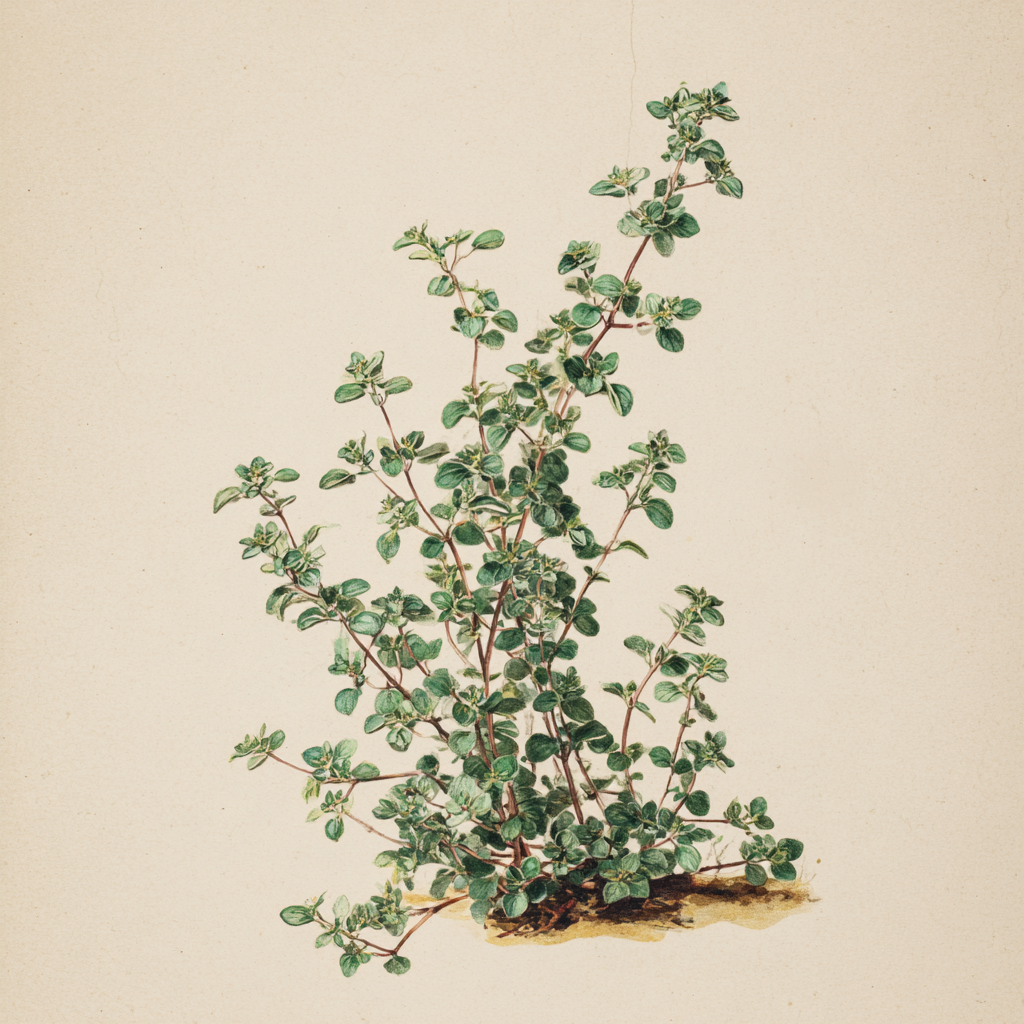
Shallow spreading roots and rhizome-like crowns that expand into clumps. Plants prefer drainage and decline in soggy winter soil.
Stem
Square branching stems that become woody near the base with age. Stems often sprawl outward and root lightly where they touch soil.
Leaves
Opposite oval leaves with a strong savory aroma, especially in sun. Leaf size and pungency vary widely between wild, Greek, and ornamental types.
Flowers
Small pink, purple, or white flowers in loose clusters. Blooming oregano is highly attractive to bees, hoverflies, and parasitic wasps.
Fruit
Produces tiny dry nutlets after flowering. Named culinary strains are often propagated by division or cuttings for reliable flavor.
Known Varieties
Common cultivars worth knowing
- Best for: cooking
Greek Oregano
Strong-flavored culinary oregano with white flowers and high aroma.
- Best for: sauces, herb blends
Italian Oregano
Milder oregano-marjoram type with rounded flavor.
- Best for: bold dishes
Hot and Spicy
Pungent selection with assertive flavor.
- Best for: edible borders
Golden Oregano
Chartreuse-leaved ornamental oregano with milder flavor.
- Best for: containers, pollinators
Kent Beauty
Ornamental cascading oregano with showy bracts.
Loading photo submission…