Okra
VegetableAbelmoschus esculentus
Have seeds for this? Add to inventory →Okra is a heat-loving tropical vegetable that thrives in long, hot summers and produces abundant edible seed pods. Its large, showy flowers are beautiful and highly attractive to pollinators.
Native Range
- Origin
- Okra is an Old World domesticate with African ancestry, though the exact wild origin is debated.
- Native Habitat
- Wild relatives occur in warm open ground, savanna margins, disturbed soils, and tropical seasonal habitats.
- Current Distribution
- Widely cultivated in warm climates; not native outside its region of origin.
Growing Conditions
Sunlight
Full Sun
Water Needs
Low
Soil
Well-draining loam or sandy loam; pH 6.0 - 6.8
Spacing
18 inches
Days to Maturity
50 - 65 days from transplant
Growing Zones
Thrives in USDA Zones 6 - 11
Companion Planting
When to Plant
Start Indoors
4 - 6 weeks before last frost
Transplant
After last frost, soil 65°F+
Direct Sow
2 - 3 weeks after last frost
Harvest
Harvest pods every 2 - 3 days when 2 - 4 inches long; pods toughen rapidly
Phenology (Natural Timing Cues)
Start Indoors
Start okra indoors 4 - 6 weeks before last frost - not much earlier, because okra grows fast and dislikes sitting in cool indoor conditions for extended periods. Cold air or cool, wet soil checks okra growth severely, and plants can be permanently set back by an early cold snap at transplanting. The indoor window is intentionally short: start early enough to have sturdy plants ready for warm outdoor conditions, but not so early they outgrow their pots before outdoor heat arrives.
- Dandelion bloom is fading.
- Lilacs are blooming or beginning to fade.
- Sunny outdoor beds are warming perceptibly during the day.
- Last frost is roughly 4 - 6 weeks away.
Direct Sow
Direct sow okra only after true summer heat is established in the soil - not just at the surface, but several inches down. Okra germinates and grows most strongly when soil temperatures are consistently above 65°F. Cold or wet seed rows produce patchy germination and weak seedlings. Soaking seed overnight before sowing softens the hard seed coat and speeds emergence significantly.
- Lilacs are well past bloom.
- Soil is clearly warm below the surface, not just sun-warmed on top.
- Warm-season weeds and grasses are growing vigorously.
- Night temperatures are staying above 60°F consistently.
Transplant
Transplant okra once heat is genuinely stable - okra is more heat-demanding than almost any other common vegetable and will sit nearly motionless in cool or unsettled conditions rather than establishing and growing. Okra transplanted into warm, active soil can grow several inches in a week; the same plant set out two weeks too early into cool soil may barely move for a month.
- Lilacs are well past bloom.
- Soil is clearly warm below the surface.
- Night temperatures stay reliably above 60°F.
- New okra growth on hardened-off starts stays firm and upright through a full warm day outdoors.
Start Dates (Your Location)
Based on your saved growing zone and this plant's timing notes.
Typical Last Frost
Set your growing zone to see personalized calendar dates.
Organic Growing Tips
Harvest pods every 2 - 3 days without fail - pods left on the plant become tough and stop production.
Soak seeds overnight before planting to soften the hard seed coat and speed germination.
Plant sunflowers nearby as companion crops that attract pollinators and provide afternoon shade.
Wear gloves and long sleeves when harvesting - okra plants have irritating fine spines on leaves and pods.
Common Pests
- Aphids
- Stink Bug
- Corn Earworm
- Root-Knot Nematode
All pest management in Garden uses safe, organic, non-toxic methods only. No synthetic pesticides, ever.
Taxonomy
- Kingdom
- Plantae
- Family
- Mallow family (Malvaceae)
- Genus
- Abelmoschus
- Species
- Abelmoschus esculentus
Natural History
Abelmoschus esculentus is a member of the mallow family (Malvaceae) and a close relative of hibiscus, cotton, and hollyhock. Its geographic origin is debated between West Africa (specifically the region of modern Ethiopia and Eritrea) and South Asia - possibly with independent selection in multiple regions. The earliest clear documentation comes from 12th-century Egypt, where it was described growing along the Nile by Arab botanists. Okra reached the Mediterranean world via Arab trade routes and appears in 13th-century Moorish Spanish agricultural manuscripts. Its most historically significant movement was the forced transport of enslaved Africans to the Americas from the 16th century onward; okra arrived in the Caribbean and southern United States carried by enslaved West Africans who brought seeds with them and preserved the plant and its culinary traditions against profound adversity. The English word okra derives from the Igbo word ọkụrụ. The word gumbo - the Louisiana stew synonymous with okra - derives from the Bantu kingombo or ngombo, tracing its origin to enslaved Congolese and Angolan Africans in Louisiana.
Traditional Use
Okra's most historically significant journey was across the Atlantic, carried by enslaved West Africans who preserved and planted the seeds of their food culture in the Americas. The words okra and gumbo, and the culinary traditions built around the plant, all trace directly to West African languages and knowledge systems.
Parts Noted Historically
West African Origin and the Transatlantic Slave Trade - Pods
Okra was a significant food crop in West Africa - in what is now Nigeria, Ghana, Benin, and the broader Slave Coast region - before the transatlantic slave trade. Enslaved Africans carried okra seeds to the Americas from the 16th century onward, preserving the plant in the Caribbean and southern United States as an act of cultural survival. The English word okra derives from the Igbo ọkụrụ. The word gumbo - the signature dish of Louisiana Creole and Cajun cooking - derives from the Bantu kingombo, tracing its origin specifically to enslaved Congolese and Angolan Africans.
Arab Mediterranean and Egyptian Cultivation - Pods
The earliest clear written documentation of okra comes from 12th-century Egypt, where Arab botanists described it growing along the Nile. Arab trade routes spread okra cultivation westward into North Africa and Moorish Spain; a 13th-century Andalusian agricultural manuscript describes okra cultivation. This Mediterranean presence predates the transatlantic movement of the plant and reflects a separate historical arc of okra's spread from its African origins.
Southern US and Louisiana Gumbo Tradition - Pods
In Louisiana and the American South, okra became a defining culinary plant through the direct continuation of West African food knowledge maintained by enslaved people. Gumbo uses okra's mucilaginous texture as a thickening agent and flavor element in a tradition explicitly traceable to West African soups. The word gumbo is the dish's name and the plant's African name simultaneously. No other American crop has a documented history as directly shaped by the forced migration of enslaved people and the preservation of African agricultural knowledge.
South Asian Bhindi Tradition - Pods
In South Asia, where okra is called bhindi or lady's finger, it has been cultivated and cooked as a significant vegetable for centuries. Indian dry-fried bhindi, Lebanese okra stew, and Egyptian bamia each represent regional appropriations of the same plant. The mucilaginous texture central to American gumbo is deliberately cooked out in Indian dry preparations - opposite ends of the culinary use spectrum from the same vegetable.
This information is provided for historical and educational purposes only and is not medical advice. Always consult a qualified healthcare professional before making decisions related to your health.
Morphology (Plant Structure & Identification)
Root System
Deep taproot with branching feeder roots, giving okra better drought tolerance than many vegetables once established.
Stem
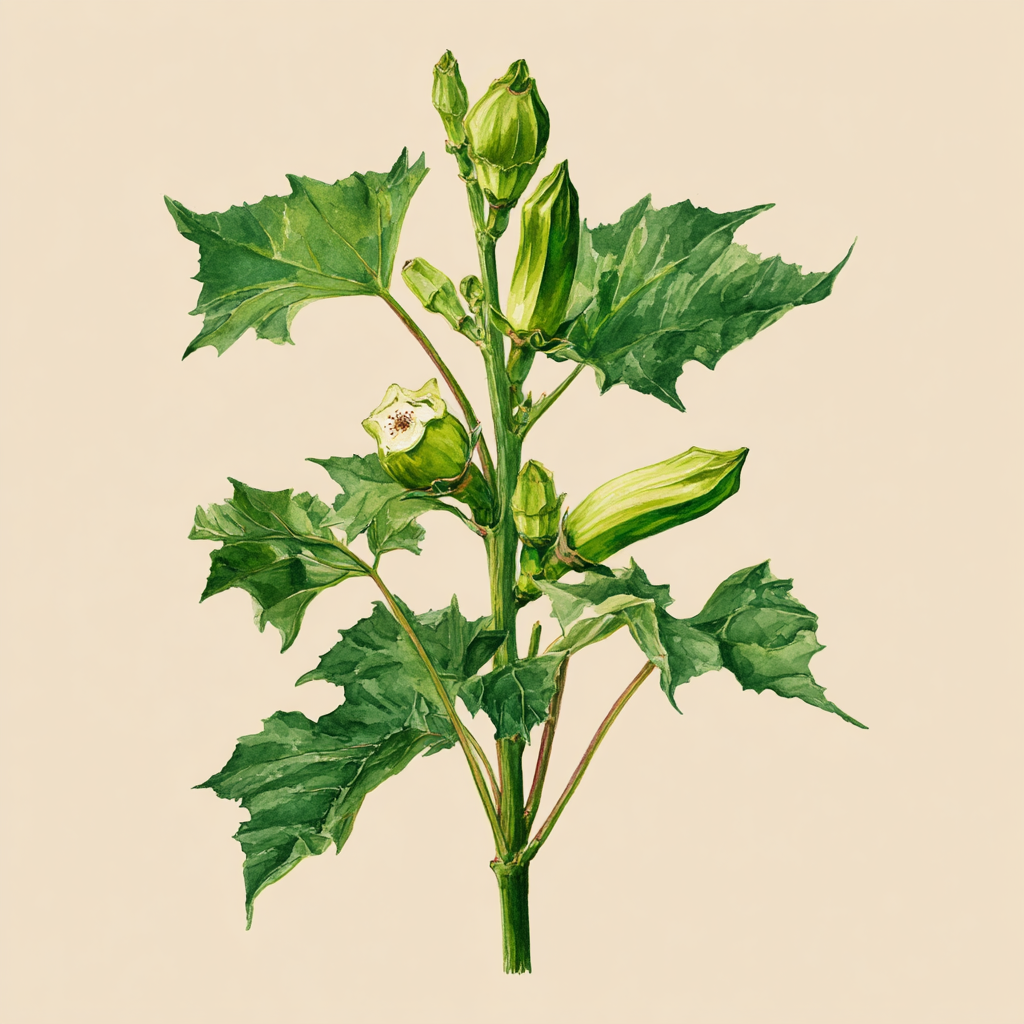
Upright, sturdy, sometimes bristly stem that can become woody at the base. Plants branch with repeated harvesting and can reach several feet tall.
Leaves
Large lobed leaves with a rough texture and fine irritating hairs on some varieties. Leaves resemble other mallow-family plants.
Flowers
Large pale yellow hibiscus-like flowers with dark red centers. Each flower is short-lived and gives way quickly to a pod in warm conditions.
Fruit
Ribbed green, red, or burgundy pods harvested young before fibers toughen. Pods lengthen quickly and become woody if left on the plant.
Known Varieties
Common cultivars worth knowing
- Best for: general garden use
Clemson Spineless
Classic green okra with productive plants and relatively smooth pods.
- Best for: shorter seasons
Annie Oakley II
Early hybrid with compact plants and heavy pod production.
- Best for: edible landscaping
Burgundy
Red-podded okra with ornamental value and tender young pods.
- Best for: high yields
Jambalaya
Early, productive variety with uniform green pods.
- Best for: traditional cooking
Star of David
Heirloom with thick, deeply ribbed pods and strong flavor.
Loading photo submission…