
Lemon
FruitCitrus limon
Have seeds for this? Add to inventory →Lemon trees are tender evergreen citrus that produce tart, aromatic fruit year-round in warm climates. They require frost-free conditions or container growing with winter protection, and reward care with continuous crops.
Native Range
- Origin
- Lemon is a cultivated Citrus hybrid with ancestry in Asian citrus lineages rather than a simple wild species range.
- Native Habitat
- Parent citrus lineages occupy warm subtropical forests, forest edges, and monsoon-influenced habitats.
- Current Distribution
- Cultivated globally; does not occur as a native plant in this form.
Growing Conditions
Sunlight
Full Sun
Water Needs
Moderate
Soil
Well-draining, slightly acidic loam; pH 5.5 - 6.5
Spacing
10 - 15 feet
Days to Maturity
3 - 5 years from seedling; grafted trees may bear in 1 - 2 years
Growing Zones
Thrives in USDA Zones 9 - 11
Companion Planting
When to Plant
Transplant
Spring in warm climates; container-grown trees can be planted year-round
Harvest
Year-round in tropical climates; colour is not always reliable - test for firmness and flavour
Phenology (Natural Timing Cues)
Transplant
Lemon trees are evergreen and never truly dormant, which means they can be transplanted almost any time in frost-free climates - but they establish best when spring warmth is consistent and roots can grow actively after planting. In cooler regions, or for container-grown trees moving outdoors for the season, wait until night temperatures are reliably above 45°F and cold swings are firmly over. Lemon roots sitting in cold, wet soil are vulnerable to root rot, making drainage and timing equally important.
- Lilacs have faded in temperate regions - a useful guide to settled warmth even where lemons do not grow alongside them.
- Soil is warming and draining freely within a day of rain.
- Night temperatures are reliably above 45°F with no cold forecast.
- New growth flushes on container citrus are staying firm outdoors rather than wilting back.
Start Dates (Your Location)
Based on your saved growing zone and this plant's timing notes.
Best Planting Window
Spring window
Spring
Plant early enough for roots to settle before summer heat.
Autumn window
Autumn in mild climates
Use autumn only where winters are mild and roots can keep growing after planting.
Planting Method
Plant a nursery-grown tree. Seed-grown fruit trees are slow and variable, so container or grafted stock is the practical choice.
Critical Timing Note
Plant after cold risk has passed so roots can establish without chilling or stalling.
Organic Growing Tips
Feed monthly through the growing season with worm castings or compost tea for steady, healthy growth.
Apply neem oil spray to control scale insects and citrus leafminer without harming beneficial insects.
Mulch out to the drip line to conserve moisture and gradually build soil organic matter.
Spray diluted seaweed solution regularly as a foliar feed and general health tonic.
Common Pests
- Citrus Leafminer
- Scale
- Aphids
- Spider Mites
- Citrus Gall Wasp
All pest management in Garden uses safe, organic, non-toxic methods only. No synthetic pesticides, ever.
Taxonomy
- Kingdom
- Plantae
- Family
- Citrus family (Rutaceae)
- Genus
- Citrus
- Species
- Citrus limon
Natural History
Citrus × limon is a hybrid of ancient origin, the result of crossing citron (Citrus medica) with sour orange or a closely related ancestor. Genetic analysis published in 2018 mapped the citrus family in detail, placing the lemon's origin in South Asia. The citron - the lemon's parent species - was among the first citrus fruits to reach the Mediterranean, likely introduced around the 4th century BCE. Arab agronomists of Moorish Spain and Sicily documented lemon cultivation extensively in the 10th-12th centuries, and it was Arab trade networks that spread the cultivated lemon across the Mediterranean from its Asian origins. The word lemon derives from the Arabic laymūn, itself from the Persian līmū. Vasco da Gama's 1497-1499 voyage documented lemon juice as effective against scurvy, though it took another 250 years for the British Navy to mandate citrus issue - James Lind's landmark 1747 controlled trial aboard HMS Salisbury demonstrated the effect definitively. Lemon peel oil, cold-pressed from the rind, became a significant Sicilian and Calabrian industry from the 18th century onward, supplying European fragrance and food flavoring markets.
Traditional Use
Lemon's food history is inseparable from two defining properties: the acidity of its juice and the aromatic oils of its peel. These shaped cooking, preservation, fragrance, and maritime medicine in distinct ways across more than 1,000 years of documented use.
Parts Noted Historically
Arab Agricultural Tradition and Mediterranean Spread - Fruit and peel
Arab agronomists of Moorish Spain and Sicily documented lemon cultivation extensively in the 10th-12th centuries. Ibn Bassal of Toledo's Kitab al-Filaha (Book of Agriculture, 11th century) describes citrus cultivation in detail. Arab trade networks carried lemons westward from South Asia across the Mediterranean, establishing the lemon as a Mediterranean fruit during the medieval period and giving it the Arabic-derived name it carries in most European languages.
Italian and Mediterranean Cooking - Fruit and peel
By the Renaissance, lemons were central to Italian cooking as a souring agent, marinade base, and flavor in both sweet and savory dishes. Lemon peel candying is documented in Italian confectionery from at least the 16th century. The tradition of preserving lemon peel - ranging from candied cedro to salt-preserved Moroccan lemons - represents a parallel preservation culture tied to the peel's aromatic oil content.
Maritime Medicine and Scurvy - Fruit
Vasco da Gama's voyages documented lemon juice as effective against scurvy - the vitamin C deficiency that devastated long ocean crews. James Lind's 1747 clinical trial aboard HMS Salisbury was the first controlled dietary experiment in naval history and confirmed citrus as the cure. The British Navy's 50-year delay in acting on this finding is one of the documented cases of institutional resistance to clear evidence; the Merchant Shipping Act of 1867 finally mandated citrus rations on British vessels.
Sicilian Peel Oil and Fragrance Industry - Peel
Cold-pressing of lemon peel for essential oil became a significant industry in Sicily and Calabria from the 18th century, supplying European fragrance and food flavoring markets. Lemon peel oil contains limonene as its dominant compound. The related bergamot orange - grown on the Calabrian coast - is the defining fragrance in Earl Grey tea and classic eaux de cologne, part of the same peel-oil tradition that connects Mediterranean citrus cultivation to modern commercial fragrance.
Lemon juice and peel are safe as food. Furocoumarin compounds in citrus peel can cause photosensitivity reactions when expressed peel oil contacts skin in strong sunlight.
This information is provided for historical and educational purposes only and is not medical advice. Always consult a qualified healthcare professional before making decisions related to your health.
Morphology (Plant Structure & Identification)
Root System
Evergreen citrus root system often grafted onto rootstock for disease resistance, size, and soil tolerance. Roots need air as much as moisture.
Stem
Small evergreen tree or large shrub with green young twigs and possible thorns. Container trees keep a compact branching habit with pruning.
Leaves
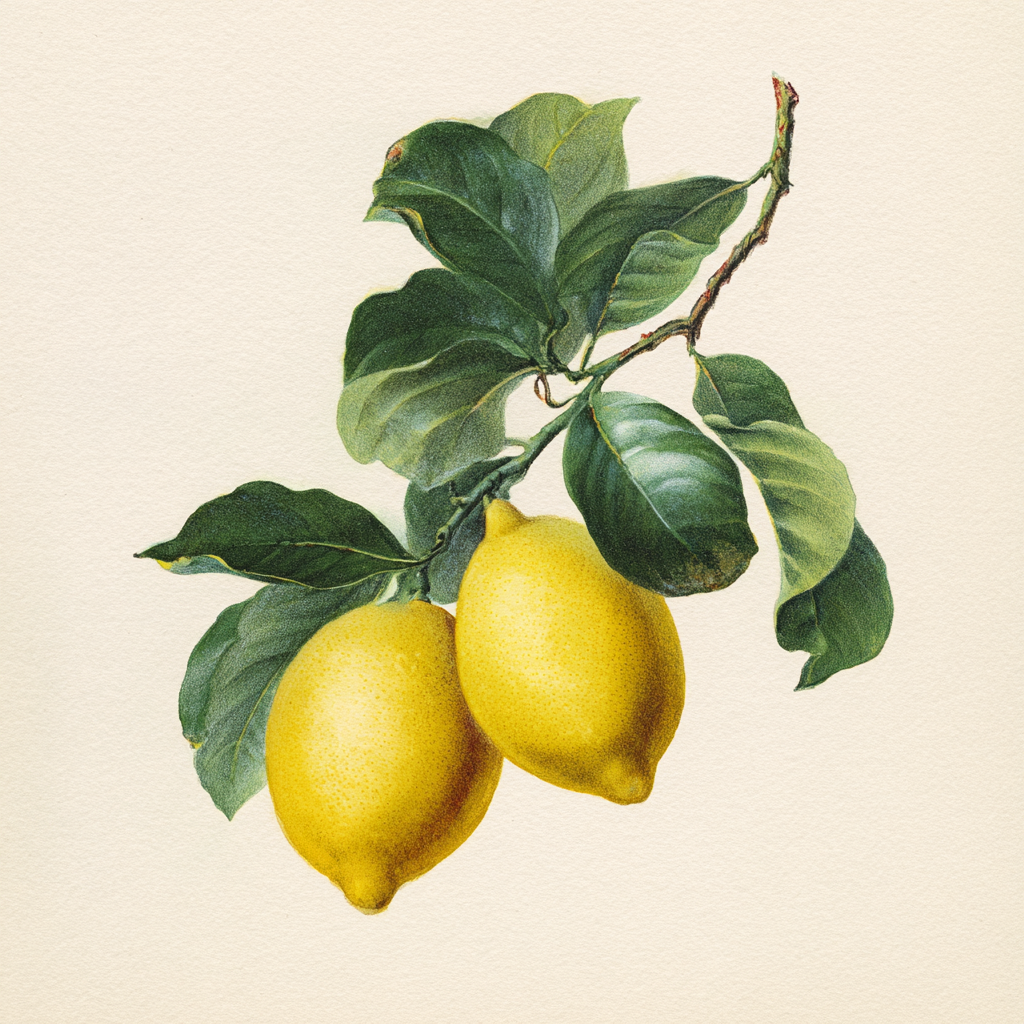
Glossy oval leaves with a strong citrus scent when crushed. Leaves persist year-round and yellowing often signals nutrient or watering problems.
Flowers
Fragrant white flowers, often flushed purple on the outside, may appear in multiple flushes in warm conditions.
Fruit
Oval yellow citrus fruit with aromatic oil-rich peel, segmented acidic pulp, and seeds depending on cultivar. Fruit can hang on the tree after coloring.
Known Varieties
Common cultivars worth knowing
- Best for: containers, home gardens
Meyer
Sweeter, less acidic lemon hybrid with thin skin and compact growth.
- Best for: culinary juice
Eureka
Common true lemon with year-round bearing in warm climates.
- Best for: warm orchards
Lisbon
Vigorous thornier lemon with strong cold and heat tolerance for a lemon.
- Best for: patios, indoor overwintering
Improved Meyer
Virus-free Meyer selection widely sold for container growing.
- Best for: novelty fruit
Ponderosa
Large-fruited citron-lemon hybrid with ornamental appeal.
Loading photo submission…