Fig
FruitFicus carica
Have seeds for this? Add to inventory →Fig trees are ancient, drought-tolerant Mediterranean fruits that produce luscious sweet fruit with minimal care. They thrive in warm, sheltered spots and can be grown in containers in cool climates to be brought indoors for winter.
Native Range
- Origin
- Common fig is native to the Mediterranean region and western Asia.
- Native Habitat
- Rocky slopes, cliffs, stream ravines, dry open woodland, and limestone crevices in warm climates.
- Current Distribution
- Naturalized across many mild regions, especially near settlement and disturbed habitats.
Growing Conditions
Sunlight
Full Sun
Water Needs
Low
Soil
Well-draining, moderately fertile loam; pH 6.0 - 6.5
Spacing
10 - 15 feet
Days to Maturity
2 - 3 years to first significant fruit; established trees produce two crops per year
Growing Zones
Thrives in USDA Zones 8 - 11
Companion Planting
When to Plant
Transplant
Spring after last frost; container-grown trees any time in mild climates
Harvest
When fruit is soft, droops on stem, and outer skin begins to split slightly
Phenology (Natural Timing Cues)
Transplant
Figs transplant most successfully when warmth is genuinely stable and the tree is just beginning to break dormancy. Planting a dormant or barely budding tree into warming soil lets roots and new shoots develop together. Avoid transplanting into cold, wet soil or during a late cold snap - fig roots are sensitive to sitting cold and waterlogged after planting, which can cause crown rot before establishment. Container-grown figs moved outdoors for the season need the same settled warmth.
- Lilacs have faded or are in the final stage of bloom.
- Fig buds are swelling visibly or the first small leaves are just opening.
- Soil in the planting site is warming at depth, not just at the surface.
- Night temperatures consistently stay above 45°F without forecast cold spells.
- Cold swings have ended for container plants moving outdoors.
Start Dates (Your Location)
Based on your saved growing zone and this plant's timing notes.
Best Planting Window
Spring window
After your last frost
Plant once frost risk has passed and spring conditions are settled.
Autumn window
Autumn in mild climates
Use autumn only where winters are mild and roots can keep growing after planting.
Planting Method
Plant a nursery-grown tree. Seed-grown fruit trees are slow and variable, so container or grafted stock is the practical choice.
Critical Timing Note
Plant after cold risk has passed so roots can establish without chilling or stalling.
Typical Harvest Window
August to September
Organic Growing Tips
Restrict root growth by planting in a confined space or container to encourage fruiting over foliage.
Plant comfrey at the base and use it as chop-and-drop mulch to build soil fertility slowly.
In cool climates, train as a fan against a south-facing wall to maximise warmth and ripening.
Prune in winter while fully dormant; wear gloves as the white latex sap causes skin irritation.
Common Pests
- Fig Beetle
- Birds
- Wasps
- Root-Knot Nematode
- Rust
All pest management in Garden uses safe, organic, non-toxic methods only. No synthetic pesticides, ever.
Taxonomy
- Kingdom
- Plantae
- Family
- Mulberry family (Moraceae)
- Genus
- Ficus
- Species
- Ficus carica
Natural History
Ficus carica may be the oldest deliberately cultivated food plant in the world. Nine carbonized figs recovered from the Neolithic site of Gilgal I in the Jordan Valley date to approximately 11,400 years ago - several thousand years before the earliest evidence of grain agriculture. Their seedless parthenocarpic character suggests they were selected human varieties rather than wild fruit, since wild figs do not set parthenocarpically. The fig appears in the oldest agricultural references in the Bible, in Sumerian texts from the 3rd millennium BCE, in Egyptian New Kingdom tomb paintings, and is one of the Seven Species of the Land of Israel (Deuteronomy 8:8). The unusual syconium structure - an inside-out flower receptacle enclosing hundreds of tiny flowers - requires the fig wasp Blastophaga psenes for pollination in Smyrna-type figs, but parthenocarpic common figs set fruit without pollination, explaining why they spread as vegetative cuttings throughout the ancient world without their specialist pollinator. Cato's De Agricultura of 160 BCE gives detailed fig cultivation instructions, and the Greeks had brought cultivated figs to Marseille (then Massalia) by around 600 BCE.
Traditional Use
Fig is one of the oldest documented food plants in human history, with evidence of cultivation predating grain agriculture in the Levant by millennia. Its food, cultural, and religious significance in Mediterranean, Middle Eastern, and North African traditions spans at least 10,000 years.
Parts Noted Historically
Ancient Near East and Biblical Tradition - Fruit
The fig appears among the first plants named in Genesis and is one of the Seven Species of the Land of Israel described in Deuteronomy. It features in Sumerian agricultural texts from the 3rd millennium BCE and Egyptian New Kingdom tomb paintings showing fig harvesting. The phrase "sitting under one's vine and fig tree" - a Hebrew idiom for security and peace appearing in Micah, Kings, and elsewhere - reflects how central the fig was to the ancient Near Eastern imagination of settled abundance.
Greek and Roman Cultivation - Fresh and dried fruit
Figs were a staple food in ancient Greece, consumed fresh, dried, and as fig cake (iskhás). Cato's De Agricultura (160 BCE) gives detailed cultivation instructions, and Pliny the Elder describes multiple distinct varieties. Roman armies distributed dried figs as military rations for their caloric density and keeping quality. Athens at one point imposed restrictions on fig export, treating the crop as a strategic food reserve - giving rise to the word sycophant (fig shower), thought by some scholars to reference those who reported illegal fig exports.
Islamic World and Quranic Significance - Fruit
The fig is mentioned multiple times in the Quran and has a surah named for it - At-Tin (The Fig, Chapter 95). In Islamic tradition, the fig is among the fruits associated with paradise. North African and Levantine fig culture represents one of the world's longest continuous fruit cultivation traditions; the Smyrna-type figs grown in modern Turkey and Tunisia are direct descendants of ancient cultivated strains.
Household Latex Use - Latex
The white latex produced by broken fig stems and leaves was noted in Greek and Roman medical texts as a topical agent. In Mediterranean folk practice, fig latex was used as a skin application for various purposes, a tradition documented in household herbals into the 19th century. The furocoumarins in fig latex are responsible for phototoxic reactions - a real effect that gave ancient observations about the sap some basis in chemistry.
Fig latex and leaf sap contain furocoumarins that can cause phototoxic skin reactions when fresh plant material contacts skin in bright sunlight. Ripe fruit is safe.
This information is provided for historical and educational purposes only and is not medical advice. Always consult a qualified healthcare professional before making decisions related to your health.
Morphology (Plant Structure & Identification)
Root System
Wide-spreading roots adapted to dry climates but capable of strong growth near moisture. Container or root restriction can help control vigor.
Stem
Multi-stemmed shrub or small tree with smooth gray bark and soft pithy young growth. Pruning wounds release white latex sap.
Leaves
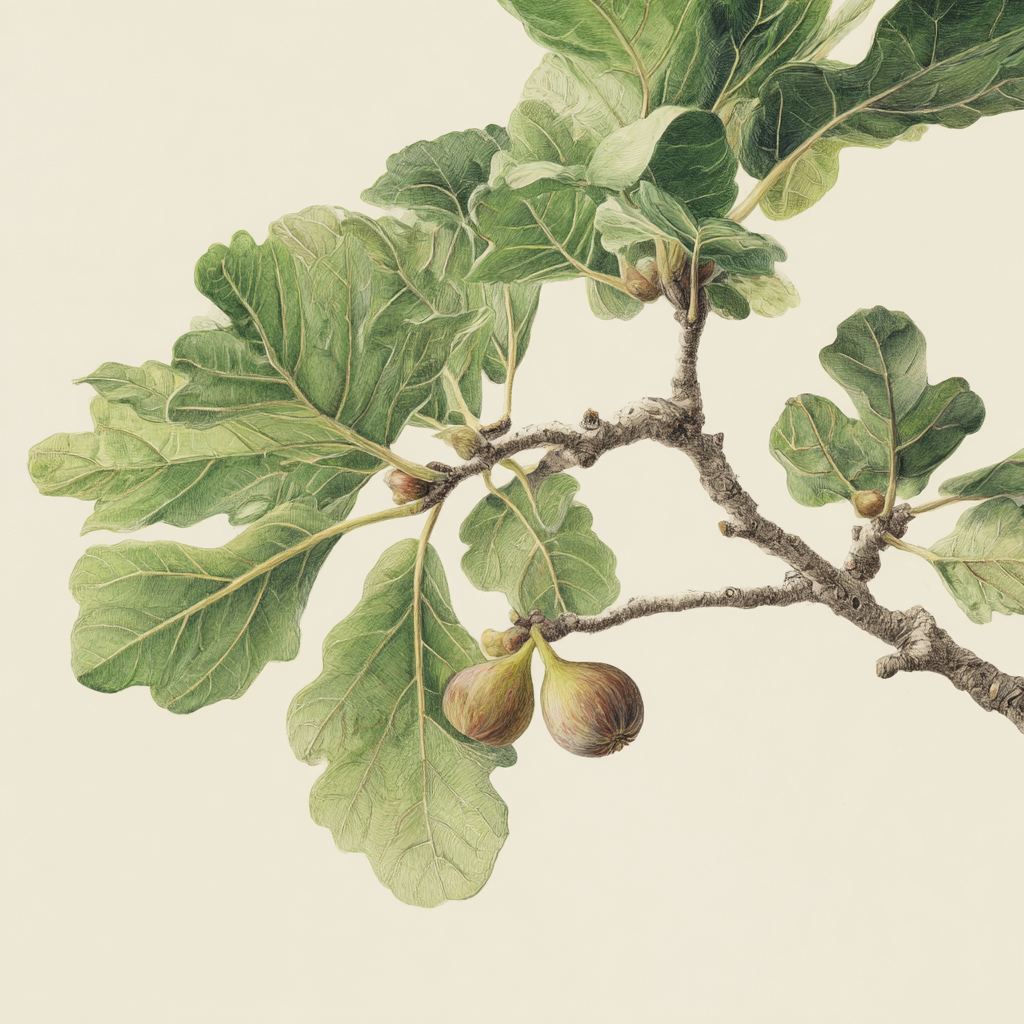
Large rough leaves, usually three- to five-lobed, with a distinctive fig scent when crushed.
Flowers
Tiny flowers are hidden inside the fig syconium, so the tree does not show obvious blossoms like most fruits.
Fruit
Soft pear-shaped figs ripen green, brown, purple, or black depending on variety. Ripe fruit droops, softens, and may crack slightly at the eye.
Known Varieties
Common cultivars worth knowing
- Best for: containers, general use
Brown Turkey
Reliable common fig with brown-purple skin and broad adaptability.
- Best for: borderline climates
Chicago Hardy
Cold-hardy fig that can regrow from roots in colder regions.
- Best for: humid regions
Celeste
Small sweet fig with closed eye and good splitting resistance.
- Best for: warm climates, drying
Black Mission
Classic dark fig with rich flavor and long cultivation history.
- Best for: drying, preserves
Kadota
Green to yellow fig with mild sweet flesh.
Loading photo submission…