
Bell Pepper
VegetableCapsicum annuum
Have seeds for this? Add to inventory →Bell peppers are warm-season crops that produce sweet, crisp fruit in a range of colours. They need a long growing season and are best started indoors well before the last frost.
Native Range
- Origin
- Capsicum annuum is native to the tropical and subtropical Americas, with domestication centered in Mexico and long movement through Indigenous American agriculture.
- Native Habitat
- Wild and semi-wild peppers occur in warm open woodland edges, thickets, disturbed soils, and frost-free seasonal habitats.
- Current Distribution
- Widely cultivated in suitable growing regions worldwide; not native outside its region of origin.
Growing Conditions
Sunlight
Full Sun
Water Needs
Moderate
Soil
Rich, well-draining loam; pH 6.0 - 6.8
Spacing
18 - 24 inches
Days to Maturity
70 - 90 days from transplant
Growing Zones
Thrives in USDA Zones 4 - 11
Companion Planting
When to Plant
Start Indoors
8 - 10 weeks before last frost
Transplant
After last frost, soil 65°F+
Harvest
70 - 90 days from transplant
Phenology (Natural Timing Cues)
Start Indoors
Start bell peppers indoors 8-10 weeks before transplant date - peppers germinate and grow more slowly than tomatoes and need a generous head start. Use a heat mat; soil temperature below 75°F will delay germination significantly.
- Deciduous trees are still bare or just showing the first bud swell.
- Dandelions have not yet reached heavy bloom.
- Tender annual weeds are not yet growing steadily outdoors.
Transplant
Transplant bell peppers only after soil has warmed - peppers stall in cool soil far more readily than tomatoes and a cold start can set the whole season back. Warm nights matter as much as warm days.
- Lilacs have bloomed and faded.
- Tender annual weeds are growing quickly and without checks.
- Soil feels warm several inches down, not just at the surface.
- Night temperatures reliably stay above 55°F.
Start Dates (Your Location)
Based on your saved growing zone and this plant's timing notes.
Typical Last Frost
Set your growing zone to see personalized calendar dates.
Organic Growing Tips
Grow basil nearby to deter aphids and flea beetles naturally.
Use row covers early in the season to protect young transplants from flea beetle damage.
Mulch heavily around the base to maintain consistent soil moisture and warmth.
Apply compost tea as a foliar spray to strengthen plants against disease.
Common Pests
- Aphids
- Flea Beetle
- Pepper Weevil
- Spider Mites
All pest management in Garden uses safe, organic, non-toxic methods only. No synthetic pesticides, ever.
Taxonomy
- Kingdom
- Plantae
- Family
- Nightshade family (Solanaceae)
- Genus
- Capsicum
- Species
- Capsicum annuum
Natural History
Bell peppers belong to Capsicum annuum, a species with its origins in central Mexico and Guatemala, part of a genus whose center of wild diversity lies in Bolivia. Capsicum peppers have been cultivated in the Americas for at least 6,000 years - among the oldest domesticated crops on the continent - and were present in Peruvian cooking as early as 4,600 years ago. When Columbus encountered them on his first voyage in 1492, he called them "peppers" as a misnomer: he was searching for black pepper (Piper nigrum) to justify the trade route, and the naming stuck despite the plants being botanically unrelated. Within 50 years of that first contact, Capsicum had spread through European trade networks to India, China, Korea, Hungary, and across Africa - one of the most rapid and transformative examples of the Columbian Exchange. Traditions that now seem deeply rooted in their regions - Hungarian paprika, Korean gochugaru, Indian chilli cooking - all date from post-Columbian introduction. The bell pepper specifically is a C. annuum variant carrying a recessive mutation that suppresses capsaicin production in the fruit walls; trace capsaicin remains in the white ribs and placenta, which is why those inner membranes are the mildest-hottest part of the fruit. Red bell peppers are simply fully ripe green bell peppers: the color shift brings a dramatic increase in sugar content and a near-tripling of vitamin C compared to the unripe green stage.
Traditional Use
Bell pepper as a distinct sweet variety is largely a modern selection, but the deep Capsicum tradition behind it stretches back thousands of years in Mesoamerica and South America. Once introduced to the Old World after 1492, Capsicum annuum was adopted with extraordinary speed and became so embedded in regional cuisines that its foreign origin is now often unrecognized.
Parts Noted Historically
Mesoamerican and South American Pre-Columbian Traditions - Fruit
Capsicum peppers were a fundamental ingredient in Mesoamerican cooking for millennia, used fresh, dried, and ground in preparations that are the direct ancestors of modern Mexican cuisine. Archaeological evidence places Capsicum use at Huaca Prieta in Peru as far back as 4,600 years ago. In the Aztec tradition, multiple pepper varieties played distinct roles in different preparations - mole, tamales, salsas - with a culinary sophistication that impressed early Spanish writers.
Hungarian Paprika Tradition - Dried fruit
Hungary is now one of the world's primary centers for sweet Capsicum annuum cultivation, and Hungarian paprika - made from dried, ground sweet and mildly hot peppers - carries DOP protection. The Kalocsa and Szeged regions are celebrated for their paprika quality. The entire tradition dates from post-1492 Ottoman introduction, yet paprika is now so deeply embedded in Hungarian cooking that it reads as a defining national ingredient.
Spanish and Mediterranean Roasted Pepper Traditions - Fruit
Spain developed significant sweet pepper traditions after Columbian introduction, including piquillo peppers (DOP-protected, from Lodosa in Navarre) and pimientos de Padrón. The tradition of roasting and preserving sweet peppers in olive oil spread through the Mediterranean and the Balkans, producing regional preparations such as Serbian and Macedonian ajvar - a roasted pepper and eggplant spread that now functions as a regional identity food.
Global Columbian Exchange Transformation - Dried and fresh fruit
The spread of Capsicum through the spice trade reshaped cooking across Africa, the Middle East, and South and East Asia within a remarkably short period. Indian, Korean, Thai, and North African cuisines were transformed by a plant with no presence in them before the 16th century. Korean gochugaru (the basis of kimchi), North African harissa, and Indian chilli cooking are all products of this single post-1492 dispersal.
Bell pepper fruit is food-safe in any quantity. The mutation that suppresses capsaicin in bell pepper fruit walls does not eliminate it entirely from the white ribs and placenta - those inner membranes retain trace amounts and are the mildest-hottest part of the fruit for sensitive individuals.
This information is provided for historical and educational purposes only and is not medical advice. Always consult a qualified healthcare professional before making decisions related to your health.
Morphology (Plant Structure & Identification)
Root System
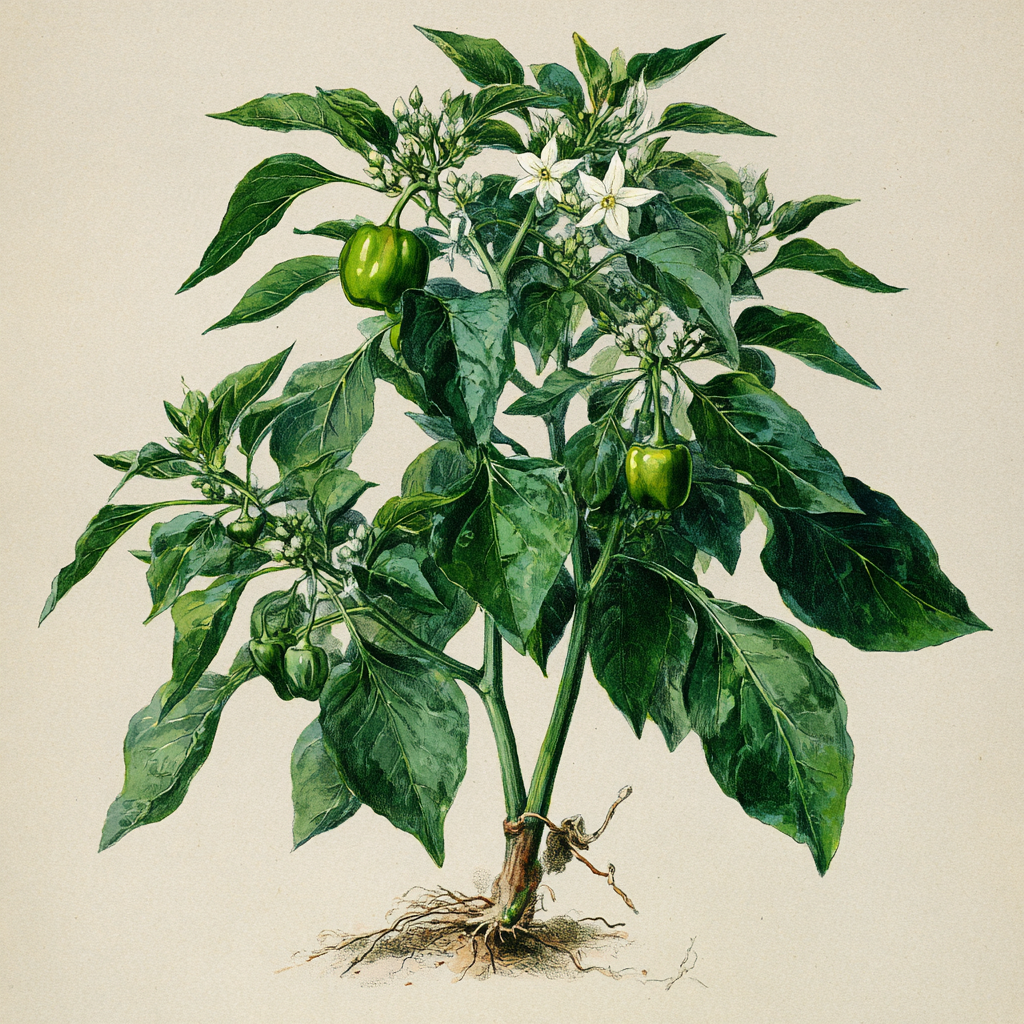
Moderately deep fibrous root system, less extensive than tomatoes. Prefers well-drained soil and is sensitive to waterlogging. Roots establish slowly which is why transplants need warm soil temperatures to thrive.
Stem
Woody, branching stem that becomes increasingly rigid with age. Plants develop a characteristic Y-shaped branching pattern. The main stem can reach 60-90cm on indeterminate varieties. Unlike tomatoes, peppers do not need to be staked until laden with fruit.
Leaves
Simple, oval to lance-shaped, smooth and glossy, alternately arranged. Dark green, 4-12cm long. Leaves are sensitive indicators of stress - drooping in heat, yellowing from nutrient deficiency, or developing spots from disease.
Flowers
Small, white, five-petaled, nodding downward from leaf axils. Self-pollinating but benefit from pollinator activity and air movement. First flowers often drop without setting fruit if temperatures are extreme or conditions are stressful.
Fruit
Technically a berry, developing from a single flower. Bell peppers have thick, crisp walls surrounding a hollow interior with a central placenta bearing seeds. Color changes from green to red, orange, or yellow as it ripens and sugar content increases dramatically - red peppers are simply fully ripe green peppers.
Known Varieties
Common cultivars worth knowing
- Best for: general use, stuffing
California Wonder
Classic blocky green bell pepper, reliable and productive. The standard by which other bells are measured. Turns red when fully ripe.
- Best for: fresh eating, visual interest
Chocolate Beauty
Unusual brown-colored bell with sweet, rich flavor. Striking appearance and excellent productivity.
- Best for: fresh eating, roasting
Orange Sun
Large, thick-walled orange bell with sweet flavor. High in vitamin C and carotenoids.
- Best for: fresh eating, salads
Purple Beauty
Deep purple bell that turns green when cooked. Mild, sweet flavor and striking raw appearance.
- Best for: fresh eating, roasting
Golden California Wonder
Yellow version of the classic California Wonder. Sweet and mild at full maturity.
- Best for: fresh eating, containers
Lipstick
Pimiento-type sweet pepper with thick walls and exceptional sweetness. Compact plant, good for containers.
- Best for: short seasons, fresh eating
Gypsy
Early-maturing hybrid with tapered fruit that ripens from yellow to orange to red. Very productive and disease resistant.
- Best for: frying, roasting, drying
Jimmy Nardello
Italian heirloom frying pepper, thin-walled and exceptionally sweet. Excellent for sauteing and roasting.
Loading photo submission…