
Arugula
VegetableEruca vesicaria
Have seeds for this? Add to inventory →Arugula is a fast-growing peppery salad green that thrives in cool weather and can be harvested repeatedly as cut-and-come-again leaves. It bolts in summer heat but self-seeds freely for successive crops.
Native Range
- Origin
- Arugula is native to the Mediterranean region and western Asia.
- Native Habitat
- Dry open ground, field margins, disturbed soils, roadsides, and seasonally cool Mediterranean habitats.
- Current Distribution
- Naturalized across many temperate regions, especially in disturbed habitats.
Growing Conditions
Sunlight
Partial Shade
Water Needs
Moderate
Soil
Well-draining loam; pH 6.0 - 7.0
Spacing
6 inches after thinning
Days to Maturity
35 - 45 days from sowing
Growing Zones
Thrives in USDA Zones 3 - 10
Companion Planting
When to Plant
Direct Sow
3 - 5 weeks before last frost; succession sow every 2 weeks
Harvest
35 - 45 days; pick leaves before flowers appear for best flavour
Phenology (Natural Timing Cues)
Direct Sow
Sow arugula in cool windows at both ends of the season. Small successions every two weeks give better continuous harvests than one large sowing - and stop spring sowing once daytime temperatures start pushing consistently past 70°F.
- Early dandelions are beginning to bloom (spring sowing).
- Soil surface is cool and holds moisture between rains.
- Cool-season weeds are growing actively.
- Daytime temperatures are reliably below 70°F.
- Summer heat has eased and first cool nights have returned (late summer sowing).
Start Dates (Your Location)
Based on your saved growing zone and this plant's timing notes.
Typical Last Frost
Set your growing zone to see personalized calendar dates.
Organic Growing Tips
Cover with fine mesh or row fabric to exclude flea beetles, which riddle leaves with tiny holes.
Grow in partial shade during summer to extend the season and delay bolting.
Allow a few plants to flower and set seed for a self-sustaining, low-maintenance patch.
Sow into beds enriched with compost and mulch immediately after germination — arugula grown in biologically active, moisture-retentive soil produces more tender, less bitter leaves and bolts later than plants in bare ground.
Common Pests
- Flea Beetle
- Aphids
- Slugs
- Cabbage White Caterpillar
All pest management in Garden uses safe, organic, non-toxic methods only. No synthetic pesticides, ever.
Taxonomy
- Kingdom
- Plantae
- Family
- Mustard family (Brassicaceae)
- Genus
- Eruca
- Species
- Eruca vesicaria
Natural History
Arugula, also known as rocket, is native to the Mediterranean basin and western Asia, where it grows wild in dry, stony ground from Morocco to Syria. It belongs to the mustard family and shares the peppery glucosinolates that characterise that group - the same compounds that give mustard, radish, and watercress their bite. The Romans cultivated it extensively; it appears by name in the writings of Virgil, Columella, and Pliny the Elder, who valued it as a pungent table green. Medieval European monastery gardens carried the tradition forward, and by the Renaissance it was a common kitchen green across southern Europe. Its popularity fell sharply through much of the 20th century in Britain and North America before a strong revival in the 1980s and 1990s, when it became closely associated with Italian-influenced restaurant cooking. A close relative, wild rocket (Diplotaxis tenuifolia), is a separate species with narrower, more deeply cut leaves and a more persistent heat - the two are often sold interchangeably but are botanically distinct.
Traditional Use
Arugula has been a kitchen green in Mediterranean cultures for over two thousand years, with documented use in ancient Roman cooking and through medieval and Renaissance food traditions. Its culinary role has always centred on its sharp peppery bite - used raw in salads, scattered over cooked dishes, or wilted briefly as a bitter green.
Parts Noted Historically
Ancient Roman Culinary Traditions - Leaves
Arugula appears in Roman agricultural and culinary texts including Columella's De Re Rustica and Pliny's Naturalis Historia. Virgil mentions it in the Moretum - a poem describing the preparation of a herb and vegetable paste that is one of the earliest documented salad recipes in Western literature. It was grown commonly in Roman kitchen gardens and used as a pungent counterpoint to milder leaves.
Italian Regional Traditions - Leaves
In southern Italy, particularly Puglia and Campania, arugula holds a distinct place in regional cooking that long predates its international popularity. Raw leaves are laid over hot pizza fresh from the oven, dressed with lemon and olive oil, or paired with orecchiette pasta and cured meats. The tradition treats it as an intense flavoring green used for its sharpness rather than as a base leaf.
Medieval Monastery and Kitchen Garden Traditions - Leaves and seeds
Arugula featured in medieval European herb lists and monastery garden records as a kitchen green valued for its strong flavor. It was grown alongside sorrel, purslane, and chicory as part of the bitter greens tradition common in pre-modern European cooking, where strong flavors were associated with stimulating appetite and digestion.
South Asian Taramira Oil Tradition - Seeds
In Pakistan and northwest India, arugula seeds are cold-pressed to produce taramira oil (also called jamba or tara oil), a strongly flavored cooking and condiment oil. This tradition is largely independent of Mediterranean culinary use and represents a distinct regional history for the same plant.
Arugula leaves and flowers are food-safe in any culinary quantity. The seeds are edible and used traditionally for oil production but have a sharp, bitter taste and are not eaten whole in most culinary traditions.
This information is provided for historical and educational purposes only and is not medical advice. Always consult a qualified healthcare professional before making decisions related to your health.
Morphology (Plant Structure & Identification)
Root System
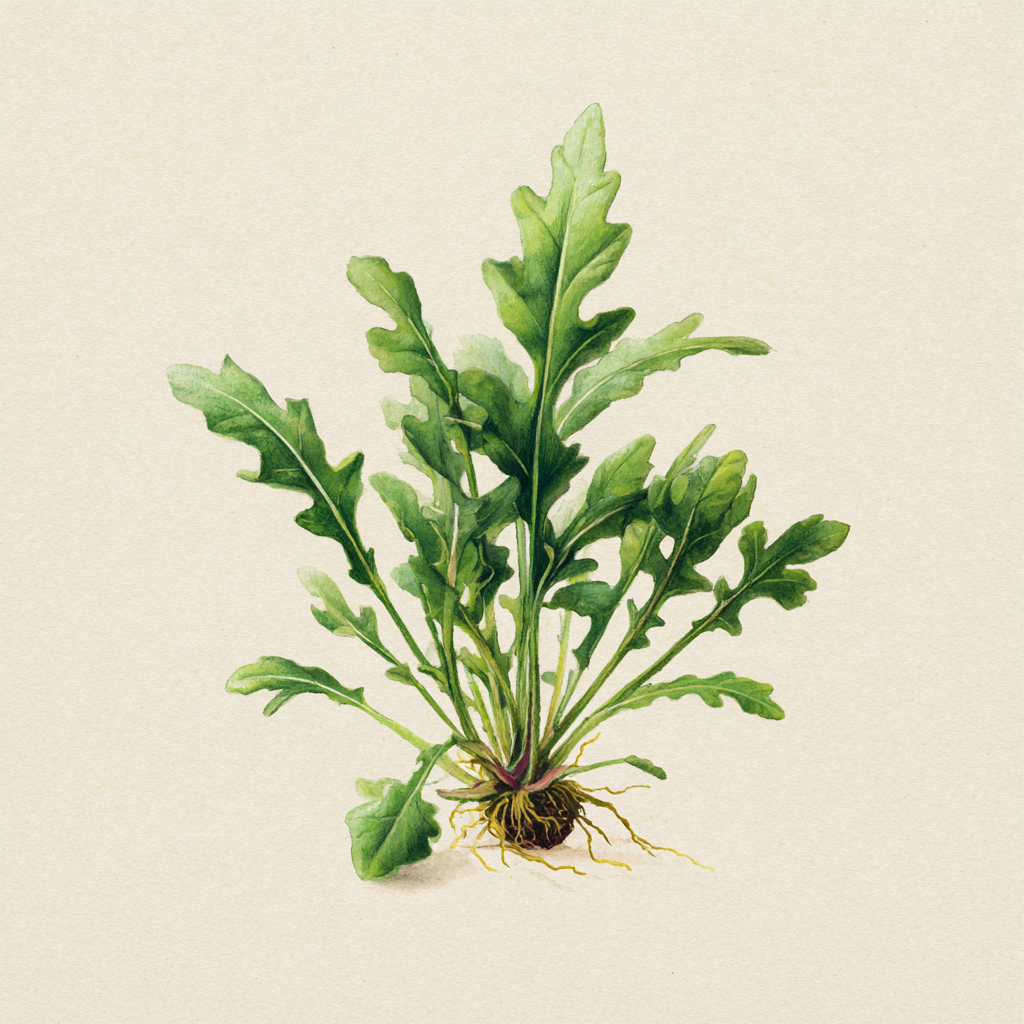
Fine taproot with shallow feeder roots, suited to quick growth in cool soil. Plants need even moisture for tender leaves.
Stem
Low rosette at first, then a branching flower stalk as plants bolt. Stems elongate rapidly in heat.
Leaves
Deeply lobed green leaves with a peppery scent and flavor. Young leaves are tender; older leaves become stronger and more fibrous.
Flowers
Small cream to white four-petaled flowers with dark veins. Flowers are edible and attract small pollinators.
Fruit
Produces narrow seed pods after flowering. The harvested crop is usually young leaves, though flowers and pods can also be used culinarily.
Known Varieties
Common cultivars worth knowing
- Best for: baby leaf
Astro
Fast-growing arugula with milder flavor and less deeply cut leaves.
- Best for: intense flavor, perennial tendency
Sylvetta
Wild arugula type with narrow leaves and stronger peppery flavor.
- Best for: salad mixes
Runway
Uniform cultivated arugula with upright growth for easy cutting.
- Best for: spicy greens
Wasabi
Very pungent type with sharp heat and narrow leaves.
- Best for: colorful salads
Dragon's Tongue
Oakleaf arugula with red veins and strong visual appeal.
Loading photo submission…