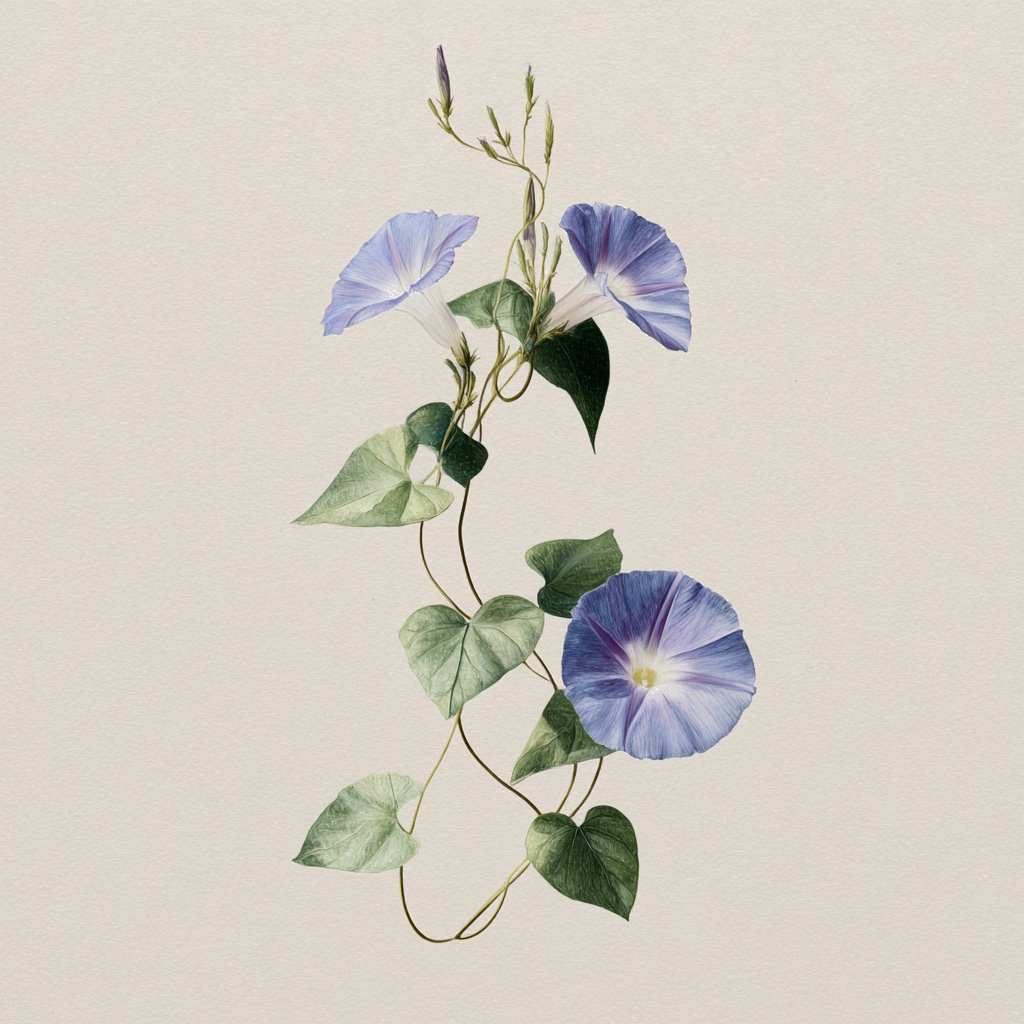
Morning Glory
FlowerIpomoea purpurea
Have seeds for this? Add to inventory →Morning glory is a fast-growing annual vine with vivid trumpet flowers that open in the morning and fade by afternoon. It provides rapid vertical cover for trellises and fences while attracting hummingbirds and butterflies, though it can self-seed aggressively.
Native Range
- Origin
- Common morning glory is native to Mexico and Central America.
- Native Habitat
- Warm open ground, thickets, field margins, roadsides, and disturbed soils where vines can climb surrounding vegetation.
- Current Distribution
- Naturalized across many warm and temperate regions, especially in disturbed habitats.
Growing Conditions
Sunlight
Full Sun
Water Needs
Low
Soil
Well-draining loam; pH 6.0 - 7.5; thrives in poor soil
Spacing
6 inches at base of trellis or support
Days to Maturity
65 - 75 days from sowing to first flower
Growing Zones
Thrives in USDA Zones 3 - 11
Companion Planting
When to Plant
Direct Sow
After last frost; nick or soak seeds overnight to speed germination
Harvest
Deadhead spent flowers to reduce aggressive self-seeding
Phenology (Natural Timing Cues)
Direct Sow
Morning glory must be direct sown at the base of its support - vines grow so rapidly in warm conditions that starting them elsewhere and moving them is rarely practical. The seed coat is extremely hard and needs either nicking with a file or overnight soaking before sowing, otherwise germination is slow and patchy even in warm soil. Wait for genuinely warm conditions; morning glory sown into cool soil germinates reluctantly and grows sluggishly. Have the trellis, fence, or support fully installed before seed goes in.
- Lilacs have fully faded.
- Soil is warm in the top few inches, not just at the surface.
- Tender annual weeds are growing actively without cold setback.
- Trellis or climbing support is fully in place before sowing.
Start Dates (Your Location)
Based on your saved growing zone and this plant's timing notes.
Typical Last Frost
Set your growing zone to see personalized calendar dates.
Organic Growing Tips
Soak or nick seeds before sowing - morning glory has an extremely hard seed coat that slows germination.
Deadhead diligently to prevent excessive self-seeding, which can become invasive in warm climates.
Grow up corn stalks or sunflower stems as a living trellis in the Three Sisters garden.
Allow spent vines to be cut and composted at season's end rather than sent to waste — morning glory biomass breaks down quickly and makes a rich addition to the compost heap that will feed next season's vegetable beds.
Common Pests
- Aphids
- Leaf Miners
- Spider Mites
All pest management in Garden uses safe, organic, non-toxic methods only. No synthetic pesticides, ever.
Taxonomy
- Kingdom
- Plantae
- Family
- Morning glory family (Convolvulaceae)
- Genus
- Ipomoea
- Species
- Ipomoea purpurea
Natural History
Ipomoea purpurea and related morning glory species belong to the Convolvulaceae (bindweed family) and are native to tropical Mexico and Central America. The genus Ipomoea is one of the largest in the flowering plant world, with around 500-600 species - including the sweet potato (Ipomoea batatas). Morning glories were cultivated by Aztec and pre-Columbian Mesoamerican peoples; Ipomoea tricolor (the heavenly blue type) was particularly significant in ritual contexts, where the ergoline alkaloids in its seeds were understood to produce visionary states. Francisco Hernández, Philip II's botanist during his 1570-1577 expedition to New Spain, documented Aztec use of ololiuqui (Ipomoea tricolor seeds) in divination rituals. The seeds were not chemically analyzed until 1960, when Albert Hofmann - who had also first synthesized LSD in 1938 - identified the active compounds as ergine (d-lysergic acid amide) and related ergolines. Morning glory became a popular ornamental in Japan during the Edo period (1603-1868), where breeders created thousands of named varieties called asagao.
Traditional Use
Morning glory's most historically significant use was among Aztec and Mesoamerican peoples, where Ipomoea tricolor seeds (ololiuqui) were used in divination and healing rituals documented by Spanish observers in the 16th century and not chemically characterized until Albert Hofmann in 1960.
Parts Noted Historically
Aztec Ritual Use of Ololiuqui - Seeds
Ipomoea tricolor seeds, called ololiuqui in Nahuatl, were used by Aztec priests and healers in divination and ritual contexts. Francisco Hernández documented their use in his 1570-1577 botanical survey of New Spain, noting that ololiuqui was administered to induce visionary states for healing and prophecy. The tradition was suppressed by Spanish colonial authorities. In 1960, Albert Hofmann identified the active compounds as ergine (d-lysergic acid amide, LSA) and related ergolines, establishing the chemical connection between this Aztec ritual plant and synthetic psychedelics.
Japanese Asagao Garden Culture - Flowers
Morning glory (asagao - "morning face") became one of the most culturally significant garden flowers in Japan during the Edo period (1603-1868). Japanese breeders created thousands of named varieties through deliberate selection and inbreeding, producing dramatic mutations including split petals, fringed edges, and contorted forms that were far removed from the wild species. Asagao cultivation became a serious competitive hobby among Edo townspeople. Annual asagao markets at temples in Tokyo date to the early 19th century and are still held today.
Victorian Ornamental Gardening - Flowers
Morning glory was a popular Victorian garden plant for its rapid cover of fences and arches. The development of the Heavenly Blue variety (Ipomoea tricolor) in the early 20th century - with its large, clear sky-blue flowers - became one of the defining ornamental morning glories in Western gardens. The speed of the vine and the brief daily opening of each flower gave morning glory a particular place in Victorian garden writing about transience and morning beauty.
Ipomoea and Sweet Potato Kinship - Flowers
Morning glory's membership in Ipomoea places it in direct kinship with the sweet potato (Ipomoea batatas), one of the world's most important food crops. The same genus includes hundreds of tropical and subtropical species used as food, dye, and ritual plant material across the Americas, Africa, and Asia. The ornamental morning glory is therefore part of a considerably more culturally significant plant complex than its garden fence role suggests.
Morning glory seeds contain ergoline alkaloids (primarily ergine/LSA) and are toxic if ingested. Seeds sold commercially are often treated with pesticides or antifungal coatings. The seeds are not edible.
This information is provided for historical and educational purposes only and is not medical advice. Always consult a qualified healthcare professional before making decisions related to your health.
Morphology (Plant Structure & Identification)
Root System
Fibrous annual root system that establishes quickly once warm soil triggers germination.
Stem
Slender twining vines that wrap around supports and can cover fences or nearby plants rapidly.
Leaves
Usually heart-shaped green leaves with pointed tips, arranged alternately along the vine.
Flowers
Funnel-shaped flowers in blue, purple, pink, white, or bicolor forms that open in the morning and fade later in the day.
Fruit
Round dry capsules holding hard dark seeds that often persist in soil and self-sow.
Known Varieties
Common cultivars worth knowing
- Best for: trellises
Heavenly Blue
Classic sky-blue flowers with pale throats on vigorous vines.
- Best for: heirloom gardens
Grandpa Ott
Deep purple heirloom with a red star and strong self-sowing habit.
- Best for: bold vertical color
Scarlet O'Hara
Bright magenta-red flowers on fast vines.
- Best for: moon garden accents
Pearly Gates
White-flowered selection with the same vigorous twining habit.
- Best for: novel blooms
Flying Saucers
Blue-and-white streaked flowers with variable patterns.
- Best for: dark color schemes
Knowlians Black
Deep purple-black flowers with a dramatic look.
Loading photo submission…