
Buttonbush
FlowerCephalanthus occidentalis
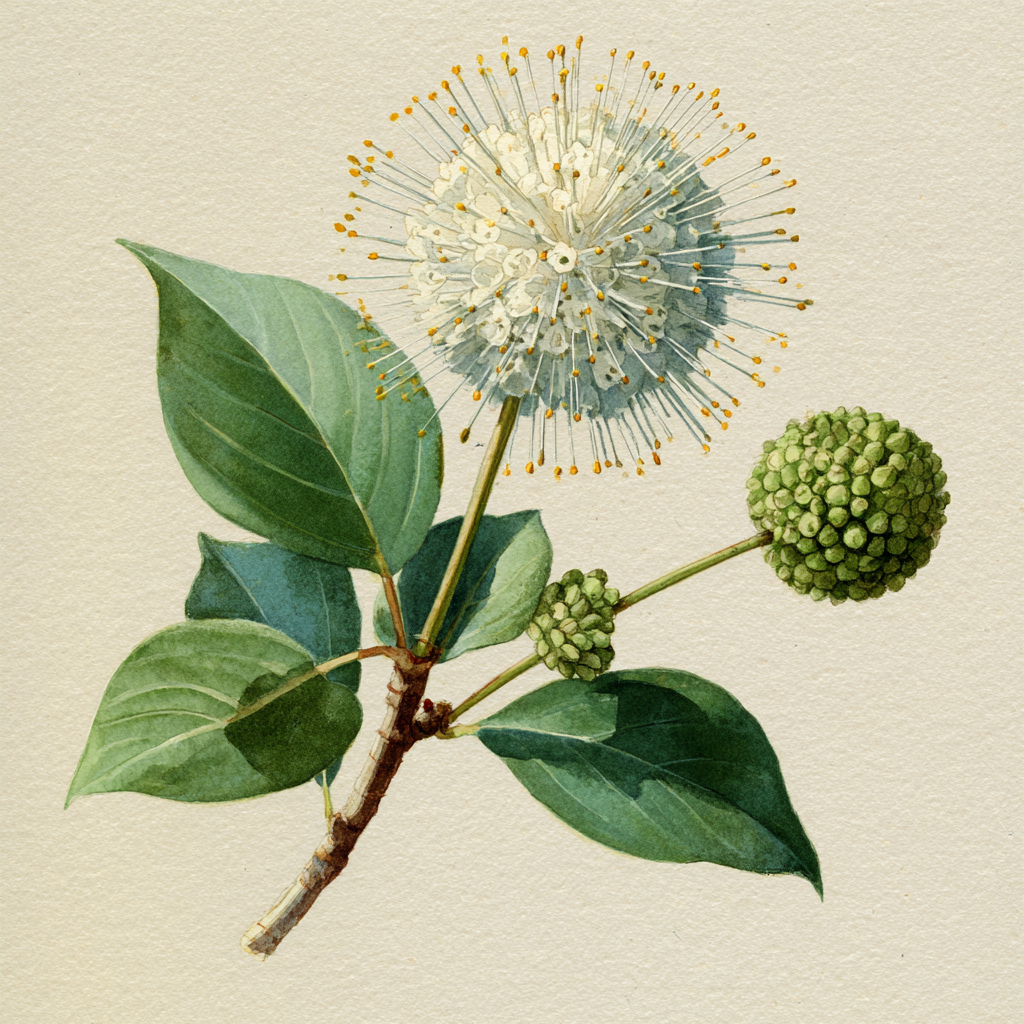
Have seeds for this? Add to inventory →Buttonbush is a native shrub of remarkable pollinator value, producing spherical, pin-cushion-like white flowers that are among the most heavily visited of any native plant in midsummer. Butterflies, native bees, hummingbirds, and other insects visit the blooms in extraordinary numbers. Uniquely adapted to wet conditions where few other shrubs succeed, it thrives in standing water, pond margins, and seasonally flooded ground. Its round seed heads persist through winter, providing food for waterfowl and songbirds.
Growing Conditions
Growing Conditions
Sunlight
Full Sun to Partial Shade
Water Needs
High
Soil
Wet to moist, tolerates standing water and heavy clay; pH 5.0-7.5; naturally grows in floodplains, swamp margins, and pond edges
Spacing
72 to 120 inches
Days to Maturity
First flowering typically in year 2-3 from transplant; full mature size (6-12 feet) in 5-7 years
Growing Zones
Growing Zones
Thrives in USDA Zones 4 - 11
When to Plant
When to Plant
Transplant
Plant container-grown stock in spring or early fall in moist to wet soil; one of the few shrubs that establishes in standing water
Harvest
No edible harvest; grown for wildlife and pollinator value
Phenology (Natural Timing Cues)
Transplant
Plant buttonbush in spring after the last frost or in early fall before hard frost. It establishes readily in moist to wet soil and is tolerant of periodic flooding, so timing is flexible as long as the ground is not frozen. Spring planting gives the plant a full season to establish before its first winter.
- Spring: soil consistently moist and nighttime temps above 40°F
- Surrounding wetland vegetation showing new growth
- Fall: temperatures cooling below 60°F and at least 6 weeks before first hard frost
- Pondside willows and alders showing leaf drop signals fall planting window
Start Dates (Your Location)
Average dates use your saved zone; readiness also checks your forecast when available.
Best Planting Window
Spring window
Spring
Plant early enough for roots to settle before summer heat.
Autumn window
Usually skip autumn planting
Use spring unless you have locally grown nursery stock and enough mild weather for roots to establish.
Planting Method
Use nursery-grown planting stock rather than treating this as a standard seed-starting crop.
Critical Timing Note
Plant after cold risk has passed so roots can establish without chilling or stalling.
Use the average timing, but check your local forecast before planting.
Organic Growing Tips
Organic Growing Tips
One of very few woody plants that will grow in standing water - ideal for rain gardens, pond margins, and wet swales.
The summer flower display rivals any cultivated shrub for pollinator activity; plant near a seating area to observe the diversity of visitors.
Round seed heads attract wood ducks, mallards, and shorebirds; especially valuable in constructed wetland plantings.
No fertilizer or amendment is needed in naturally moist sites; excess fertility promotes leggy growth over flowering.
Care Guidance
Optional seasonal guidance for what you can do, even when nothing is urgent.
Care Guidance
Watering
During active growth and extended dry periods, this plant often benefits from steadier moisture. If the top inch dries out, a slow deep watering at the base is often enough.
Feeding
Extra feeding is rarely required if soil is healthy. If growth looks pale or slow, a light compost top-dressing is often enough before adding anything stronger.
Pruning
If pruning is needed, dormancy or the period just after harvest is often the simplest window. Dead, damaged, or crossing growth is usually the first place to start.
Seasonal care
In late fall, a light cleanup and fresh mulch can help if winter protection is useful in your climate. Leaving a little space around crowns and trunks often helps air move and keeps excess moisture from sitting there.
Known Varieties
Common cultivars worth knowing
Known Varieties
Straight Species
The wild-type buttonbush; maximum ecological value for pollinators and waterfowl. Seed-grown plants from local sources are ideal for restoration plantings.
Best for
Rain gardens; pond margins; wet swales; maximum pollinator value
Sugar Shack
Compact selection reaching 3-4 feet rather than the typical 6-12; same extraordinary pollinator value in a manageable size; suited to smaller rain gardens and wet borders.
Best for
Smaller rain gardens; wet borders; container culture in wet areas
Companion Planting
Companion Planting
Good companions
- Blue Flag Iris
- Native Sedges
Support & insectary plants
Nearby plants that attract pollinators, beneficial insects, or improve soil health.
- Swamp Milkweed
Attracts pollinators and beneficial insects
- Cardinal Flower
Attracts pollinators and beneficial insects
- Winterberry Holly
Attracts pollinators and beneficial insects
Avoid planting near
No known conflicts
Common Pests
Common Pests
- Buttonbush Leafminer
- Scales; generally very pest-resistant in moist sites
All pest management in Garden uses safe, organic, non-toxic methods only. No synthetic pesticides, ever.
Native Range
Native Range
- Origin
- Native to North America, Central America, and the Caribbean.
- Native Habitat
- Swamps, pond margins, streambanks, floodplain forests, and seasonally flooded thickets across a wide range from Nova Scotia to California and south to Cuba and Mexico.
- Current Distribution
- Widespread across North and Central America within its native range; increasingly used in rain gardens and constructed wetland plantings.
Taxonomy
Taxonomy
- Kingdom
- Plantae
- Family
- Coffee family (Rubiaceae)
- Genus
- Cephalanthus
- Species
- occidentalis
Morphology
Morphology
Root System
Dense, fibrous, and spreading; highly adapted to wet, anaerobic soils; forms thickets over time and provides excellent streambank stabilization.
Stem
Multi-stemmed deciduous shrub, 6-12 feet tall; young stems reddish-brown, older bark gray and furrowed.
Leaves
Opposite or whorled, ovate to elliptic, 3-6 inches long; glossy dark green; turn yellow in fall.
Flowers
Spherical 1-inch white flower heads composed of dozens of small tubular florets, each tipped with a protruding style; fragrant; bloom July-August.
Fruit
Hard, spherical clusters of nutlets that persist through winter and are consumed by waterfowl.
Natural History
Natural History
Cephalanthus occidentalis is native across a vast range from Nova Scotia and Ontario south to Cuba and Mexico and west to California, growing naturally in swamps, streambanks, pond margins, and floodplain forests. Despite its wide range, it is often overlooked in native plant gardening because it requires wet conditions that are absent in most suburban landscapes. The genus name derives from the Greek kephale (head) and anthos (flower), describing the spherical flower heads. Indigenous peoples across its range used bark preparations medicinally. Its extraordinary value to pollinators was documented in early entomological literature and has been repeatedly confirmed in modern pollinator studies.
Loading photo submission…