Plantain
HerbPlantago major / Plantago lanceolata
Have seeds for this? Add to inventory →A common and highly resilient plant found in lawns, paths, and disturbed soils. Plantain thrives under pressure where many other plants struggle, making it one of the most widespread and accessible useful plants in the world.
Native Range
- Origin
- Old World Europe and temperate Asia, where both broadleaf plantain (Plantago major) and ribwort plantain (Plantago lanceolata) evolved in grasslands and disturbed habitats
- Native Habitat
- Open, compacted, and frequently disturbed ground including paths, lawns, meadows, field edges, grazed pastures, and areas with foot traffic or livestock pressure
- Current Distribution
- Globally widespread and naturalized across North America and other temperate regions, particularly thriving in disturbed habitats, lawns, roadsides, and compacted soils.
Growing Conditions
Sunlight
Full Sun to Partial Shade
Water Needs
Low to Moderate
Soil
Highly adaptable; thrives in compacted, disturbed, and poor soils
Spacing
6 - 12 inches
Days to Maturity
Harvest anytime once established
Growing Zones
Thrives in USDA Zones 3 - 9
Companion Planting
Good Companions
- Most garden plants (highly compatible, non-competitive)
- Grasses
- Clover
- Dandelion
Keep Away From
No known antagonists
When to Plant
Start Indoors
Not necessary
Transplant
Direct sow or allow to naturalize
Harvest
Leaves can be harvested throughout the growing season
Phenology (Natural Timing Cues)
Direct Sow
Plantain establishes itself naturally in disturbed, compacted, and path-edge soil and will naturalize in most gardens without any deliberate sowing. When actively seeding it, the critical requirement is surface contact and bare or lightly disturbed soil - the seeds need light to germinate and should be pressed into the surface rather than buried. Timing matters less than site conditions: cool to mild weather with some reliable moisture is ideal, but plantain is forgiving across a range of conditions. Spring and autumn are both effective. Midsummer sowing into dry compacted soil is the main combination that reliably fails.
- Early dandelions and common lawn weeds are actively germinating and greening.
- The soil surface stays lightly moist between rain or watering events.
- Lawns and path edges are visibly greening after winter dormancy.
- For autumn sowing: summer heat has eased and cool, damp weather has returned.
Transplant
Plantain transplants easily because its shallow fibrous roots re-anchor quickly in any reasonable soil. Small rosettes can be lifted from paths, lawns, or disturbed ground with a trowel and relocated to beds or herb gardens. The main requirement is that soil stays damp around the roots for the first week or two after moving. Transplanting into dry cracking soil during midsummer heat is the main failure mode - roots desiccate before they can spread. Any other season with decent moisture is workable.
- Small rosettes have a visible root plug that holds together when lifted with a trowel.
- Soil at the destination site is damp and crumbles cleanly, not bone dry.
- Cool, overcast weather or a period of rain is expected within the next few days.
- Lawn growth is active, confirming conditions are mild enough for root establishment.
Start Dates (Your Location)
Based on your saved growing zone and this plant's timing notes.
Best Planting Window
Spring window
Spring
Use spring planting when soil can be worked and the plant can establish before heat.
Autumn window
Usually skip autumn planting
Use spring unless you have locally grown nursery stock and enough mild weather for roots to establish.
Planting Method
Establish by direct sowing, transplanting small starts, or allowing existing plants to naturalize.
Critical Timing Note
Plant early enough for roots to establish before weather stress arrives.
Organic Growing Tips
Allow some plants to establish in pathways or edges rather than removing them.
Harvest young leaves for best texture and palatability.
Cut back flowering stalks if you want to encourage leaf production.
Leave some plants to flower and seed to maintain long-term presence.
Common Pests
- No significant pest issues
All pest management in Garden uses safe, organic, non-toxic methods only. No synthetic pesticides, ever.
Taxonomy
- Kingdom
- Plantae
- Family
- Plantain family (Plantaginaceae)
- Genus
- Plantago
- Species
- Plantago major / Plantago lanceolata
Natural History
Plantago major (broadleaf plantain) and Plantago lanceolata (narrowleaf plantain) are native to Europe and temperate Asia but followed European colonization with such precise fidelity that Indigenous peoples across North America gave the plant names meaning "white man's footprint" or "Englishman's foot" - it appeared wherever European settlers disturbed soil, built roads, and cleared land. The genus name Plantago derives from the Latin planta, meaning the sole of the foot, referencing both the flat spreading leaf form and the plant's characteristic habitat along paths and trackways. Plantago lanceolata was listed by name in the Anglo-Saxon Nine Herbs Charm recorded in the 10th-century Lacnunga manuscript - one of the oldest surviving texts of English vernacular medicine - where it is called "waybread" and described as powerful against poison and infection, suggesting it was already embedded in English folk plant knowledge more than a thousand years ago. The tight rosette and shallow fibrous roots of both species are specific adaptations to compacted, disturbed soil: the rosette stays below mowing height, the roots exploit the narrow gaps in compacted ground, and the seeds germinate readily in bare disturbed patches. A close relative, Plantago ovata (blond psyllium), is the source of psyllium husk - the mucilaginous seed coat that is now one of the world's most widely used dietary fiber supplements and pharmaceutical excipients. The gel-forming property of psyllium seeds is shared to a lesser degree by common lawn plantain, which explains why plantain seeds were used in some older household preparations. The commercial psyllium industry, based primarily in Gujarat, India, now produces hundreds of thousands of tonnes of psyllium husk annually for global food and pharmaceutical markets.
Traditional Use
Plantain is one of the most consistently documented plants in European folk medicine across two thousand years, partly because it was always at hand - growing in every path, every lawn, every disturbed corner of the inhabited world it followed humans into.
Parts Noted Historically
Anglo-Saxon Nine Herbs Charm - Leaves
The 10th-century Lacnunga manuscript contains the Nine Herbs Charm, a vernacular Old English text that names nine plants held to have power against poison and infection. Plantago lanceolata appears as "waybread" - weg-braede in Old English, road-bread or way-loaf - and is addressed directly in the charm's verse: "And you, Waybread, mother of plants, open to the east, mighty within; over you carts creaked, over you queens rode." The charm's structure mixes Christian and pre-Christian invocations, suggesting it preserves plant knowledge from a period before the Christianisation of England while being written down in its post-Christian form. This is among the earliest named references to a specific plant in English literature.
European Household Topical Tradition - Leaves
Across European folk medicine from classical antiquity through the early modern period, plantain leaves were one of the most consistently recorded plants for external applications. Fresh crushed or bruised leaves applied directly to insect stings, minor wounds, and skin irritations appear in Greek, Roman, medieval, and 16th-century English sources. John Gerard described Plantago major in detail in his 1597 Herball, and Nicholas Culpeper's 1652 Complete Herbal gave it prominent coverage. The consistency of the external-use record across such a long period and such different cultural contexts suggests the plant has real activity - modern research has identified aucubin, allantoin, and tannins in plantain leaves, compounds with documented anti-inflammatory properties.
North American Indigenous and Settler Use - Leaves
The speed with which plantain followed European settlement into North America was noted by observers as early as the 17th century. Indigenous peoples across the continent adopted the plant into their own plant knowledge after it naturalized - the Cherokee, Mohegan, and other nations developed uses for a plant that had arrived with the colonizers and spread to every disturbed habitat. The name "white man's footprint" carries both literal ecological observation (it appeared where Europeans walked) and deeper commentary on the ecological transformation of the land. North American folk herbalism absorbed plantain from both European settler traditions and adapted Indigenous knowledge, and it remains one of the most commonly referenced plants in North American wild herb guides.
Psyllium and the Pharmaceutical Connection - Seeds
Plantago ovata, the blond psyllium native to South Asia and the Mediterranean, produces seeds whose husks form a thick gel when wet - a mucilaginous fiber that is now the active ingredient in products like Metamucil and a widely used excipient in pharmaceutical manufacturing. The gel-forming property is a scaled-up version of the mucilage found in common Plantago species. Psyllium husk is one of the most rigorously studied dietary fibers: its effects on cholesterol, blood glucose, and bowel function are supported by multiple clinical trials, making plantain-family seeds among the few traditional plant materials that have crossed cleanly into evidence-based medicine. Gujarat, India currently produces the majority of the world's commercial psyllium crop.
Plantain leaves from clean, unsprayed sites are a well-documented and safe topical plant with a continuous use history of over a thousand years in English alone. Harvest only from sites not treated with herbicides or heavily contaminated - roadside plants in high-traffic areas are not clean harvest sources.
This information is provided for historical and educational purposes only and is not medical advice. Always consult a qualified healthcare professional before making decisions related to your health.
Morphology (Plant Structure & Identification)
Root System
Fibrous roots with a short crown that anchors well in compacted or disturbed soil.
Stem
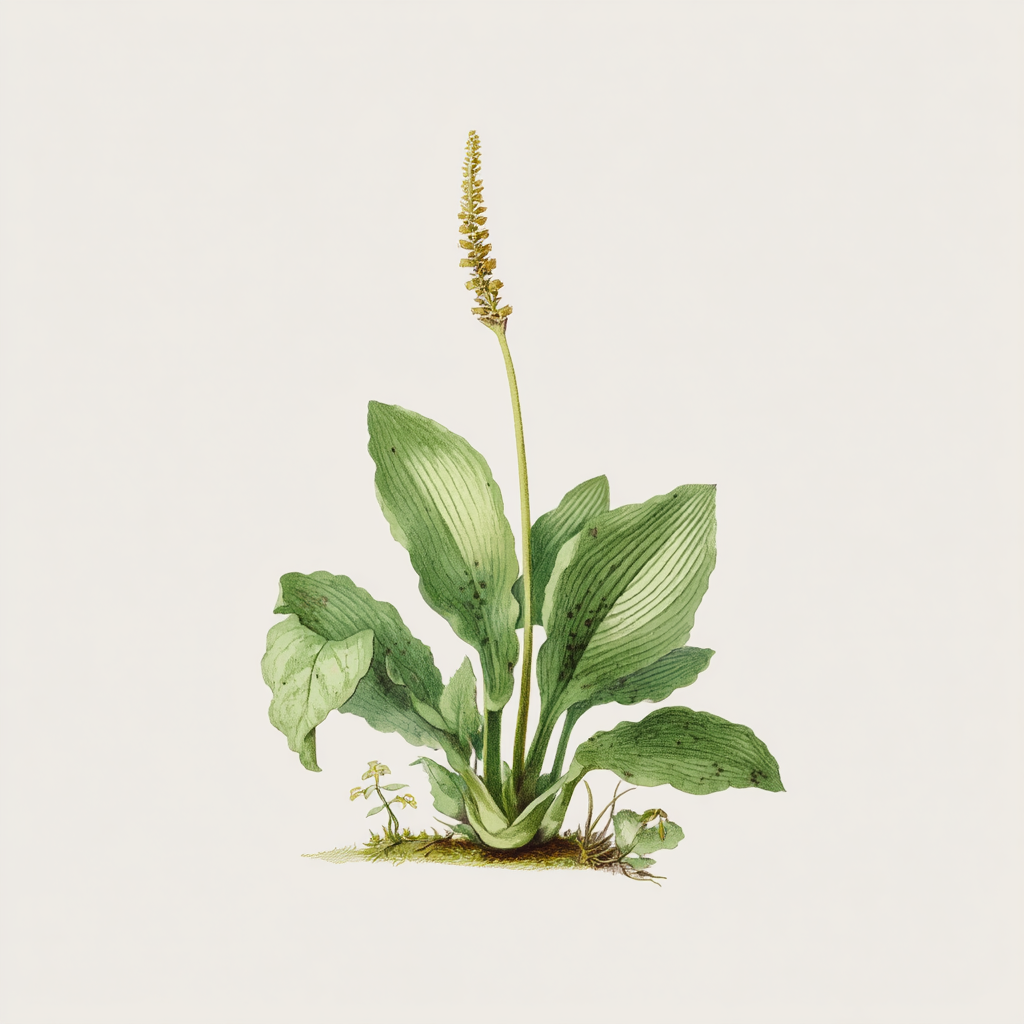
Leaves form a low basal rosette; upright leafless flower stalks rise from the center and stay tough under mowing or foot traffic.
Leaves
Broadleaf plantain has wide oval leaves, while narrowleaf plantain has long lance-shaped leaves. Both show strong parallel veins running from base to tip.
Flowers
Tiny greenish to brownish flowers are packed along upright spikes. Narrowleaf plantain usually has shorter darker flower heads on taller stalks.
Fruit
Small capsules on the mature spike release many tiny seeds that spread easily in lawns, paths, and open soil.
Known Varieties
Common cultivars worth knowing
- Best for: yard identification
Broadleaf Plantain
Plantago major with wide oval leaves and low rosettes common in lawns, paths, and compacted soil.
- Best for: field identification
Narrowleaf Plantain
Plantago lanceolata with narrow ribbed leaves and taller flower stalks common in meadows and rough grass.
- Best for: regional comparison
Rugel's Plantain
Plantago rugelii, a North American lookalike with broad leaves and reddish petiole bases.
Loading photo submission…